

Can Enterprise AI Run Without the Cloud? Edge AI, Local Models and On-Device Inference
TL;DR , Key Takeaways:
- Enterprise AI can run at the edge, including directly on devices or on infrastructure close to where data is generated.
- Local inference can reduce latency, bandwidth usage and dependence on continuous cloud connectivity.
- Smaller models are particularly useful at the edge because edge hardware usually has less memory, compute and power than a large cloud GPU environment.
- Edge AI does not mean every AI task has to run locally. A strong architecture can handle simple tasks locally and send complex requests to the cloud.
- Local AI can be useful for privacy, offline operation, real-time response and predictable performance.
- The best edge architecture often uses small specialised models rather than trying to place a large general-purpose LLM on every device.
- Knowledge and business logic can remain in a broader enterprise system while lightweight models handle tasks locally.
- Our Zero Tiny ONNX models are designed specifically for on-device speech recognition, with 5–15 MB model packages, CPU-only inference and no internet dependency.
- Shunya Labs supports cloud, private VPC, on-premises, air-gapped and edge deployment, allowing enterprises to choose where different parts of the AI workload should run.
- The real question is not “Can we eliminate the cloud?” but “Which parts of the AI workflow should run locally, and which should run centrally?”
For most AI applications, the cloud is the default.
A request goes to a remote model, the model processes it, and the result comes back to the application. That architecture works well when connectivity is reliable, the workload can tolerate network delay, and the data can be sent to the chosen environment.
But not every enterprise AI application fits that model.
A factory may need an AI system to respond immediately on the production floor. A vehicle may need to process voice locally. A retail kiosk may need to work even when connectivity is unreliable. A healthcare device may need local processing for privacy or operational reasons. A telecom network may need intelligence close to where the data is generated.
This is where edge AI and local inference become useful.
Edge inference means running AI on or near the device or location where the data is generated, rather than sending every request to a distant cloud service. AWS describes on-device inference as a form of edge inference where the model runs directly on the device, reducing dependence on cloud connectivity and improving response time for applications that need immediate processing.
The important point is that enterprise AI does not have to be cloud-only.
It can also be:
- cloud + edge
- private infrastructure + edge
- on-premises + edge
- or fully local for specific workloads.
And smaller models are making these architectures increasingly practical.
What is edge AI?
Edge AI means running AI inference close to the source of the data.
That can mean: directly on a device, on a local server, at a branch location, inside a factory, on a telecom network or at another nearby edge location.
The traditional architecture is:
Device → Internet → Cloud → AI model → Internet → Device
An edge architecture can instead be:
Device → Local AI model → Response
Or:
Device → Local AI model → Cloud only when needed
AWS identifies several edge inference patterns, including on-device inference, gateway inference and fog-style architectures, with the appropriate choice depending on latency, hardware and workload requirements.
This makes edge AI less about one specific technology and more about where inference happens.
Why would an enterprise want AI to run locally?
There are several practical reasons.
Lower latency
When the model runs close to the user or data source, the request does not need to travel to a remote cloud service and back.
That can matter for:
- Voice interfaces
- Industrial systems
- Robotics
- Retail devices
- Automotive applications
- Interactive kiosks
- Real-time monitoring
AWS identifies reduced latency as one of the main benefits of edge inference.
Less dependence on internet connectivity
A cloud-only system may stop working when connectivity disappears.
A local model can continue operating even when the network is unavailable or unstable.
That is especially useful for:
- remote locations
- vehicles
- industrial environments
- branch offices
- field operations
- devices with intermittent connectivity
More local data processing
Instead of sending every raw input to a remote service, some processing can happen locally.
That can be useful when data is: sensitive, high volume, expensive to transmit or subject to local operational requirements.
Lower bandwidth usage
If a device can process data locally and send only the result, it may not need to transmit the entire raw input.
AWS notes that edge systems can transmit summarised outputs or metadata rather than the full underlying data, reducing data movement and bandwidth requirements.
Does enterprise AI need the cloud at all?
Sometimes.
Often, only part of the AI workload needs the cloud.
A useful enterprise architecture is:
Simple task → local model
Structured task → local model + local knowledge
Complex task → cloud or private infrastructure
For example, a retail kiosk could recognise a customer’s voice locally:
“Show me my order status.”
A lightweight model can identify the intent and perhaps extract the order reference.
If the kiosk has a local connection to the required business system, it can complete the request locally.
If the request becomes more complex:
“I have two recent orders and one was partially refunded. Can you explain what happened?”
the system can escalate the request to the broader enterprise intelligence layer.
This creates a hybrid AI architecture rather than forcing every interaction into either cloud or local processing.
Why smaller models are important for edge AI
This is where the model-size discussion becomes especially important.
Cloud infrastructure can support powerful accelerators with substantial memory and compute.
An edge device often cannot.
A local system might have:
- limited RAM
- limited CPU
- no dedicated GPU
- battery constraints
- limited storage
- unreliable connectivity
Trying to deploy a large general-purpose model into that environment can be impractical.
A smaller specialised model changes the equation.
It may require: less memory, less compute, less storage, less power and can be easier to load and update.
Our on-device AI models are a concrete example. Zero Tiny ONNX is currently packaged at 5–15 MB, is CPU-only, and is designed to work offline without internet connectivity.
That is a very different infrastructure requirement from running a large general-purpose model in a cloud GPU environment.
Edge AI does not mean putting a huge LLM on a device
This is an important distinction.
When people hear “AI on the edge,” they sometimes imagine putting a full general-purpose LLM onto a phone, kiosk or vehicle.
That is not necessary for many enterprise use cases.
Instead, the local model can perform a specific task.
For example:
- detect a voice command
- identify intent
- extract a value
- classify an event
- trigger a workflow
- detect an anomaly
- recognise a predefined condition
These workloads can often be handled by smaller, purpose-trained models.
Our Custom SLM architecture follows the broader principle of building models around specific enterprise workflows and terminology rather than assuming every task needs a large general-purpose model.
What can run locally?
The answer depends on the model and the workload, but local AI is particularly useful for tasks with clear boundaries.
Voice and speech
A device can locally detect: wake words, commands, intent, speech patterns, basic transcription
Our Zero Tiny ONNX models are designed specifically for on-device speech recognition across phones, kiosks, embedded systems, vehicles and other constrained environments.
Retail and kiosks
A kiosk may need to understand:
“I want to check my order.”
The local model can identify the intent and start the relevant workflow.
Automotive
A vehicle interface may need to recognise:
“Call home.”
or:
“Change the temperature.”
These are latency-sensitive tasks where local processing can be useful.
Industrial environments
A local model can analyse sensor or operational data and respond without waiting for a round trip to a remote service.
Telecom
Models can be deployed close to network operations where response time and connectivity are important.
Healthcare devices
Certain processing tasks can be performed locally where privacy, connectivity or immediate response matter.
The appropriate architecture depends on the task and regulatory requirements.
What should stay in the cloud?
Not every workload belongs at the edge.
Cloud or central infrastructure is usually more practical when the system needs:
- large models
- large-scale reasoning
- central knowledge
- cross-enterprise analytics
- model training
- fleet-wide monitoring
- heavy computation
- long-term storage
- complex multi-step workflows
This is why the most useful architecture is often hybrid.
The device handles what needs to happen immediately.
The enterprise platform handles what needs broader intelligence.
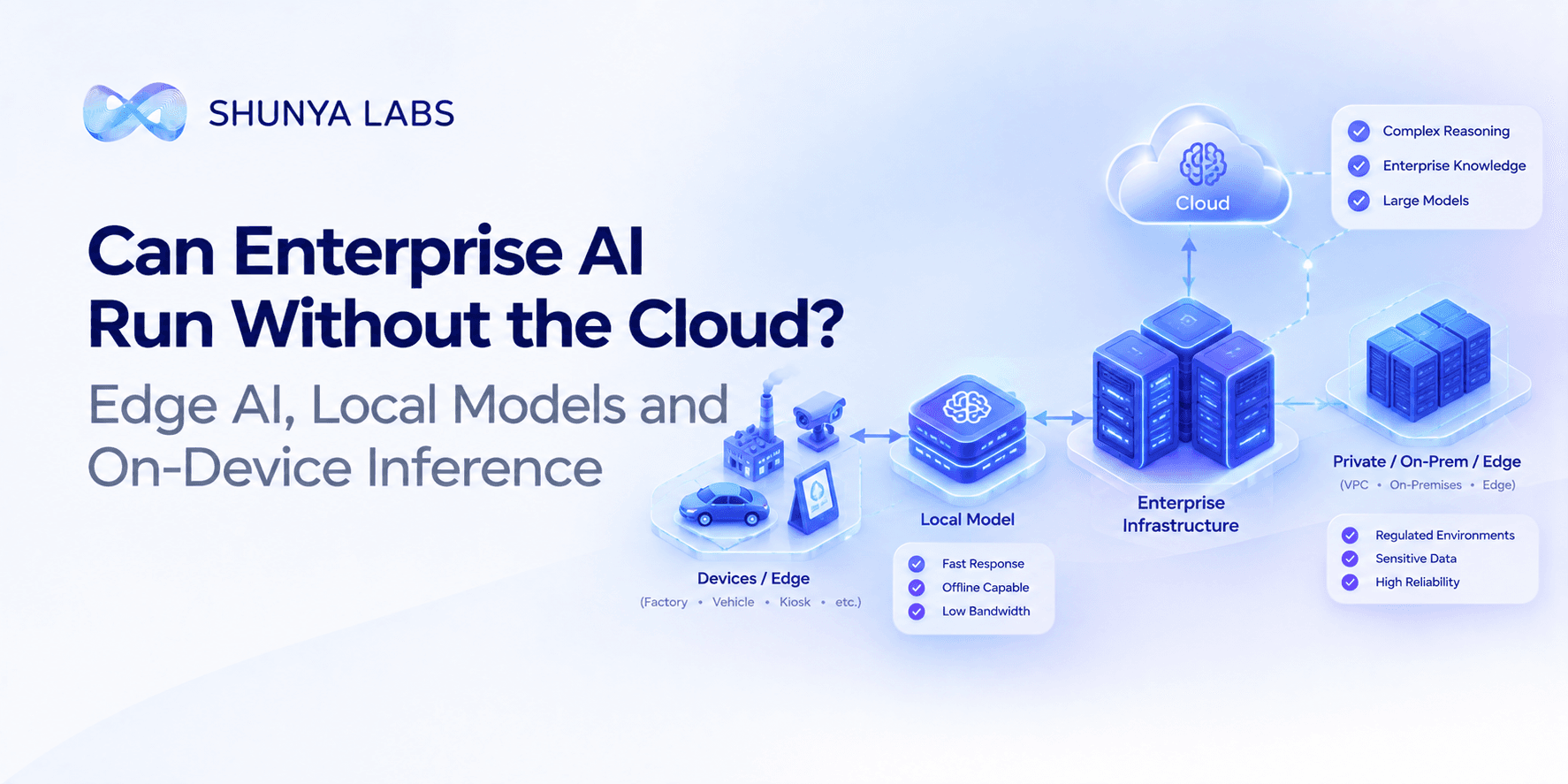
A practical edge AI architecture
A useful architecture can look like:
User / device
↓
Local model
↓
Simple task?
→ Complete locally
→ Complex task?
↓
Enterprise intelligence layer
↓
Knowledge graph + retrieval + larger model + business systems
↓
Response
This approach gives enterprises the best of both environments.
The local layer can provide:
speed
offline capability
privacy
low bandwidth usage
The central layer can provide:
broader reasoning
enterprise knowledge
complex workflows
central governance
monitoring
This is how the platform’s enterprise AI architecture can be understood across different deployment environments. The platform supports cloud, private VPC, on-premises, air-gapped and edge deployment, allowing the architecture to place different workloads where they make the most sense. (Shunya Labs)
Local AI can reduce network dependence
One of the most overlooked benefits of edge AI is that the network does not have to be part of every decision.
Consider an offline vehicle.
A voice command such as:
“Turn on the lights.”
should not need to travel to a cloud server.
The same is true for a factory device responding to a local operational event.
The model can process the request immediately.
When connectivity returns, the system can synchronise with the central platform.
Our on-device architecture explicitly supports this pattern: Zero Tiny ONNX can run offline and then escalate to the broader intelligence stack when connectivity becomes available.
That creates a useful architecture:
Local first → cloud when necessary
rather than:
Cloud always → local only when the cloud fails
Edge AI can improve reliability
Cloud connectivity is not always guaranteed.
A field device may have: weak cellular coverage, intermittent internet, network congestion and/or temporary outages
If every AI decision depends on a round trip to a remote service, those conditions can affect the application.
Local inference can continue working through many of those interruptions.
AWS identifies improved reliability as a key advantage of edge inference because local processing can continue even when cloud connectivity is intermittent.
This can be particularly important for AI systems that support physical operations.
What are the limitations of edge AI?
Edge AI is not automatically the right choice.
There are real trade-offs.
Limited hardware
Edge devices usually cannot match the compute and memory available in a data centre.
Model limitations
A very small local model may not be capable of handling highly complex reasoning.
Deployment complexity
Managing models across thousands of devices can be more operationally complex than running one central service.
Updates
Models need to be updated, versioned and monitored across the edge fleet.
Security
Devices deployed in the field need their own security controls and update mechanisms.
Hardware diversity
Different devices may have different CPUs, operating systems and capabilities.
AWS also highlights hardware constraints, deployment complexity and security/updates as important challenges in edge inference. (Amazon Web Services)
This is why successful edge AI requires more than simply shrinking a model.
It requires a deployment strategy.
How do you deploy AI to thousands of devices?
Enterprise edge deployments need a way to manage the entire model lifecycle.
That includes:
- Model packaging
Make the model easy to deploy across supported devices. - Version management
Know which model is running on each device. - Monitoring
Track performance and failures. - Updates
Roll out new versions safely. - Fallbacks
Define what happens when local inference is unavailable. - Cloud integration
Synchronise models, configuration and results when connectivity exists.
Our on-device deployment architecture uses ONNX Runtime and is designed to run the same lightweight model across Android, iOS, Windows, Linux and embedded Linux, with support for ARM and x86 environments.
That matters because edge AI only becomes useful at enterprise scale when deployment is manageable across the fleet.
Edge AI and privacy
Local inference can also change the way sensitive data moves through a system.
With fully local processing, data does not necessarily have to leave the device.
Our on-device speech models are designed so that speech can remain on the device during local processing.
This can be useful for applications where data movement needs to be minimised.
However, local processing should not automatically be described as “more secure” in every situation.
Security depends on the device, model, operating environment, encryption, access controls, update process and overall architecture.
The benefit is that local inference gives enterprises more control over where processing happens.
Edge AI for regulated enterprises
This is particularly relevant to industries where infrastructure location matters.
Examples include:
BFSI
Healthcare
Telecom
Government
Industrial operations
Critical infrastructure
The platform supports deployment across private VPC, on-premises, air-gapped and edge environments, making deployment location part of the architecture rather than an afterthought.
For some workloads, the requirement may be:
“The data must stay inside our network.”
For another:
“The system must continue to work when disconnected.”
For another:
“The AI needs to respond within a few hundred milliseconds.”
Edge and private deployment can address these constraints differently.
Edge AI can reduce cloud costs too
The cloud cost conversation is often focused on model inference.
But enterprises may also spend money transmitting and processing large amounts of data centrally.
If a device can process information locally and only send:
the result
an event
a summary
or selected metadata
the central system may have less data to process.
AWS specifically notes that edge architectures can reduce data transmission and bandwidth consumption by processing data locally and transmitting only the necessary outputs.
This does not mean edge is always cheaper.
Devices still need:
- hardware
- deployment
- maintenance
- updates
- security
The question is whether local processing creates a better total architecture for the workload.
Smaller models make edge AI more practical
This brings us back to model size.
A large model may require:
high-memory GPUs
specialised hardware
substantial power
high-bandwidth networking
A small model may be able to run with:
CPU
limited RAM
local storage
low power
That can turn edge AI from an architectural possibility into something that is actually deployable.
Our Zero Tiny ONNX models are 5–15 MB, CPU-optimised and designed for offline inference, making them suitable for constrained environments where a larger model would be impractical.
The best edge architecture is usually hybrid
The strongest enterprise design is rarely:
Everything local
or:
Everything in the cloud
It is usually:
Run each part of the workload where it makes the most sense.
For example:
Local model → detect intent
Local system → handle immediate response
Enterprise platform → retrieve business knowledge
Larger model → handle complex reasoning
Enterprise API → execute the action
Cloud → monitor and update the fleet
This gives each layer a clear responsibility.
It also means an enterprise can start with a lightweight local capability and expand into a broader intelligence layer when required.
Edge AI for voice
Voice is one of the strongest use cases for local AI because people notice latency immediately.
Imagine saying:
“Turn on the lights.”
A noticeable cloud round trip makes the interaction feel unnatural.
A local model can identify the intent immediately.
For more complex requests, the system can escalate.
Our enterprise voice architecture supports cloud, private VPC, on-premises and edge deployment, and the platform currently reports less than 1.5 seconds end-to-end voice-to-voice response for its voice agents.
This creates an architecture where:
simple voice interaction → local
complex voice reasoning → enterprise intelligence layer
That is often more practical than forcing every voice interaction through a large remote model.
How to decide whether your enterprise needs edge AI
Edge AI is worth evaluating when several of these requirements are present:
- Very low latency
- Intermittent connectivity
- Offline operation
- Sensitive data
- High data transmission volume
- Local decision-making
- Distributed physical locations
- Limited network bandwidth
- Need for local resilience
- CPU or constrained hardware environments
If none of these are important, a cloud deployment may remain simpler.
The choice should be based on the actual workload.
What should run locally and what should run centrally?
A useful decision framework is:
| Workload | Local / edge | Central / cloud |
|---|---|---|
| Wake-word detection | Strong fit | Usually unnecessary |
| Simple voice intent | Strong fit | Optional |
| Basic classification | Strong fit | Optional |
| Offline commands | Strong fit | Poor fit |
| Large document analysis | Limited | Strong fit |
| Complex reasoning | Limited | Strong fit |
| Enterprise-wide analytics | Limited | Strong fit |
| Large knowledge retrieval | Depends | Strong fit |
| Business system integration | Depends | Strong fit |
| Device-specific processing | Strong fit | Optional |
| Model training | Not usually | Strong fit |
The most useful architecture is often a combination of both sides.
Final thoughts
Enterprise AI does not have to live entirely in the cloud.
For some workloads, it can run:
- on the device
- at the branch
- inside a factory
- within a telecom network
- in a private data centre
- or across a hybrid edge-and-cloud architecture.
The key requirement is choosing a model that fits the environment.
A large model may be powerful, but it can bring significant hardware and operational requirements.
A smaller, purpose-trained model can often be much easier to deploy where resources are limited.
That is why model size, deployment location and workload complexity should be considered together.
The most practical architecture is often:
Small local model → fast response
Knowledge and enterprise systems → broader context
Large model → complex reasoning
Cloud → central management and deeper processing
This is the model behind our on-device AI models, Custom SLMs and broader enterprise AI platform.
The question is no longer:
“Cloud or edge?”
It is:
“Where should each part of the AI workload run to deliver the required speed, privacy, reliability and intelligence?”
For an increasing number of enterprise applications, the answer is closer to the data, closer to the user, and sometimes directly on the device.
Frequently Asked Questions
Can enterprise AI run without the cloud?
Yes. AI models can run on devices, local servers, private infrastructure or edge locations. Whether fully local deployment is appropriate depends on the workload, model size, hardware and business requirements.
What is edge AI?
Edge AI means running AI inference on or near the device or location where the data is generated, rather than sending every request to a remote cloud environment.
What is local AI inference?
Local inference means an AI model processes data within the local device or infrastructure rather than sending the input to a remote AI service.
Why use AI at the edge?
Common reasons include lower latency, offline operation, reduced network dependence, local processing, privacy requirements and lower data transmission.
What AI models can run on edge devices?
The answer depends on the device and workload. Smaller, optimised models are generally more practical when hardware is constrained. Our Zero Tiny ONNX models, for example, are 5–15 MB and CPU-only.
Can AI run locally without a GPU?
Yes. Some models are designed specifically for CPU inference. Our on-device speech models are designed to run without a dedicated GPU.
Does edge AI eliminate the cloud?
Not necessarily. A strong enterprise architecture can use local inference for fast or offline tasks and cloud or private infrastructure for more complex processing. AWS also describes hybrid edge architectures where local inference works alongside central cloud systems.
Is edge AI more secure than cloud AI?
Not automatically. Security depends on the entire system, including the device, operating environment, access controls, encryption, model updates and data handling. Edge AI does give enterprises more control over where data is processed.
Can edge AI reduce AI costs?
It can reduce some cloud, bandwidth and inference requirements, but edge deployments also introduce hardware, management and maintenance costs. The right comparison is the total cost of the complete architecture.
Can voice AI run at the edge?
Yes. Simple voice tasks such as speech recognition, intent detection and commands can run locally, while complex conversations can be escalated to a broader enterprise intelligence layer. Our voice agent architecture supports edge deployment as part of its deployment options.
Learn More
Explore our on-device AI models, Custom Small Language Models, enterprise AI platform, enterprise voice agents,and AI benchmarks.

Bio: Navvya works at the intersection of product strategy and applied AI research at Shunya Labs. With a background in human behaviour and communication, she writes about the people, markets, and technology behind voice AI, with a particular focus on how speech interfaces are reshaping access across emerging markets.