

Custom SLMs for Enterprise AI: When a Domain-Specific Model Makes Sense
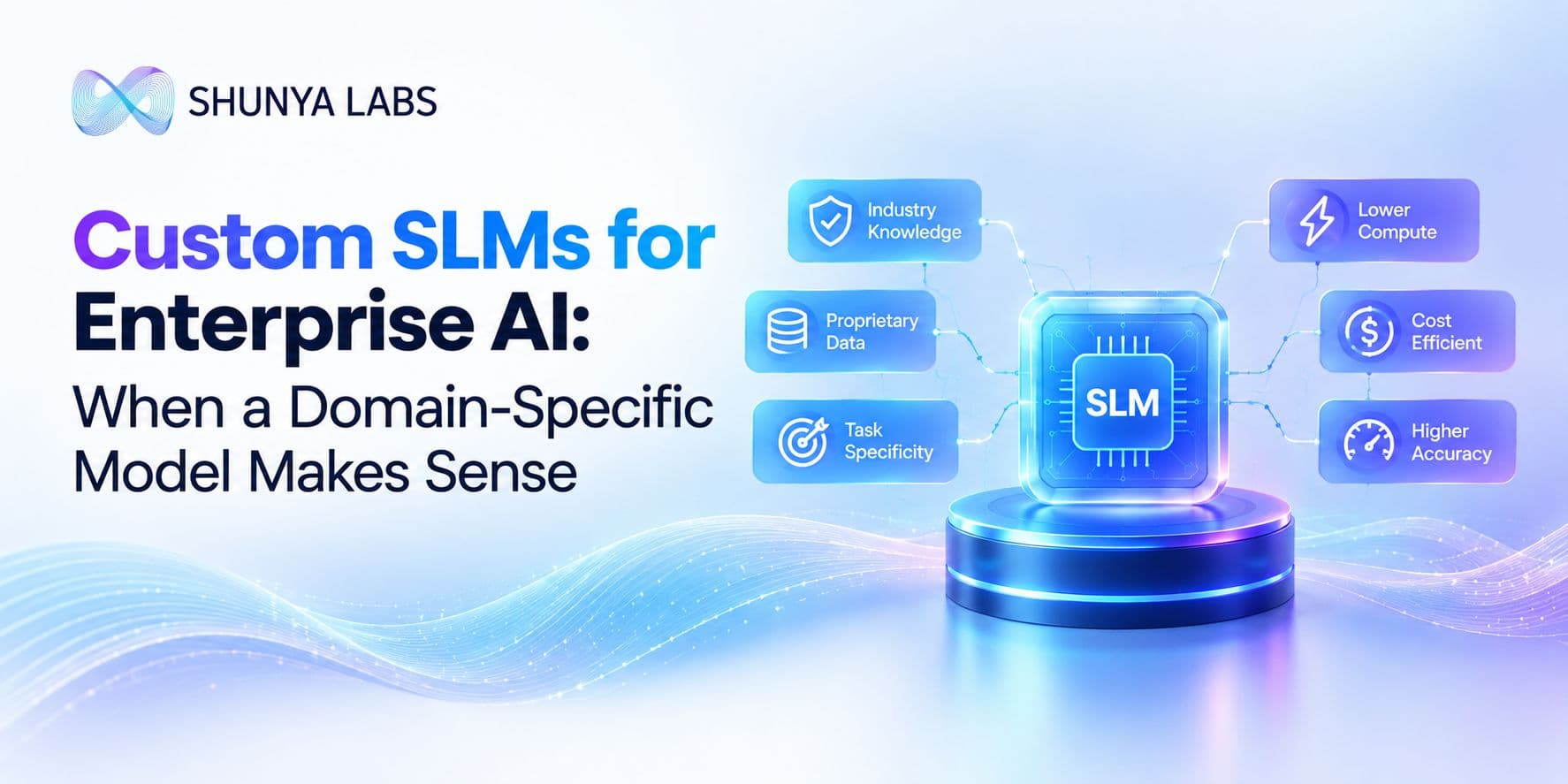
TL;DR , Key Takeaways:
- A custom SLM is a smaller language model adapted or trained for a specific enterprise domain, workflow or decision process.
- Custom SLMs are most useful when the workload is narrow, repetitive, high-volume, domain-specific or latency-sensitive.
- They can provide lower inference requirements, more predictable outputs and greater deployment controlthan using a large general-purpose model for every task.
- Enterprises do not always need to train a new model. Prompting, RAG, fine-tuning, custom SLMs and hybrid architectures solve different problems.
- Custom SLMs are particularly relevant for BFSI, healthcare, telecom, customer support, logistics and other domains with specialized terminology and workflows.
- A strong custom model should learn more than vocabulary. It should understand intents, business rules, workflows and expected outputs.
- Shunya builds purpose-trained SLMs using enterprise data, terminology, intents, workflows and SOPs, with model ownership and deployment options for enterprise environments.
- The right evaluation is based on task accuracy, latency, infrastructure cost, reliability and business outcomes, not model size alone.
Enterprise AI is moving beyond the question of which foundation model to use.
The more important question is becoming:
Should your business rely on a general-purpose model, or build AI that is specifically trained around how your organization works?
A custom Small Language Model (SLM) is one approach to that problem. Instead of asking a large general-purpose model to understand every possible domain, an enterprise can build or adapt a smaller model around its own terminology, workflows, decisions, data and operating requirements.
This is particularly useful when AI needs to be fast, predictable, cost-efficient and deployable within the enterprise environment.
Gartner’s current research describes domain-specific language models as a way to improve performance, reliability and relevance for specialized enterprise workflows, while Microsoft Research has demonstrated the potential of fine-tuned SLMs for high-throughput enterprise tasks.
For enterprises, however, a custom SLM is not automatically the right answer.
The real question is:
When does building a domain-specific model create enough value to justify the work?
What is a custom SLM?
A Small Language Model is a relatively compact language model designed to perform language tasks with lower computational requirements than much larger models.
A custom SLM goes a step further.
It is adapted or trained for a specific organization’s:
Domain
Terminology
Workflows
Intents
Decision processes
Output requirements
Instead of building a model that needs to answer almost anything, the enterprise defines what the model actually needs to do.
For example, a banking organization might need a model that can reliably classify:
Card dispute
Loan enquiry
EMI issue
Fraud alert
KYC request
Account closure
The model doesn’t need to know everything about the world.
It needs to understand the business.
That distinction is the foundation of domain-specific AI.
Why build a custom SLM?
General-purpose LLMs are incredibly capable, but enterprises often use them for tasks that are much narrower than the models were designed for.
Imagine using a powerful general-purpose model to classify millions of customer requests into 12 predefined categories.
It can work.
But the enterprise may still be paying for:
Large inference infrastructure
Higher latency
Long prompts
External API calls
and broader capabilities that the task doesn’t actually require.
A custom SLM can instead be optimized around the specific job.
This can make sense when an enterprise needs:
High throughput
Low latency
Predictable outputs
Domain-specific terminology
Private deployment
Lower inference requirements
Research from Microsoft also shows that fine-tuned SLMs can perform high-throughput enterprise classification tasks at quality levels comparable to or better than much larger models for specialized workloads.
Custom SLM vs general-purpose LLM
The biggest mistake is treating the choice as:
small model = good, large model = bad
The better distinction is general capability versus specialized capability.
| Requirement | General LLM | Custom SLM |
|---|---|---|
| Broad knowledge | Strong fit | Limited |
| Open-ended reasoning | Strong fit | Task-dependent |
| Narrow enterprise task | Can be overkill | Strong fit |
| High-volume classification | Possible | Strong fit |
| Domain terminology | Requires context | Can be built in |
| Predictable output | Depends on prompting | Can be optimized |
| Low-latency inference | Model-dependent | Often more practical |
| Edge deployment | More demanding | Often more practical |
| Private deployment | Model-dependent | Often easier |
| Changing external knowledge | Strong fit with retrieval | Needs retrieval or updates |
| Complex unfamiliar requests | Strong fit | More limited |
These are architectural tendencies, not guarantees. Actual performance depends on the model, training data, inference stack and task.
What should a custom SLM actually learn?
A good enterprise model shouldn’t simply memorize the company’s documents.
It should learn the patterns required to perform the task.
That could include:
Terminology
Products, SKUs, drug names, policy codes, internal abbreviations and industry language.
Intents
What customers, employees or systems are actually trying to accomplish.
Workflows
What happens after a request is identified.
Business rules
Which actions are allowed, restricted or require escalation.
Output structure
What the downstream application expects.
For example:
Input:
“Customer wants to defer this month’s EMI.”
Model output:
intent = payment_deferral
eligibility_check = required
next_action = retrieve_account_status
A specialized model can be optimized around this exact behavior.
Shunya’s current custom-model approach explicitly starts with enterprise data, terminology, intents, workflows and SOPs, then trains custom intelligence around the resulting business requirements.
Custom SLMs are not the same as RAG
This distinction is important.
RAG gives a model access to external information at inference time.
Fine-tuning changes how the model behaves.
A custom SLM can combine model specialization with retrieval, rules and tools.
For example:
Customer question
→ Custom SLM identifies intent
→ RAG retrieves current policy
→ Business rule checks eligibility
→ Tool updates CRM
This is often more useful than expecting one large model to perform every step.
A domain-specific model is therefore not a replacement for RAG.
They can work together.
When does a custom SLM make sense?
A custom SLM becomes especially interesting when several of these conditions are true:
The task is narrow
You can clearly define what success looks like.
The workload is large
Millions of similar requests can make inference efficiency financially meaningful.
Latency matters
The system needs to respond quickly.
Domain terminology matters
Generic models repeatedly struggle with specialized vocabulary.
The output is structured
The model needs to produce predictable categories, fields or actions.
The data is sensitive
The organization needs greater control over where inference happens.
The workflow is stable
The task doesn’t change completely every few weeks.
The business value is measurable
You can compare model performance against a meaningful baseline.
This is close to the emerging enterprise use case for domain-specific language models. Gartner’s 2026 research specifically describes DSLMs as useful where accuracy, compliance, reliability and specialized enterprise performance matter.
When a custom SLM may not make sense
A custom model isn’t automatically the smartest architecture.
A general LLM may remain preferable when:
The task is highly open-ended
Requirements change frequently
Broad world knowledge is essential
Requests are unpredictable
The workload is too small to justify customization
You don’t have enough representative training data
For example, a research assistant that has to answer arbitrary questions across unrelated fields may benefit more from a strong general-purpose model with retrieval than from a narrowly specialized SLM.
The right question is not:
“Can we build our own model?”
It is:
“Will specialization materially improve the business outcome?”
Custom SLMs for voice AI
Voice agents are an especially interesting application.
A typical Voice Agent might contain:
Speech-to-Text
↓
Intent / entity understanding
↓
Knowledge
↓
Reasoning
↓
Business action
↓
Text-to-Speech
Not every stage needs the largest possible model.
A custom SLM can be particularly useful for:
Intent detection
Entity extraction
Routing
Policy classification
Conversation state
Structured decisions
This can reduce the amount of work sent to a larger model.
For example:
“Mera card block ho gaya hai, naya card kaise milega?”
A specialized model can quickly identify:
language
intent
product
required workflow
The system can then retrieve the customer’s account information and determine the appropriate next action.
Shunya combines Speech-to-Text, Speech Intelligence, Custom SLMs, Voice Agents, and Text-to-Speech as part of its broader voice-AI architecture.
Custom SLMs and private AI
One of the strongest reasons to consider a custom SLM is deployment control.
A company may need AI to run in:
Cloud
Private VPC
On-premise
Edge
because of:
Data sovereignty
Regulatory requirements
Latency
Network constraints
Intellectual property
Operational security
Shunya’s current platform supports cloud, private VPC, on-premise and edge deployment, while its Custom SLM offering emphasizes model ownership and on-premise deployment.
Smaller models can also make local inference more practical when hardware and connectivity are constrained.
How enterprises should build a custom SLM
The model itself is only one part of the project.
A practical process looks like:
1. Define the task
Start with a measurable business problem.
Not:
“We want an AI model.”
Instead:
“We want to classify and route 5 million support requests per month.”
2. Build the dataset
Collect representative:
Examples
Edge cases
Terminology
User language
Historical decisions
Correct outputs
3. Establish a baseline
Compare against:
Current workflow
Rules engine
General LLM
Existing SLM
Without a baseline, it is difficult to measure whether customization helped.
4. Train or fine-tune
Adapt a suitable base model around the task.
5. Evaluate
Test:
Accuracy
Latency
Failure cases
Domain terminology
Out-of-distribution inputs
6. Put it into the workflow
Connect it to:
RAG
Knowledge graphs
APIs
Business rules
Human escalation
7. Monitor in production
Track:
Accuracy drift
New terminology
Failure patterns
Latency
Cost
A model should improve as the business changes.
The data is often more valuable than the model size
This is one of the most important principles in enterprise AI.
A generic model may have billions of parameters.
But the enterprise has something that public models do not:
its own operating data.
That includes:
Customer conversations
SOPs
Product catalogues
CRM records
Policy documents
Historical decisions
Domain terminology
This information captures how the organization actually works.
Shunya’s current Custom SLM platform describes this directly: bring enterprise data, train purpose-built intelligence, evaluate it against ground truth, own the resulting model, and deploy it within the required environment.
That is a fundamentally different approach from simply calling a generic model API.
How to evaluate whether the model is worth it
A custom SLM should earn its place through measurable improvement.
Evaluate:
| Metric | What to measure |
|---|---|
| Accuracy | Correct answers or classifications |
| Critical error rate | Business-impacting mistakes |
| Latency | Response time at production load |
| Throughput | Requests handled concurrently |
| Infrastructure | CPU, GPU and memory requirements |
| Cost | Cost per request / completed task |
| Reliability | Stability across real workloads |
| Domain performance | Accuracy on specialist terminology |
| Deployment | Ability to run in the required environment |
| Maintenance | Effort required as the business changes |
The final decision should come from the business workflow, not from benchmark scores in isolation.
Final words
Custom SLMs make sense when an enterprise has a specific problem that can benefit from specialized intelligence.
That usually means:
A narrow task
High request volume
Specialized terminology
Low-latency requirements
Predictable outputs
Sensitive data
or deployment constraints.
They are not replacements for general-purpose LLMs in every scenario.
A useful enterprise architecture can instead combine:
LLMs for broad reasoning
Custom SLMs for specialized decisions
RAG for changing knowledge
Knowledge graphs for relationships
Business rules for control
Tools for actions
This turns model selection into an architecture decision rather than a model-size contest.
Shunya’s Custom SLM approach is built around your data, your terminology, your workflows and your decision processes, with the goal of creating purpose-trained intelligence that can be owned and deployed within the enterprise environment.
For organizations building voice agents, contact-center AI, BFSI systems, healthcare AI, enterprise search or other high-volume domain-specific applications, that distinction can be significant.
The real question is not:
“How big should our model be?”
It is:
“How much of our business should the model understand by design?”
That is where a custom SLM can become more than a smaller model.
It can become an intelligence layer built around the way your enterprise actually works.
Frequently asked questions
What is a custom SLM?
A custom Small Language Model is a compact language model adapted or trained for a specific enterprise domain, workflow, terminology or decision process.
What is a domain-specific language model?
A domain-specific language model is designed or adapted around a particular field such as banking, healthcare, legal, telecom or customer support, rather than being optimized primarily for general-purpose use. Gartner currently describes domain-specific language models as a way to improve relevance, reliability and specialized enterprise performance.
Are custom SLMs better than LLMs?
Not universally. Custom SLMs are often more appropriate for focused and repetitive tasks, while general-purpose LLMs remain useful for broad knowledge and complex open-ended reasoning.
What are the benefits of custom SLMs?
Potential benefits include lower inference requirements, lower latency, better domain specialization, more predictable behavior and greater deployment control, depending on the workload and implementation.
What is the difference between fine-tuning and building a custom SLM?
Fine-tuning is a method for adapting a model to a particular task or domain. A custom SLM refers to the resulting specialized model architecture and deployment approach. A custom SLM may be created through fine-tuning or other training methods.
Can a custom SLM use RAG?
Yes. A custom SLM can use RAG to retrieve changing enterprise knowledge while the model handles specialized reasoning or classification.
When should an enterprise build a custom SLM?
A custom SLM is worth evaluating when the workload is high-volume, domain-specific, latency-sensitive, structured, sensitive, or operationally important, and specialization can be measured against a strong baseline.
Can custom SLMs run on-premise?
Yes. Smaller models can be practical for private infrastructure, depending on their architecture and hardware requirements. Shunya’s current Custom SLM offering includes on-premise deployment and model ownership.
Can custom SLMs be used in voice agents?
Yes. They can handle focused parts of a voice workflow such as intent recognition, entity extraction, routing, policy decisions and structured reasoning, while larger models handle more complex requests.
What data should enterprises use to train a custom SLM?
Useful data can include customer conversations, SOPs, product catalogues, terminology, historical decisions, workflows, policies and correctly labeled examples.
How do you measure a custom SLM?
Measure accuracy, critical errors, latency, throughput, infrastructure requirements, cost, reliability and business outcomes using representative enterprise data.
Does Shunya build custom SLMs?
Yes. Shunya offers purpose-trained Custom SLMs built around enterprise data, terminology, intents, workflows and SOPs, with evaluation against ground truth and model ownership.

Bio: Navvya works at the intersection of product strategy and applied AI research at Shunya Labs. With a background in human behaviour and communication, she writes about the people, markets, and technology behind voice AI, with a particular focus on how speech interfaces are reshaping access across emerging markets.