

Enterprise AI Architecture: A Practical Guide to Building AI Systems at Scale
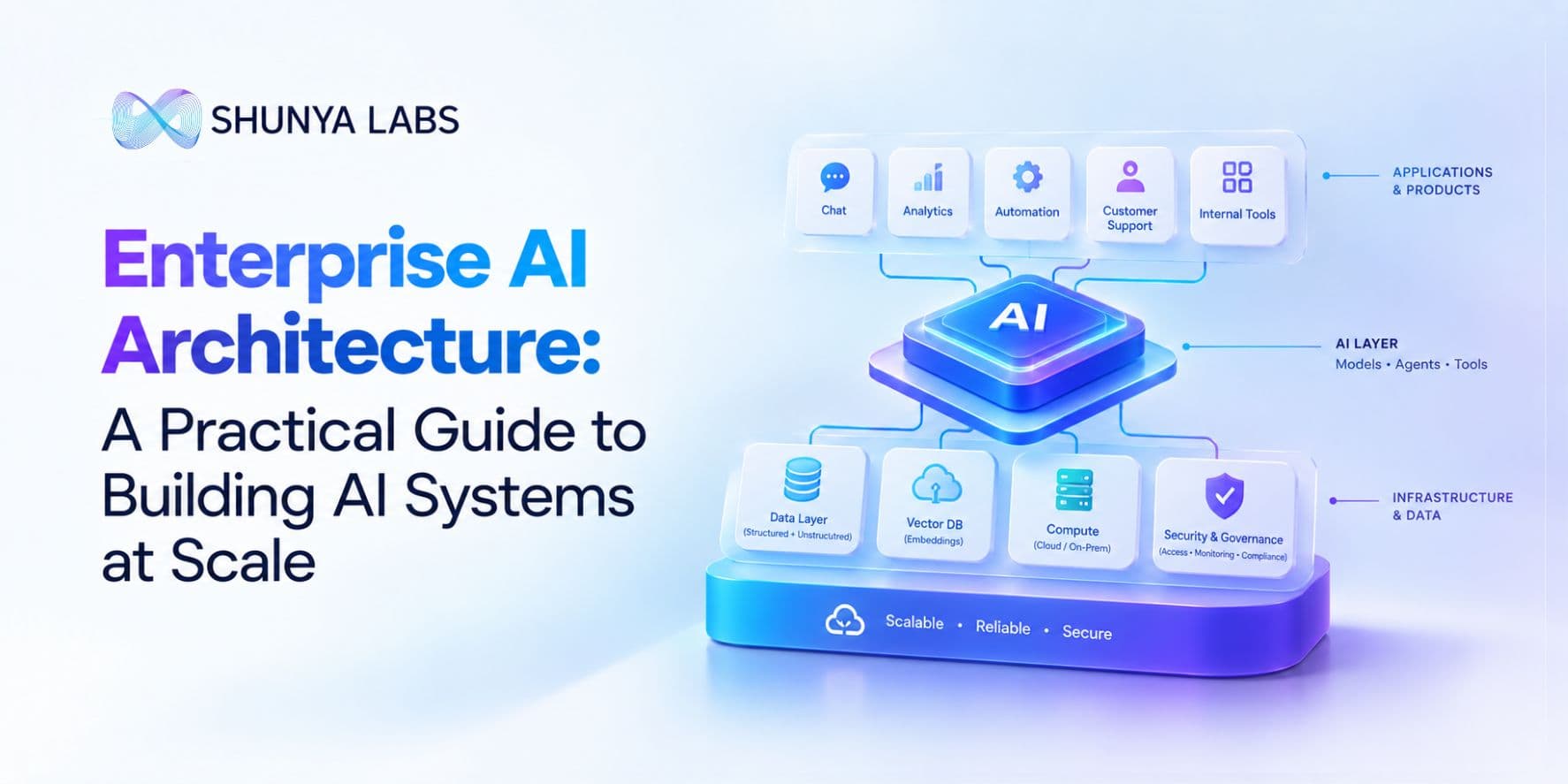
TL;DR , Key Takeaways:
- Enterprise AI architecture is bigger than the AI model. The model is only one part of a production system.
- A practical architecture usually needs data, knowledge, models, orchestration, integrations, security, evaluation, and deployment.
- RAG, knowledge graphs, fine-tuning, and custom SLMs solve different problems. They should not be treated as interchangeable technologies.
- AI agents need access to the right knowledge and tools, with permissions controlling what they can see and do.
- Model choice should follow the business workflow, rather than forcing every use case onto one large model.
- Voice AI adds another architecture layer involving speech recognition, reasoning, text-to-speech, latency, telephony, and conversation state.
- Production architecture should be designed around accuracy, latency, cost, security, deployment requirements, and measurable business outcomes.
- The most useful architecture is the one that can connect AI directly to the systems and workflows where work actually happens.
Enterprise AI is moving beyond isolated chatbots and proof-of-concepts. Companies are now looking at AI for customer support, operations, knowledge management, sales, employee workflows, voice automation, analytics, and decision support.
That changes the architecture problem.
A production AI system is not just an LLM connected to a prompt. It needs reliable data, enterprise knowledge, model selection, workflow orchestration, integrations, security, evaluation, monitoring, and a deployment model that fits the business.
AWS describes enterprise AI architecture as a set of layers spanning applications, agents, model access, tools, knowledge bases, and cross-layer controls such as security and observability. Gartner similarly highlights AI-ready data, context, metadata, semantic layers, integration, and governance as important foundations for scaling AI.
This guide explains the major layers of enterprise AI architecture, what each layer does, and how businesses can decide what they actually need.
What is enterprise AI architecture?
Enterprise AI architecture is the design of the technology layers that allow AI to work with an organisation’s data, knowledge, applications, workflows, and users.
A simple AI application might look like:
User → Prompt → LLM → Response
An enterprise system is closer to:
User → Application → Orchestration → Knowledge + Data → Model → Tools + Business Systems → Guardrails → Response or Action
And that is still a simplified version.
An enterprise AI system may need to retrieve information from internal documents, understand relationships between business entities, enforce permissions, call APIs, update a CRM, trigger a workflow, log the interaction, evaluate the output, and hand the task to a human when necessary.
That is why production AI is primarily an architecture problem, not simply a model-selection problem.
The core layers of an enterprise AI architecture
There is no single architecture that every organisation should copy. However, most enterprise systems need several recurring layers.
| Layer | What it handles |
|---|---|
| Data | Documents, databases, APIs, conversations and business data |
| Knowledge | Context, relationships, policies, SOPs and business rules |
| Models | LLMs, SLMs, speech models and specialised models |
| Orchestration | Prompts, agents, workflows, routing and decision logic |
| Tools & integrations | CRM, ERP, APIs, telephony and enterprise applications |
| Security & governance | Identity, permissions, privacy, auditability and controls |
| Evaluation & observability | Accuracy, latency, cost, failures and system behaviour |
| Deployment | Cloud, VPC, on-premises, edge and hybrid environments |
AWS’s current enterprise agentic architecture follows a similar layered approach, including model access, tools, knowledge bases, agents, applications, security, and observability.
1. Data is the foundation
Enterprise AI cannot be better than the information it can reliably access.
That information may already exist across:
- CRM systems
- ERP platforms
- databases
- PDFs and documents
- internal wikis
- product catalogues
- emails
- call recordings
- APIs
- support tickets
- policies and SOPs
The challenge is rarely just “how much data do we have?”
The more important questions are:
Is the data accessible? Is it current? Is it structured? Can the AI understand what it means? Who is allowed to access it?
Gartner’s recent guidance on AI-ready data highlights the importance of context, metadata management and semantic layers when building data foundations for AI at scale.
This is also where organisations should avoid building AI on top of disconnected data silos without a clear information model.
2. The knowledge layer gives AI business context
An enterprise model may know general facts about a topic, but that does not mean it knows your company’s products, policies, workflows, terminology or relationships.
That is where the knowledge layer comes in.
Knowledge-grounded AI architecture can combine enterprise information with structured relationships, policies and business rules so the system has a more reliable representation of how the organisation actually works.
This can include:
Products → plans → eligibility → pricing → policies → customer segment → workflow
That context matters when the AI needs to answer questions such as:
Which plan is this customer eligible for?
or:
What should happen when this transaction meets these conditions?
This is one reason knowledge graphs and RAG are not the same thing.
RAG is useful for retrieving relevant information from a collection of documents or other sources.
A knowledge graph can explicitly represent relationships between entities and concepts.
For many enterprise applications, a combination of retrieval, structured knowledge, rules, and model reasoning can provide a stronger foundation than relying on a model’s general knowledge alone.
3. Choose the right model for the workload
One of the biggest architecture mistakes is assuming that one model should do everything.
Different tasks have different requirements.
A complex reasoning task may justify a larger model. A narrow classification or routing task may work better with a smaller specialised model.
This is where Small Language Models become useful.
Instead of sending every request through a large general-purpose model, an enterprise can use a smaller model for specific tasks such as:
- intent classification
- routing
- domain terminology
- structured extraction
- workflow decisions
- repetitive enterprise tasks
Shunya’s custom SLM architecture describes purpose-trained enterprise models ranging from 15M to 1.5B parameters, designed around a company’s data and workflows.
The important architectural idea is not simply “small model versus large model.”
It is model specialization.
Use the model that matches the task, rather than assuming the biggest available model is automatically the right one.
4. Orchestration turns intelligence into workflows
An AI model can generate an answer.
An enterprise system often needs to do something.
For example:
Customer asks about a failed payment
→ identify intent
→ retrieve account information
→ check payment status
→ apply business rules
→ initiate the appropriate workflow
→ confirm the outcome
The architecture therefore needs an orchestration layer that determines:
What should happen next?
This could involve a simple workflow, deterministic business logic, an AI agent, or a combination of all three.
AWS’s enterprise agent architecture describes agents as components that interpret goals, reason and plan, retrieve knowledge, and use authorised tools to perform actions.
For higher-risk processes, deterministic business rules and human approval can remain part of the workflow rather than allowing the model to make every decision independently.
5. Tools and integrations connect AI to the business
An AI system that cannot interact with enterprise systems is often limited to generating information.
Production systems need to connect with the tools where work happens.
That might include:
Salesforce, SAP, ServiceNow, payment systems, ticketing platforms, telephony systems, internal APIs, HR systems, or custom enterprise applications.
This is particularly important for AI agents.
An agent might understand that a customer wants to reschedule an appointment, but actually completing that task requires access to the appointment system.
The architecture therefore needs clear boundaries around:
- what tools are available
- which users can access them
- what actions each tool can perform
- what approvals are required
- what gets logged
This is where identity, authorisation, and tool-level controls become architecture components rather than administrative afterthoughts.
6. Security and governance need to be built into the architecture
Enterprise AI can interact with sensitive information and increasingly perform real actions.
Security therefore cannot sit at the end of the project.
An enterprise architecture may need:
identity and access controls, encryption, audit logs, data retention policies, environment isolation, approval workflows, monitoring, and human oversight.
AWS places security and observability across multiple layers of its enterprise agentic architecture rather than treating them as a separate final step.
Deployment requirements also vary significantly between organisations.
A public cloud deployment may be suitable for one workflow, while another may require a VPC, on-premises environment, air-gapped infrastructure, or edge deployment.
Shunya’s deployment architecture supports cloud, edge, and on-premises environments, including air-gapped deployment options.
The right question is therefore not simply:
Is this AI secure?
It is:
Where does the data go, which systems can the AI access, who can authorize actions, and how can those actions be audited?
7. Evaluation tells you whether the system actually works
A production AI architecture needs an evaluation layer.
A demo can look impressive while still performing poorly on real enterprise data.
Evaluation should measure the things that matter to the workflow:
accuracy, hallucination rate, retrieval quality, latency, task completion, escalation rate, cost, consistency, and failure modes.
For voice systems, additional metrics may include:
word error rate, response latency, speaker separation, interruption handling, language switching, and successful task completion.
Shunya publishes speech benchmarks including a 3.10% composite WER across eight OpenASR datasets for its Zero STT model.
But benchmark numbers are only one part of production evaluation.
The strongest test is still your own data.
For example, a healthcare company should test medical terminology. A bank should test financial conversations. A global support team should test accents and multilingual conversations.
8. Voice AI adds another architecture stack
Voice AI is often treated as simply speech-to-text + LLM + text-to-speech.
At production scale, there is much more involved.
A real-time enterprise voice system needs to manage:
speech recognition → intent understanding → knowledge retrieval → reasoning → tool execution → response generation → speech synthesis → turn-taking
Latency becomes particularly important because users experience the entire pipeline as one conversation.
Shunya’s current enterprise voice agent architecture describes the flow as Listen, Ground, Decide, Translate, and Speak, combining speech recognition, knowledge grounding, reasoning and speech generation. The page currently reports sub-500ms first audio for its speech recognition layer and a 3.10% composite WER.
This architecture becomes particularly relevant for contact centres, BFSI, healthcare, telecom, logistics and e-commerce, where conversations often include accents, domain terminology, code-switching and real-time actions.
For example, Shunya’s speech-to-text platform supports multilingual and code-switched speech and combines transcription with capabilities such as intent detection, sentiment, emotion, speaker diarization and translation.
What should an enterprise AI architecture look like?
A useful reference architecture can be thought of as:
Experience layer
Chat, voice, employee applications, customer applications, workflows
↓
Orchestration layer
Agents, workflows, routing, business rules, prompt logic
↓
Knowledge layer
RAG, knowledge graphs, documents, structured enterprise knowledge
↓
Model layer
LLMs, custom SLMs, speech models, specialised models
↓
Tools and integration layer
CRMs, APIs, databases, ERP, telephony and enterprise systems
↓
Governance layer
Security, identity, permissions, auditability, evaluation and monitoring
↓
Infrastructure layer
Cloud, VPC, on-premises, edge and compute
The important point is that these layers should work together.
Changing the model should not require rebuilding the entire application. Updating enterprise knowledge should not require retraining the model every time. Adding a new workflow should not require creating an entirely separate AI stack.
That modularity is what makes an architecture scalable.
How to choose the right enterprise AI architecture
Start with the business workflow, not the technology.
Ask:
What task are we trying to improve?
Then determine:
What information does the system need?
Then:
What does it need to decide or generate?
Then:
Does it only need to answer, or does it need to take action?
Then:
Which enterprise systems does it need to access?
Finally:
What accuracy, latency, security, deployment and cost requirements apply?
This sequence prevents the common mistake of choosing an AI model first and trying to fit the business problem around it.
Enterprise AI architecture is becoming an intelligence layer
The next stage of enterprise AI is not about adding another chatbot to every application.
It is about creating a reusable intelligence layer that sits across business data, enterprise knowledge, models and workflows.
Shunya describes its enterprise Voice AI platform in exactly this way, combining speech AI, knowledge graphs, custom Small Language Models, orchestration and deployment infrastructure into an intelligence layer for enterprise applications.
That approach also makes it possible to support different interfaces using the same underlying intelligence.
A customer could interact through voice.
An employee could use chat.
An operations team could consume structured insights.
A CRM workflow could trigger an automated action.
The interface changes, but the underlying business knowledge, models, rules and integrations can remain shared.
Final thoughts
The hardest part of enterprise AI is rarely finding a powerful model.
The harder problem is building a system where the model has the right information, the right context, the right tools, the right permissions, and the right workflow.
That is why modern enterprise AI architecture increasingly combines:
AI models + enterprise data + knowledge + orchestration + integrations + governance + evaluation + deployment
The architecture should ultimately reflect the business, not the other way around.
For organisations building production AI, the useful question is no longer:
Which AI model should we use?
It is:
What architecture will allow AI to understand our business, work with our systems, and reliably complete the tasks we actually care about?
Frequently Asked Questions
What is enterprise AI architecture?
Enterprise AI architecture is the overall design that connects AI models with enterprise data, knowledge, applications, workflows, integrations, security, evaluation and infrastructure.
What are the main components of enterprise AI?
The main components typically include data, knowledge, models, orchestration, tools and integrations, security, evaluation, observability and deployment infrastructure.
Do enterprises need an LLM for every AI use case?
No. Different workloads can use different models. Large models can handle complex reasoning, while smaller specialised models can be useful for classification, routing, extraction and domain-specific workflows.
What is the difference between RAG and a knowledge graph?
RAG primarily retrieves relevant information from available sources. A knowledge graph represents entities and their relationships, making it useful for workflows where understanding connections between business concepts matters.
What does a production AI architecture need?
A production architecture needs more than a model. It generally needs reliable data, enterprise knowledge, integrations, security controls, evaluation, monitoring, deployment infrastructure and clear workflow boundaries.
How does voice AI fit into enterprise AI architecture?
Voice AI adds speech-specific components including speech recognition, text-to-speech, conversation handling, real-time latency management and telephony, while the underlying enterprise knowledge, models, tools and governance can be shared with other AI interfaces.
Learn More
Explore Shunya Labs’ enterprise AI platform, custom SLMs, enterprise voice agents, enterprise speech-to-text, AI deployment options, and published speech benchmarks.

Bio: Navvya works at the intersection of product strategy and applied AI research at Shunya Labs. With a background in human behaviour and communication, she writes about the people, markets, and technology behind voice AI, with a particular focus on how speech interfaces are reshaping access across emerging markets.