

Google Cloud Text-to-Speech (TTS) Alternatives: How Shunya Compares for Production Voice AI
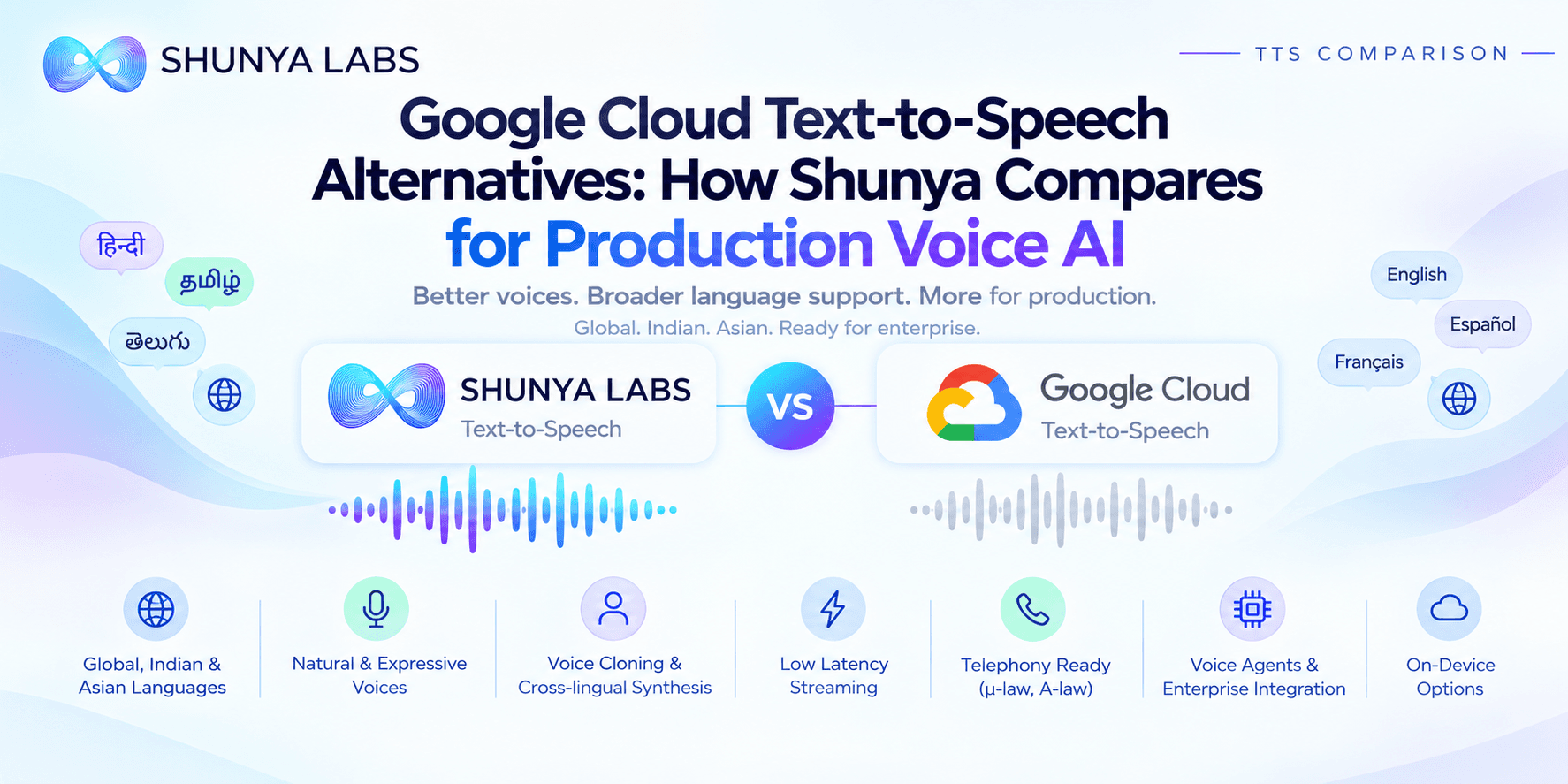
TL;DR , Key Takeaways:
- Google Cloud TTS offers a broad enterprise speech platform with multiple model families, streaming, SSML, custom voice capabilities, and deep integration with Google Cloud.
- Shunya focuses on production voice applications across global, Indian, and Asian languages, with dedicated Indic voices and cross-lingual synthesis.
- Shunya’s documented TTS stack includes 46 voices, 11 expression styles, voice cloning, and streaming.
- Google offers advanced Gemini-TTS prompting for control over style, accent, pace, tone, and emotional expression.
- Google’s Chirp 3: HD voices are built for natural conversational speech and low-latency streaming.
- Shunya’s strongest differentiation is Indic voice specialization, cross-lingual voice identity, telephony-ready output, and integration with the broader voice-AI stack.
- Google is particularly attractive for organizations already standardized on Google Cloud.
- Shunya is particularly relevant when voice is a core product capability, especially for Indian and Asian markets, multilingual enterprise experiences, and voice agents.
Google Cloud Text-to-Speech has been a go-to option for teams that need cloud-based speech synthesis, broad language support, multiple voice models, SSML controls, streaming, and enterprise infrastructure.
The platform has also changed significantly. Google now offers newer systems such as Chirp 3: HD and Gemini-TTS, alongside established voice families. Gemini-TTS can use natural-language prompts to control style, accent, pace, tone, and emotional expression, while Chirp 3: HD is designed around more conversational, natural-sounding speech and streaming.
That makes Google Cloud TTS a serious option for production applications.
But enterprise voice AI has moved beyond the question of whether a service can generate a natural-sounding sentence.
A production system may need to handle:
Indian and Asian languages
Brand names and technical terminology
Currency and numbers
Real-time conversations
Telephony
Voice cloning
Consistent voice identity
Low-latency streaming
Private or edge deployment
And increasingly, TTS sits inside a larger system that includes speech-to-text, reasoning, voice agents, and speech intelligence.
That is where alternatives such as Shunya become relevant.
Shunya Zero TTS is positioned around global, Indian, and Asian voice applications, with a dedicated Indic voice stack, cross-lingual synthesis, voice cloning, expressive styles, streaming, and enterprise voice integration. Its documentation lists 46 voices across 23 Indic languages plus English and 11 expression styles.
The question, then, isn’t simply:
“What is the best Google TTS alternative?”
It is:
“Which TTS platform is the best fit for the voice experience my product needs to deliver?”
What makes a good enterprise TTS platform?
A TTS API is easy to evaluate when the input is:
“Hello, how can I help you today?”
Almost every modern system can produce a good result.
Production applications generate much harder text.
For example:
“Your payment of ₹1,25,499.50 has been received.”
Or:
“Your appointment is scheduled for 12 October at 10:30 AM.”
Now the TTS system has to get the content, pronunciation, pacing, emphasis, and tone right.
A serious enterprise evaluation should therefore consider:
Voice naturalness
Pronunciation
Prosody
Language quality
Expression
Voice consistency
First-audio latency
Streaming behavior
Telephony compatibility
Voice cloning
Cost at scale
This is a much better framework for evaluating Google Cloud TTS alternatives than simply comparing the number of voices or supported languages.
Google Cloud TTS has a major advantage: model choice
One of Google’s biggest strengths is the breadth of its TTS stack.
The current Google Cloud offering includes several generations and approaches to speech synthesis, including Gemini-TTS, Chirp 3: HD, Neural2, WaveNet, and Standard voices.
That gives developers flexibility.
A team can choose a model based on:
Voice quality
Latency
Expressiveness
Cost
Language
Application type
The newest models are particularly interesting.
Gemini-TTS uses natural-language prompts to control delivery.
Chirp 3: HD focuses on highly natural conversational voices and streaming.
This model variety is one reason Google Cloud TTS remains attractive for large enterprises.
Shunya takes a more focused approach.
Rather than offering many generations of general-purpose cloud voices, its Zero TTS stack is designed around production voice applications, with particular specialization around Indic voices, cross-lingual synthesis, enterprise conversations, and voice agents.
The tradeoff is straightforward:
Google gives you breadth of cloud voice technologies.
Shunya emphasizes specialization around production voice use cases.
Voice naturalness isn’t enough
Modern TTS has largely solved the old problem of obviously robotic speech.
The harder question is whether the voice remains natural when the conversation becomes complex.
A production assistant might need to say:
“I understand. Your refund of ₹8,500 was initiated yesterday, and it should reach your account within three to five working days.”
A good TTS system needs to understand that this is:
Conversational
Reassuring
Informational
Moderately paced
with emphasis on the refund amount and expected timeline.
Google’s Gemini-TTS gives developers natural-language controls for style, accent, pace, tone, and emotion, which is a significant step beyond basic synthesis parameters.
Shunya provides 11 expression styles, including Conversational, Narrative, News, Happy, Sad, Angry, Fearful, Surprised, and Enthusiastic.
The difference is mainly in how the control is exposed.
Google: prompt-driven control.
Shunya: predefined production-oriented styles.
For creative experimentation, prompt-driven control can be extremely flexible.
For enterprise deployments where a brand wants consistent voice behavior, defined styles can be easier to standardize.
Pronunciation is where production TTS gets serious
Voice quality can be subjective.
Pronunciation is much easier to test.
Take:
₹25,499.50
AB-2047-X
12 October 2026
500 mg
shunyalabs.ai
A TTS system that sounds excellent but pronounces these incorrectly can still fail the business requirement.
Google Cloud TTS offers SSML, giving developers control over pronunciation, pauses, emphasis, rate, pitch, and other speech characteristics.
Gemini-TTS adds natural-language prompting on top of that control model.
Shunya provides language-aware generation and pronunciation controls, while separating the voice identity from the spoken language for its cross-lingual workflows.
For enterprise applications, this makes pronunciation accuracy a first-class benchmark rather than an afterthought.
Indian voice quality requires more than language availability
Google has substantial Indian-language support.
Its current Chirp 3: HD catalogue includes voices across Indian locales, including languages such as Hindi, Bengali, Gujarati, Kannada, Malayalam, Marathi, Punjabi, Tamil, Telugu, and Urdu, with exact availability dependent on model and release status.
That is strong coverage.
Shunya’s positioning is more explicitly centered on Indic voice generation.
The Zero TTS Indic stack is designed around Indian phonetics, regional pronunciation, and local speech patterns, with documented voices spanning global, asian and 23 Indic languages.
This distinction matters because Indian TTS isn’t simply about translating an English sentence into Hindi.
It can involve:
Indian names
Regional place names
Indian currencies
English words embedded in Indian-language speech
Local pronunciation
Regional vocabulary
For an Indian customer-service assistant, those details often matter more than the headline language count.
One voice identity across languages
Enterprise brands increasingly want a consistent virtual assistant across markets.
Imagine the same assistant speaking:
English
then Hindi
then Tamil
then Japanese.
The customer should still recognize the same assistant.
Shunya supports cross-lingual synthesis, with voice identity separated from the language being spoken.
This enables a brand to maintain:
One voice
Multiple languages
One identity
Google also offers many voices and locales, but multilingual consistency needs to be tested at the voice level, not assumed from language support.
A useful benchmark is to synthesize the same script in several target languages and compare:
Timbre
Accent
Pacing
Prosody
Emotional delivery
The question isn’t just whether each language sounds good.
It’s whether they still sound like the same assistant.
Voice cloning is now part of the mainstream TTS stack
Voice cloning is no longer limited to specialist startups.
Google currently offers Instant Custom Voice for eligible use cases, allowing organizations to create a custom voice from recorded speech.
Shunya also supports voice cloning from a short reference recording, with cross-lingual synthesis available through its TTS stack.
That means voice cloning should not be the primary criterion when comparing Google Cloud TTS alternatives.
Instead, evaluate:
Reference audio required
Similarity
Consistency
Cross-lingual identity
Long-form stability
Latency
Telephony performance
For a multinational brand, cross-lingual voice identity can be more valuable than the ability to create one highly accurate clone.
Any production voice cloning workflow should also have appropriate consent and rights from the source speaker.
Google Cloud TTS streaming is built for realtime applications
Google’s Chirp 3: HD voices support streaming, including bidirectional streaming where text is sent continuously and audio is returned continuously.
This is important for:
Voice agents
Realtime assistants
Interactive applications
Conversational AI
Instead of waiting for an entire response to be generated, a system can begin producing audio while the response is still being formed.
Shunya also supports WebSocket streaming TTS, making it suitable for realtime conversational applications and voice agents.
But the important benchmark isn’t simply:
Streaming: yes
Measure:
User stops speaking → first audible response
That includes:
STT
LLM reasoning
TTS
Network
Buffering
This is why end-to-end conversational latency is more useful than isolated TTS latency.
Telephony changes what “good TTS” means
Many enterprise voice applications don’t live inside a browser.
They live on the phone.
That means:
IVR
Contact centers
Outbound calling
Voice bots
The audio may be encoded at 8 kHz and require telephony formats such as μ-law or A-law.
Shunya’s TTS API supports μ-law and A-law, alongside PCM, WAV, MP3, OGG Opus, and FLAC.
Google Cloud TTS supports a broad range of audio encodings and can be integrated into communication workflows through the wider Google Cloud ecosystem.
The best test is an actual phone call.
Take the same response and evaluate:
Clarity
Pronunciation
Latency
Pauses
Turn-taking
Audio quality after compression
A studio listening test does not tell you enough about the experience of an actual customer calling a contact center.
Voice agents change the TTS architecture
A voice agent typically looks like:
User speaks
↓
Speech-to-text
↓
Reasoning
↓
Text-to-speech
↓
User hears response
TTS is one component in a realtime loop.
Google Cloud has the advantage of fitting naturally into the wider Google Cloud and Vertex AI ecosystem.
Shunya’s Voice Agent and Platform take a more speech-native approach, combining:
STT
TTS
Voice agents
Speech intelligence
Custom SLMs
Knowledge-grounded AI
This becomes useful when the team wants the speech layer and conversational layer to feel like a single system rather than a collection of independent cloud services.
Google Cloud’s ecosystem can be the deciding factor
There are applications where the best Google Cloud TTS alternative is simply Google Cloud TTS itself.
If your organization already uses Google Cloud extensively, you may already have:
Identity and access management
Cloud billing
Monitoring
Logging
Storage
Vertex AI
Cloud Run
and established security processes.
Adding TTS inside that environment can be considerably easier than introducing another vendor.
This is particularly important for large enterprises where vendor consolidation and infrastructure governance matter as much as model quality.
Shunya is more focused on the voice layer.
For organizations where voice is becoming a major application interface, the value comes from combining speech capabilities rather than simply fitting TTS into an existing cloud ecosystem.
Pricing needs to be evaluated by model and workload
Google Cloud TTS pricing varies considerably depending on the model.
The current pricing page lists:
Chirp 3: HD: $30 per 1 million characters after the stated free allowance.
Instant Custom Voice: $60 per 1 million characters.
The Gemini-TTS models use text-token and audio-token pricing, rather than a simple character-based model.
That means comparing “Google TTS price” to another provider isn’t especially useful without specifying the model.
Shunya’s current pricing is available on its pricing page.
At enterprise scale, calculate:
Cost per million characters
Cost per generated minute
Peak concurrency
Voice cloning
Required model
STT
LLM
Infrastructure
The meaningful number is cost per completed interaction, not cost per character in isolation.
Where Google Cloud TTS is the better fit
Google Cloud TTS is particularly compelling when you need:
Deep Google Cloud integration
TTS can fit directly into an existing cloud architecture.
Multiple model families
Google provides Standard, WaveNet, Neural2, Chirp 3: HD, Gemini-TTS, and custom voice options.
Prompt-driven voice control
Gemini-TTS provides natural-language control over style, accent, pace, tone, and emotion.
SSML
Useful for precise programmatic control over speech delivery.
Broad locale coverage
Google has a large catalogue of global and regional voices.
Enterprise cloud infrastructure
Organizations already operating on Google Cloud may benefit significantly from keeping TTS within their existing environment.
Where Shunya is a strong alternative
Shunya is particularly compelling when:
Indian voice quality is central
The Zero TTS Indic stack is purpose-built around Indic speech and regional pronunciation.
You need global, Indian, and Asian voice applications
Shunya’s TTS positioning spans these markets rather than treating Indic voices as a secondary requirement.
One voice must work across languages
Shunya supports cross-lingual synthesis, helping maintain voice identity across multilingual applications.
The voice is part of a realtime conversational product
The Shunya Voice Agent connects TTS with STT and conversational AI.
Telephony is important
Shunya supports μ-law and A-law alongside other common audio formats.
You need structured expression styles
Shunya provides 11 expression styles designed around predictable voice delivery.
You need a broader voice-AI stack
The Shunya Platform connects STT, TTS, voice agents, SLMs, edge speech understanding, and knowledge-grounded AI.
Edge or local inference matters
See Shunya On-Device Models for lightweight local voice applications.
Google Cloud TTS alternatives by use case
| Use case | Relevant fit |
|---|---|
| Existing Google Cloud architecture | Google Cloud TTS |
| Broad cloud TTS | Both |
| SSML-heavy applications | Google Cloud TTS |
| Prompt-driven voice control | Google Gemini-TTS |
| Indian-language enterprise TTS | Shunya |
| Indic-focused voice applications | Shunya |
| Cross-lingual brand voice | Both / Shunya |
| Realtime TTS | Both |
| Voice agents | Both |
| Enterprise IVR | Both / Shunya |
| Telephony | Both |
| Voice cloning | Both |
| Edge voice applications | Shunya |
| Google Cloud-native deployment | Google Cloud TTS |
| Broader STT + TTS + voice-AI stack | Shunya |
How to evaluate Google Cloud TTS alternatives
The best comparison starts with the text your product actually generates.
Build a test set containing:
Conversational sentences
Names
Numbers
Currency
Dates
Acronyms
URLs
Product names
Medical terminology
Indian-language text
Code-switched text
Longer responses
Then evaluate:
Naturalness
Does the voice sound human?
Pronunciation
Are important names, numbers, places, and terms spoken correctly?
Prosody
Are pauses and emphasis natural?
Expression
Can the voice communicate the intended tone?
Voice consistency
Does the same voice remain recognizable across repeated outputs and languages?
First-audio latency
How quickly does the user hear the response?
Streaming behavior
Does the voice stay natural when text arrives incrementally from an LLM?
Telephony quality
Does it remain clear after phone-network encoding?
Cost
What does the system actually cost at your production volume?
For voice agents, measure:
User stops speaking → first audible response
That is usually more meaningful than standalone TTS benchmark numbers.
Final words
Google Cloud Text-to-Speech is a powerful enterprise platform.
Its current offering spans Gemini-TTS, Chirp 3: HD, Neural2, WaveNet, Standard voices, streaming, SSML, custom voice capabilities, and broad cloud infrastructure integration.
For organizations already deeply invested in Google Cloud, those capabilities can make it a natural choice.
Shunya takes a different approach.
Its TTS stack is designed around global, Indian, and Asian voice applications, with Indic-focused voices, cross-lingual synthesis, voice cloning, expressive styles, streaming, and enterprise voice applications. Its documented catalogue includes 46 voices across 23 Indic languages plus English.
The strongest reason to consider Shunya isn’t simply language coverage.
It is the combination of:
Indic voice specialization
Cross-lingual voice identity
Production-oriented expression
Telephony support
Voice cloning
Edge options
and integration with STT, speech intelligence, voice agents, SLMs, and knowledge-grounded AI.
Google Cloud TTS is a strong fit when the priority is cloud infrastructure, model variety, SSML, and Google ecosystem integration.
Shunya becomes particularly compelling when the requirement is production conversational voice, especially across Indian and Asian markets.
The best way to choose isn’t to listen to one polished demo.
Take your actual application text.
Test:
Names.
Numbers.
Currency.
Indian languages.
Code-switching.
Technical terminology.
Long responses.
Then measure pronunciation, naturalness, first-audio latency, voice consistency, telephony performance, and cost.
Because the best TTS platform isn’t necessarily the one with the biggest model catalogue.
It’s the one that consistently produces the right voice for the product you’re building.
Frequently asked questions
What are the best alternatives to Google Cloud Text-to-Speech?
The right alternative depends on the application. Shunya, ElevenLabs, Cartesia, Smallest.ai, and Inworld all target different parts of the TTS market, from creative voice generation to realtime enterprise voice AI.
Is Shunya a Google Cloud TTS alternative?
Yes. Shunya provides production TTS across global, Indian, and Asian voice applications, with Indic-focused voices, cross-lingual synthesis, voice cloning, streaming, and enterprise voice-agent integration.
Does Google Cloud TTS support Indian languages?
Yes. Google supports multiple Indian-language voices, including Hindi, Bengali, Gujarati, Kannada, Malayalam, Marathi, Punjabi, Tamil, Telugu, and Urdu, with exact availability depending on model and voice.
Does Shunya support Indian voices?
Yes. Zero TTS Indic provides dedicated Indic voices, with the current documentation listing 23 Indic languages plus English.
Does Google Cloud TTS support voice cloning?
Yes. Google currently offers Instant Custom Voice for eligible use cases.
Does Shunya support voice cloning?
Yes. Shunya supports voice cloning from a short reference recording and cross-lingual synthesis.
Does Google Cloud TTS support expressive speech?
Yes. Gemini-TTS supports natural-language prompting for style, accent, pace, tone, and emotional expression.
Does Shunya support expressive speech?
Yes. Shunya provides 11 expression styles, including Conversational, Narrative, News, Happy, Sad, Angry, Fearful, Surprised, and Enthusiastic.
Does Google Cloud TTS support realtime streaming?
Yes. Chirp 3: HD supports streaming speech synthesis, including bidirectional streaming.
Does Shunya support streaming TTS?
Yes. Shunya provides WebSocket streaming TTS for realtime applications.
Does Shunya support telephony?
Yes. Shunya supports μ-law and A-law as well as PCM, WAV, MP3, OGG Opus, and FLAC.
Which is better for Indian enterprise voice AI?
Shunya has a particularly strong proposition when the application depends on Indic voice specialization, regional pronunciation, cross-lingual voice identity, telephony, and enterprise voice agents.
Which is better for Google Cloud users?
For organizations already standardized on Google Cloud, Google Cloud TTS can be the more natural fit because TTS integrates directly into the existing cloud infrastructure and governance model.
Which is better for voice agents?
Both can support voice-agent applications. Google offers realtime Chirp 3: HD and Gemini-TTS capabilities, while Shunya integrates TTS with STT, speech intelligence, voice agents, SLMs, and knowledge-grounded AI.
Which is cheaper?
Google Cloud pricing varies by model. Current published pricing lists Chirp 3: HD at $30 per million characters after its stated free allowance, while Gemini-TTS uses token-based pricing. Shunya uses its own model and enterprise pricing structure.
How should I compare Google Cloud TTS alternatives?
Use the same production text and compare naturalness, pronunciation, prosody, expression, voice consistency, first-audio latency, streaming behavior, telephony quality, and cost at your expected volume.

Bio: Navvya works at the intersection of product strategy and applied AI research at Shunya Labs. With a background in human behaviour and communication, she writes about the people, markets, and technology behind voice AI, with a particular focus on how speech interfaces are reshaping access across emerging markets.