

Knowledge Graph and RAG: How to Build a Hybrid Enterprise AI Architecture
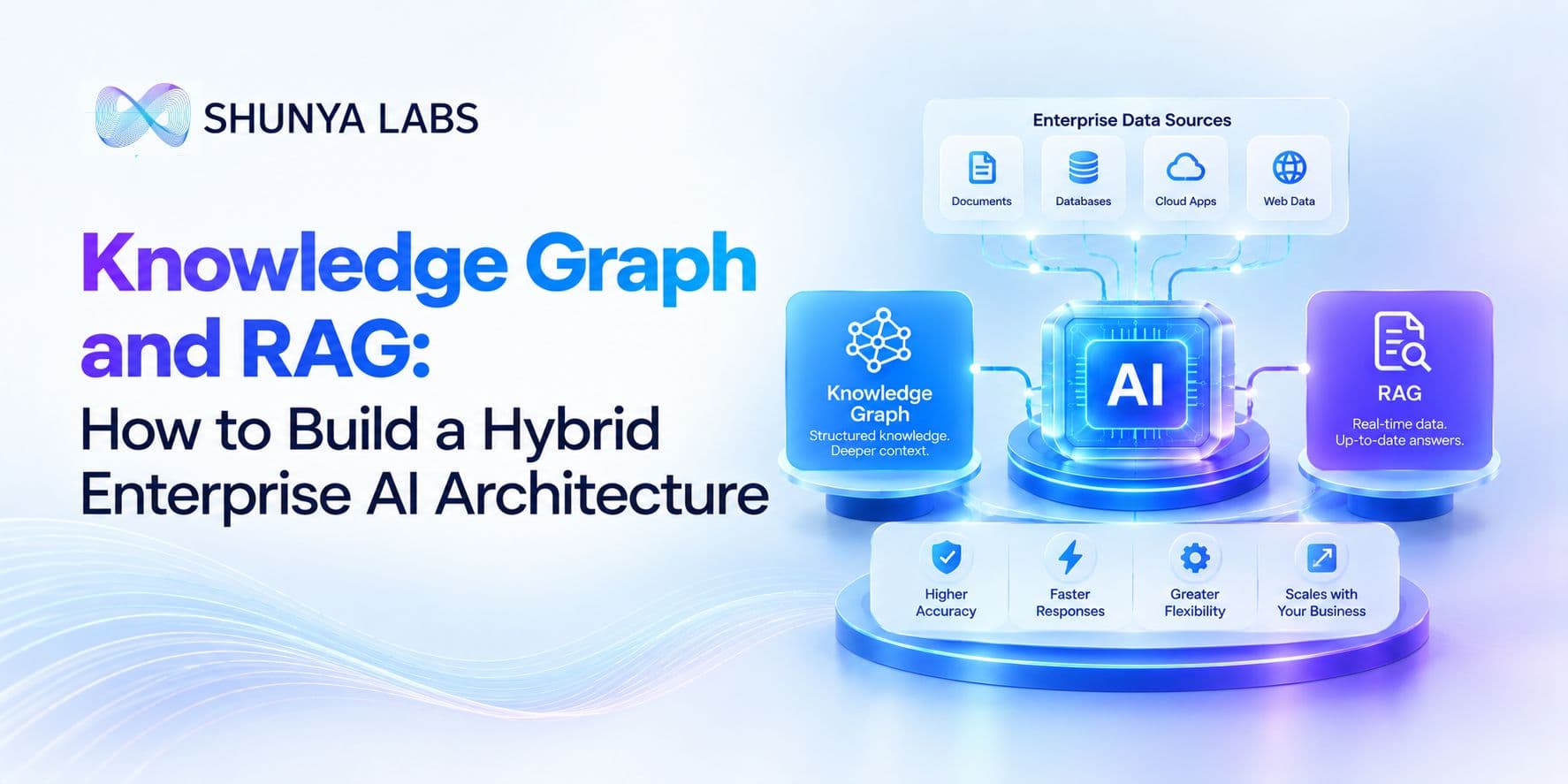
TL;DR , Key Takeaways:
- RAG retrieves relevant information. It is especially useful when answers are contained in documents or passages.
- Knowledge graphs represent relationships. They are useful when the answer depends on how entities connect to one another.
- A hybrid architecture combines both instead of forcing every question through one retrieval method.
- The knowledge graph can provide structure, constraints, entity relationships, or query routing before RAG retrieves supporting text.
- RAG can then provide the actual document context, evidence, and natural-language detail needed by the model.
- Hybrid retrieval is particularly useful for complex enterprise questions, compliance, BFSI, healthcare, supply chains, product intelligence, and agentic workflows.
- You do not need a knowledge graph for every AI application. Start with RAG when semantic retrieval is enough and introduce graph-based reasoning where relationships materially affect the answer.
- The goal is not to replace RAG. It is to make enterprise retrieval more structured, contextual, and reliable where the business problem requires it.
Enterprise AI systems often start with a simple idea: connect company documents to an LLM using Retrieval-Augmented Generation (RAG).
That works well for many questions.
But as enterprise use cases become more complex, the questions change.
Instead of asking:
“What does our refund policy say?”
users start asking:
“Which customers are affected by this policy change?”
“Which products depend on this supplier?”
“What happens to the contract if this milestone changes?”
“Which regulations apply to this product, region, and customer segment?”
These questions are not purely about finding the right paragraph. They require understanding relationships between entities, documents, rules, and business processes.
That is where a hybrid Knowledge Graph + RAG architecture becomes useful.
Microsoft has described a similar enterprise pattern where a knowledge graph can first apply constraints and narrow the relevant knowledge space, while RAG performs semantic retrieval within that scope. AWS has also recently published architectures combining knowledge-graph retrieval with RAG methodologies such as GraphRAG and LightRAG for questions that span multiple documents and relationships.
What is Knowledge Graph RAG?
Knowledge Graph RAG is an architecture that combines a knowledge graph with retrieval-augmented generation.
Traditional RAG generally works like this:
Question → retrieve relevant chunks → send context to LLM → generate answer
The retrieval system searches a corpus using methods such as vector similarity, keyword search, semantic search, or a combination of these approaches. Microsoft describes RAG as a pattern that grounds language models in organization-specific content rather than relying only on model memory.
A knowledge graph adds another representation:
Entity → relationship → entity
For example:
Product A → manufactured by → Supplier B
Supplier B → operates in → India
Product A → governed by → Regulation C
Regulation C → applies to → Region D
Now the AI system can reason over both:
What does the document say?
and:
How is this information connected?
That is the central idea behind a hybrid Knowledge Graph + RAG architecture.
Why traditional RAG can struggle with enterprise questions
RAG is extremely useful when the answer exists in a relatively identifiable piece of content.
For example:
“What is the company’s reimbursement limit for business travel?”
A retrieval system can locate the relevant policy section and provide it to the model.
But consider:
“Which employees are affected if the reimbursement policy changes for international travel?”
Now the system may need to connect:
Policy → travel category → employee type → location → business unit → eligibility
No single document chunk may contain the complete answer.
AWS describes this limitation in its recent work on knowledge-graph RAG. Similarity-based retrieval can work well when the answer is located in a passage, but it becomes more difficult when the answer is distributed across multiple documents or depends on relationships between entities.
This is also why search systems increasingly support hybrid retrieval, combining semantic, keyword, structured, and agentic retrieval approaches rather than relying on one retrieval mechanism.
What a knowledge graph adds to RAG
A knowledge graph provides a structured representation of enterprise knowledge.
Instead of storing only text such as:
“Premium customers can access priority support.”
the system can represent:
Premium Customer → eligible for → Priority Support
That relationship can then connect to:
Priority Support → governed by → Support Policy
and:
Support Policy → applicable region → APAC
This becomes particularly useful when an enterprise has:
- complicated product hierarchies
- regulatory relationships
- organisational structures
- customer segments
- supplier networks
- policy dependencies
- workflows
- contracts
- asset relationships
- healthcare entities
- financial relationships
Shunya’s enterprise AI platform describes its knowledge graph as a structured layer for products, regulations, SOPs, workflows, and enterprise knowledge, with the graph providing the business context while the model generates the response.
How a hybrid Knowledge Graph + RAG architecture works
A practical architecture can look like this:
User question
↓
Query understanding
↓
Knowledge graph lookup
↓
Entity and relationship filtering
↓
RAG retrieval
↓
Relevant documents and evidence
↓
Model reasoning
↓
Grounded answer or business action
The important part is that the graph and RAG do different jobs.
The graph can answer:
What entities are relevant?
What relationships matter?
What constraints apply?
Which parts of the enterprise knowledge model should be searched?
RAG can then answer:
What do the relevant documents actually say?
This separation allows the architecture to combine structured and unstructured knowledge rather than treating all enterprise knowledge as plain text.
Knowledge Graph vs RAG: When should you use each?
The question is not whether a knowledge graph is better than RAG.
The better question is:
What kind of question does your enterprise AI need to answer?
| Requirement | RAG | Knowledge Graph | Hybrid |
|---|---|---|---|
| Find information in documents | Strong fit | Possible | Strong fit |
| Semantic search | Strong fit | Limited | Strong fit |
| Explain entity relationships | Limited | Strong fit | Strong fit |
| Multi-hop questions | Can struggle | Strong fit | Strong fit |
| Rule-based filtering | Limited | Strong fit | Strong fit |
| Cross-document reasoning | Can struggle | Strong fit | Strong fit |
| Fast initial prototype | Strong fit | More work | Moderate |
| Highly structured domains | Useful | Strong fit | Strong fit |
| Unstructured enterprise content | Strong fit | Requires graph extraction | Strong fit |
| Cited document evidence | Strong fit | Not its primary role | Strong fit |
For a relatively simple internal knowledge assistant, starting with RAG may be enough.
For a system where relationships and constraints are central to the business problem, a graph layer becomes much more valuable.
For many enterprise workloads, the hybrid approach is the practical middle ground.
How Graph RAG improves enterprise search
One of the biggest applications is enterprise search.
Traditional search often asks:
“Which documents are most similar to this query?”
A graph-aware architecture can ask:
“Which entities, relationships, policies, and documents are relevant to this query?”
Consider a banking example.
A customer asks:
“Why was this transaction blocked, and what can I do next?”
The system may need to connect:
Customer → account → transaction → risk rule → product → applicable policy → next permitted action
The graph establishes the relevant business relationships.
RAG can then retrieve the exact policy language, customer communication templates, or supporting documentation.
This combination gives the model both structure and evidence.
Hybrid RAG is especially useful for regulated industries
Some enterprise environments cannot rely entirely on probabilistic semantic retrieval.
BFSI, healthcare, insurance, government, and other regulated environments often have explicit relationships, eligibility conditions, policies, and workflows.
Microsoft’s 2026 architecture discussion describes hybrid retrieval as useful when enterprise domains contain clear hierarchies, deterministic relationships, rule-driven mappings, and a need for consistency and explainability.
For a BFSI AI architecture, for example, the system might need to understand:
Customer → product → account → transaction → risk policy → regulatory requirement → permissible action
For healthcare AI, the relationships may look more like:
Patient → condition → medication → dosage → contraindication → clinical protocol
The exact implementation varies, but the architectural principle remains the same.
Knowledge Graph + RAG for AI agents
Hybrid retrieval becomes even more useful when the AI system is an agent rather than a simple question-answering assistant.
An agent may need to:
- Understand the user’s request.
- Identify relevant entities.
- Retrieve supporting information.
- Check business rules.
- Call an enterprise system.
- Perform an action.
- Explain what happened.
AWS’s recent enterprise retrieval work highlights this progression from single-step RAG toward agentic retrieval, where systems can determine which knowledge source to consult and retrieve information iteratively for more complex questions.
Shunya’s enterprise voice agent platform follows a similar architecture for conversational workflows, with speech recognition followed by knowledge grounding, decision-making, translation, and speech generation. The platform describes grounding responses against enterprise knowledge graphs and SOPs rather than relying only on general model knowledge.
This is important because an agent should not simply retrieve information.
It needs to know what information is relevant to the task and what it is authorised to do with it.
Where RAG fits into the hybrid architecture
RAG is still essential.
The knowledge graph does not replace enterprise documents.
A graph might tell the system:
Product X → affected by → Regulation Y
But the model may still need the exact clause from the regulatory document.
That is where RAG adds value.
The architecture can therefore use the graph to identify:
Product X + Regulation Y + India + Enterprise Customers
and then use RAG to retrieve:
the relevant sections of the regulation, product policy, customer agreement, and internal SOP
The model can then generate an answer backed by those sources.
This makes the architecture more useful for traceable enterprise AI because the final response can combine structured relationships with source evidence.
How to build a hybrid RAG architecture
A production implementation can be built in several stages.
Start with your enterprise data
Connect the sources that contain useful business knowledge:
documents, databases, APIs, CRM records, SOPs, policies, product catalogues, contracts, and other internal systems.
AWS notes that enterprise retrieval systems often need to bring together connectors, parsers, vector stores, knowledge graphs, retrieval logic, access control, security, and observability.
Identify the entities and relationships
Do not turn everything into a graph just because you can.
Start with the relationships that actually affect decisions.
For example:
Customer → owns → Account
Account → associated with → Product
Product → governed by → Policy
Policy → applies to → Region
These relationships form the structured layer.
Add semantic retrieval
Use vector or hybrid retrieval for information that is primarily contained in documents or other unstructured sources.
This is the part where enterprise RAG can remain extremely useful.
Decide how the two systems interact
There are several possible patterns:
Graph → RAG
Use graph relationships to narrow the retrieval space.
RAG → Graph
Retrieve documents first, then use extracted entities to traverse the graph.
Graph + RAG in parallel
Retrieve structured relationships and unstructured evidence independently.
Agentic retrieval
Let an agent decide which retrieval strategy is required for the question.
AWS’s current knowledge-graph RAG work demonstrates architectures where different graph retrieval methodologies can coexist on the same underlying stack, depending on the query.
Do you need a knowledge graph for your RAG system?
Not necessarily.
A knowledge graph introduces additional work around data modelling, entity resolution, relationship extraction, updates, governance, and operational maintenance.
RAG may be enough when:
- most information is unstructured
- users mainly ask factual questions
- relationships between entities are limited
- a quick enterprise search system is the priority
- the answer usually exists in one or a few passages
A hybrid architecture becomes more compelling when:
- answers span multiple documents
- users ask multi-hop questions
- business rules matter
- relationships affect the answer
- explainability is important
- the enterprise has complex taxonomies or hierarchies
- AI agents need to make decisions or take actions
The right architecture should follow the shape of the problem.
How to evaluate a hybrid Knowledge Graph + RAG system
Do not measure the system only by whether the generated answer sounds good.
Evaluate the full retrieval chain.
Important metrics include:
retrieval precision
Did the system find the right information?
relationship accuracy
Did it follow the correct entities and relationships?
groundedness
Is the answer supported by retrieved evidence?
answer accuracy
Is the final answer actually correct?
task completion
Did the AI complete the requested workflow?
latency
How long did the full response take?
cost
How much compute and retrieval infrastructure does each request require?
failure rate
What happens when information is missing, contradictory, or ambiguous?
For production systems, evaluation should be based on representative enterprise workloads rather than only generic benchmarks. Shunya’s platform currently positions simulation, production evaluation, human review, and regression testing as part of the development lifecycle.
For speech-heavy applications, the evaluation can also include speech recognition benchmarks, latency, multilingual performance, speaker handling, and task completion.
The future of enterprise RAG is not retrieval alone
RAG remains one of the most useful patterns for grounding enterprise AI.
But enterprise questions are becoming more complex.
Companies increasingly want AI systems that can understand documents, entities, relationships, rules, workflows, and actions together.
That is why the next generation of enterprise retrieval is moving toward architectures that combine:
semantic retrieval + structured knowledge + business rules + agents + enterprise systems
AWS’s recent work on knowledge-graph RAG, task-aware retrieval, and agentic retrieval reflects this shift toward systems that can handle questions requiring more than nearest-neighbour document retrieval.
The same direction is visible in Microsoft’s work on relationship-aware enterprise AI and hybrid Knowledge Graph + RAG architectures.
The goal is not to make every AI application more complicated.
It is to make the architecture match the complexity of the business knowledge it is expected to understand.
Final thoughts
The most useful way to think about Knowledge Graph + RAG is not as two competing technologies.
Think of them as two complementary ways of representing enterprise knowledge.
RAG helps AI find the right information.
Knowledge graphs help AI understand how that information connects.
When combined thoughtfully, they can create a more capable architecture for enterprise AI, especially when questions involve multiple sources, complex relationships, business rules, and real-world workflows.
For companies starting today, the practical path is usually straightforward:
Start with the business questions.
Determine whether semantic retrieval is enough.
Add structured relationships where they materially improve the answer.
Then connect that knowledge layer to the models, workflows, tools, and systems that turn an AI response into useful business action.
That is where hybrid enterprise AI architecture becomes valuable.
Frequently Asked Questions
What is Knowledge Graph RAG?
Knowledge Graph RAG is an AI architecture that combines knowledge graphs for structured relationships with RAG for retrieving relevant information from enterprise content.
How does Knowledge Graph RAG work?
A hybrid system can identify relevant entities and relationships through a knowledge graph, use those relationships to guide retrieval, retrieve supporting documents through RAG, and then provide the combined context to an AI model.
Is Knowledge Graph RAG better than traditional RAG?
It depends on the use case. Traditional RAG is often sufficient for questions that can be answered from relevant document passages. Knowledge Graph + RAG becomes more useful when answers depend on relationships, constraints, hierarchies, or information spread across multiple sources.
What is GraphRAG?
GraphRAG generally refers to retrieval architectures that use graph-based representations of information to improve retrieval and reasoning over complex knowledge. Microsoft’s GraphRAG and other graph-based approaches are increasingly being used for questions that go beyond simple similarity search. AWS recently demonstrated GraphRAG and LightRAG on a shared enterprise retrieval stack.
When should an enterprise use a knowledge graph?
A knowledge graph can be useful when relationships between entities are central to the problem, such as customers and products, regulations and policies, suppliers and contracts, patients and treatments, or accounts and transactions.
Can Knowledge Graph RAG be used for AI agents?
Yes. A knowledge graph can provide structured enterprise context while RAG retrieves supporting content. This can be particularly useful for agents that need to reason, retrieve information, follow business rules, and interact with enterprise systems.
How does Knowledge Graph RAG reduce AI hallucinations?
It does not eliminate hallucinations by itself. The architecture can reduce unsupported responses by grounding the model in enterprise knowledge, explicit relationships, retrieved evidence, and business constraints. The quality of the underlying data and retrieval system still matters.
Learn More
Explore Shunya’s enterprise AI platform, custom Small Language Models, enterprise voice agents, enterprise speech-to-text, BFSI AI solutions, healthcare AI solutions, enterprise AI, and Shunya’s published benchmarks.

Bio: Navvya works at the intersection of product strategy and applied AI research at Shunya Labs. With a background in human behaviour and communication, she writes about the people, markets, and technology behind voice AI, with a particular focus on how speech interfaces are reshaping access across emerging markets.