

Knowledge Graphs and RAG for Enterprise AI: How to Choose the Right Architecture
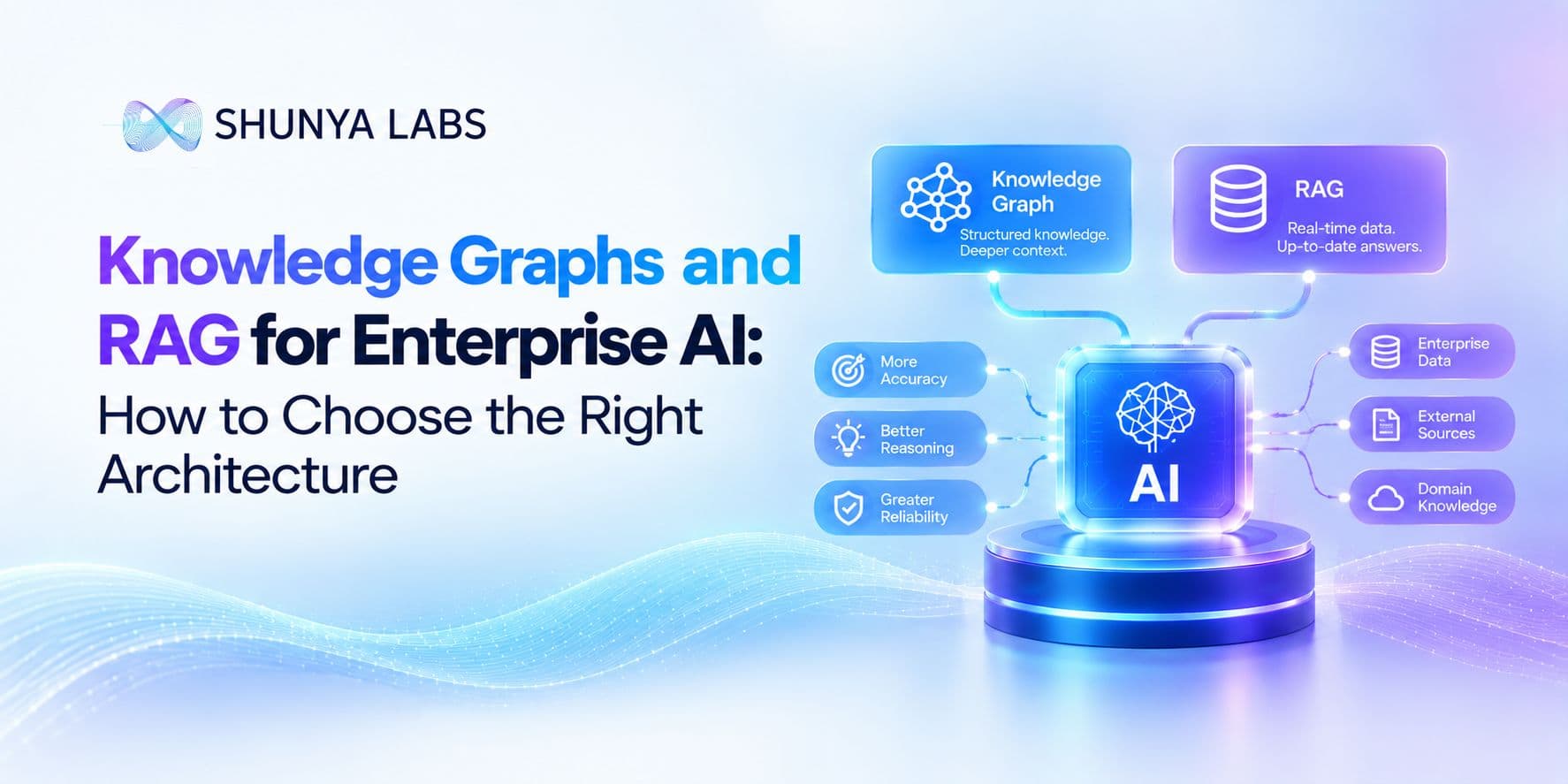
TL;DR , Key Takeaways:
- RAG is primarily useful for retrieving relevant information from external knowledge sources and supplying it to a language model at runtime.
- Knowledge graphs represent entities and relationships explicitly, making them useful for questions involving connections, dependencies, multi-hop reasoning, and structured enterprise context.
- RAG works particularly well with unstructured information such as documents, policies, manuals, support articles, and reports.
- Knowledge graphs become particularly useful when the answer depends on relationships between entities, rather than a single relevant document passage.
- Enterprises do not have to choose one. Current AWS and Microsoft guidance both describe architectures that combine vector retrieval, structured data, and knowledge graphs for more complex enterprise retrieval problems.
- A hybrid architecture can use RAG for document content, knowledge graphs for relationships, business rules for constraints, and an LLM or SLM for reasoning.
- Shunya’s Enterprise AI Platform combines knowledge graphs, purpose-trained SLMs, enterprise data, business rules, and voice AI as part of a unified intelligence layer.
- The right architecture depends on data structure, query complexity, freshness, explainability, latency, scale, and the consequences of incorrect answers.
Retrieval-Augmented Generation (RAG) has become one of the standard ways enterprises connect AI models to their private information. It allows an application to retrieve relevant content from documents, databases, or other sources and provide that information to a language model at runtime.
But enterprise knowledge is not always just a collection of documents.
Many business questions depend on relationships:
Which account belongs to this customer?
Which products are affected by this policy?
Which regulation applies to this transaction?
Which employees report to this manager?
Which supplier is connected to these purchase orders?
This is where knowledge graphs become useful. A knowledge graph represents entities and the relationships between them, allowing AI systems to reason over connections rather than retrieving only similar pieces of text. Google describes knowledge graphs as improving context-aware search by understanding relationships between people, content, and interactions, while Microsoft and Google Cloud are increasingly discussing graph-based approaches alongside RAG for enterprise AI.
For enterprise AI, the choice is therefore rarely:
RAG or knowledge graph.
A better question is:
What kind of knowledge does the application need to retrieve, understand, and reason about?
In many systems, the answer is RAG + knowledge graph + business rules, with each layer solving a different problem.
What is RAG?
RAG stands for Retrieval-Augmented Generation.
Instead of asking a language model to answer entirely from its trained knowledge, the application retrieves relevant information from an external source and includes it in the model’s context before generating the answer.
A basic enterprise RAG architecture looks like:
User question
↓
Search / retrieval
↓
Relevant documents
↓
LLM
↓
Answer
The knowledge source could contain:
Product documentation
SOPs
HR policies
Regulatory documents
Support articles
Contracts
Internal reports
This is one reason RAG has become so widely used in enterprise AI.
The model does not need to memorize every internal document.
It can retrieve the relevant information when it needs it.
What is a knowledge graph?
A knowledge graph represents information as entities and relationships.
For example:
Customer → owns → Account
Account → uses → Product
Product → governed by → Policy
Policy → applies to → Region
Region → regulated by → Regulation
Instead of treating those facts as independent pieces of information, the graph makes their relationships explicit.
Google Cloud describes knowledge graphs as improving search by understanding relationships between entities and providing more context-aware results.
This becomes particularly useful for questions such as:
“Which products are affected by the new policy for customers in this region?”
That question may require several relationships to be followed:
Customer
→ Region
→ Policy
→ Products
A traditional similarity search may retrieve useful documents, but a graph can explicitly represent the relationships needed to answer the question.
RAG and knowledge graphs solve different problems
The easiest distinction is:
RAG retrieves information.
A knowledge graph represents relationships.
RAG is particularly effective when the answer lives in a passage of text.
For example:
“What is our current refund policy?”
A search system can retrieve the relevant policy section and give it to the model.
A knowledge graph becomes more useful when the question is:
“Which customers using Product A in Region B are affected by Policy C?”
Now the problem involves multiple entities and relationships.
| Requirement | RAG | Knowledge graph |
|---|---|---|
| Retrieve document passages | Strong fit | Useful |
| Current documents | Strong fit | Useful with sync |
| FAQs and support content | Strong fit | Useful |
| Policies and manuals | Strong fit | Useful |
| Entity relationships | Possible | Strong fit |
| Multi-hop reasoning | More difficult | Strong fit |
| Dependency analysis | Possible | Strong fit |
| Relationship-aware search | Limited | Strong fit |
| Structured enterprise data | Possible | Strong fit |
| Explain relationships | Limited | Strong fit |
| Unstructured enterprise data | Strong fit | Requires extraction / modeling |
| Frequently changing text | Strong fit | Depends on graph updates |
These are general architectural tendencies. A well-designed RAG system can handle structured information, and a knowledge graph can also be combined with document retrieval.
When should enterprises use RAG?
RAG is a natural choice when the core problem is:
“The AI needs access to information that is not reliably inside the model.”
Typical examples include:
Employee handbooks
Product manuals
Support documentation
Regulatory filings
Internal policies
Technical documentation
Contracts
Knowledge bases
Google describes RAG as combining traditional information retrieval with generative models to make responses more relevant, current, and grounded in specific data.
RAG is also attractive because the knowledge source can be updated without retraining the underlying language model.
That makes it particularly useful when information changes frequently.
For example:
Pricing changes
Product updates
New policies
Support documentation
Regulatory requirements
The retrieval layer can be updated independently.
When should enterprises use a knowledge graph?
Knowledge graphs become particularly useful when the business problem is about relationships and dependencies.
Examples include:
Customer-account relationships
Product dependencies
Supply chains
Organizational structures
Regulatory relationships
Fraud networks
Insurance policies
Healthcare relationships
Financial transactions
Google Cloud’s current BigQuery Graph positioning specifically highlights questions where the important information is not an individual row but how things connect, such as account relationships and transaction paths.
Knowledge graphs are also useful when the enterprise needs to answer multi-hop questions.
For example:
“Which suppliers are affected if this component is discontinued?”
That could require:
Component
→ Product
→ Manufacturing line
→ Supplier
→ Purchase order
A graph can represent that path explicitly.
Why RAG alone can struggle with complex enterprise questions
RAG typically retrieves the chunks that appear most relevant to the user’s query.
That works well for many questions.
But complex enterprise questions can require information spread across multiple documents and entities.
AWS’s current enterprise retrieval guidance explicitly notes that teams often need to combine connectors, vector stores, knowledge graphs, and retrieval logic, particularly when questions span different sources or require more complex reasoning.
AWS has also recently discussed cases where conventional similarity retrieval can struggle with analytical tasks spanning hundreds of documents, because relevant information can depend on connections across the document set rather than individual retrieved fragments.
That doesn’t mean RAG has stopped being useful.
It means retrieval quality and knowledge representation have to match the question being asked.
Why knowledge graphs alone aren’t enough
A knowledge graph isn’t a replacement for all enterprise knowledge.
Many important facts exist in:
PDFs
Emails
Reports
Contracts
Product documentation
Meeting transcripts
SOPs
Those sources contain rich textual context that does not naturally belong in a graph.
This is why hybrid architectures are becoming increasingly relevant.
Microsoft’s current architecture guidance describes combining RAG with structured approaches such as knowledge graphs to improve consistency and reliability when enterprise information contains both structured and unstructured components.
The practical architecture becomes:
Documents
→ RAG
Entities and relationships
→ Knowledge graph
Rules
→ Business logic
Model
→ Reasoning
The hybrid architecture: RAG + knowledge graph
A more complete enterprise AI system can look like:
User question
↓
Intent / query analysis
↓
Retrieve relevant documents
+
Traverse relevant relationships
↓
Knowledge + context
↓
Business rules
↓
LLM / SLM
↓
Answer or action
This lets each component do the job it is best suited for.
RAG provides context
It retrieves the actual text.
Knowledge graphs provide relationships
They explain how entities are connected.
Business rules provide control
They determine what the application is allowed to do.
The model provides reasoning
It turns the available information into an answer or decision.
This is closer to the architecture enterprises need when moving from AI assistants to AI agents.
Knowledge graphs and AI agents
Voice and digital agents increasingly need to reason over enterprise systems rather than simply retrieve documents.
A customer might ask:
“Can I move my appointment to tomorrow morning?”
The system may need:
Customer record
→ Current appointment
→ Available slots
→ Eligibility rules
→ Booking system
→ Action
A knowledge graph can represent the entities and relationships.
RAG can retrieve the relevant scheduling policy.
Business rules can enforce eligibility.
A tool can update the appointment.
The AI agent can then explain the result.
Shunya’s Voice Agent platform follows a similar enterprise architecture by grounding conversations in knowledge graphs, SOPs, business rules, and connected enterprise systems.
That is particularly important when an AI system needs to complete a task rather than simply answer a question.
Knowledge graphs and custom SLMs
Knowledge representation and model choice are separate decisions.
An enterprise may use:
Knowledge graph
RAG
Custom SLM
LLM
depending on the workload.
For example:
Custom SLM
→ identifies intent
Knowledge graph
→ determines relevant entities and relationships
RAG
→ retrieves supporting policy text
Business rules
→ validate the action
LLM
→ handles complex reasoning or natural-language generation
Shunya’s Custom SLM approach is designed around enterprise-specific data, terminology, workflows and decision processes, making custom models a natural complement to an enterprise knowledge layer.
This creates a useful separation:
Model = how to reason
Knowledge = what the business knows
Rules = what the business allows
Tools = what the system can do
That separation can make enterprise AI easier to control and maintain.
Knowledge graphs vs vector databases
Another common search question is whether an enterprise should use a knowledge graph or vector database.
They are not necessarily substitutes.
A vector database is primarily useful for similarity-based retrieval.
A graph database is useful for relationship-based traversal.
For example:
Vector search
“Find documents about late payment fees.”
Graph query
“Which customers, products, and policies are connected to this account?”
Many enterprise systems can use both.
AWS’s current Managed Knowledge Base architecture explicitly discusses the need to choose and sometimes combine vector stores and knowledge graphs depending on the application’s retrieval and reasoning requirements.
The best architecture depends on the questions the system needs to answer.
How to decide between RAG, knowledge graphs, or both
Use this simple framework.
Choose RAG when:
The knowledge is primarily textual
Documents change frequently
Users ask document-based questions
You need fast implementation
Similarity retrieval is sufficient
Choose a knowledge graph when:
Relationships are central
Questions require multiple hops
Entities are well defined
Dependencies matter
Explainable relationships are important
Use both when:
Documents and structured relationships matter
Questions cross multiple data sources
The application needs complex reasoning
Enterprise data changes at different speeds
AI agents need both context and relationships
This hybrid approach is increasingly reflected in enterprise AI architecture guidance.
How Shunya approaches enterprise knowledge
Shunya’s Enterprise AI Platform places knowledge graphs at the center of its enterprise intelligence layer, alongside purpose-trained SLMs and enterprise data.
The platform describes a graph containing:
Products
Policies
SOPs
Workflows
and other enterprise relationships. It also connects documents, APIs, CRM records, and enterprise systems so that AI responses can be grounded in the organization’s own information.
The broader architecture is:
Knowledge
Purpose-trained intelligence
Speech
Business rules
Enterprise systems
rather than simply:
LLM + prompt.
That architecture is particularly relevant for regulated and operational workloads where the AI needs to explain, decide, and act within defined business boundaries.
How to evaluate a knowledge-grounded AI architecture
Don’t evaluate RAG or knowledge graphs in isolation.
Evaluate the complete application.
Measure:
| Metric | What to evaluate |
|---|---|
| Retrieval accuracy | Did the system retrieve the right information? |
| Relationship accuracy | Did it identify the correct entities and connections? |
| Groundedness | Does the answer reflect the available enterprise data? |
| Task accuracy | Did it reach the correct decision? |
| Task completion | Did it complete the requested action? |
| Latency | How long did retrieval and reasoning take? |
| Freshness | How quickly do changes appear in responses? |
| Explainability | Can the answer be traced to sources and relationships? |
| Cost | What does each completed task cost? |
| Reliability | Does performance remain stable in production? |
For difficult enterprise workloads, answer quality alone is not enough.
You need to know:
Why did the system reach this answer?
Which sources did it use?
Which relationships did it traverse?
Which rules were applied?
Which action did it perform?
That is what makes an enterprise AI system auditable.
Final words
RAG and knowledge graphs should not be treated as competing technologies.
They solve different parts of the enterprise knowledge problem.
RAG is excellent for retrieving relevant text.
Knowledge graphs are valuable for representing and reasoning over relationships.
Business rules control what the system is allowed to do.
SLMs and LLMs provide the reasoning capability.
Tools and APIs turn decisions into actions.
The most effective architecture is often a combination:
RAG + Knowledge Graph + Rules + Model + Tools
This is especially important as enterprise AI moves from simple question answering toward agents that need to understand context, make decisions, and complete workflows. Current AWS, Microsoft, and Google Cloud work all point toward increasingly sophisticated combinations of retrieval, structured knowledge, graph relationships, and agentic reasoning.
Shunya’s approach is built around this same architectural direction.
Its Enterprise AI Platform combines knowledge graphs, purpose-trained SLMs, enterprise data and business rules, while Voice Agents use that intelligence layer to understand customers, ground responses, take actions, and respond in real time.
The right question for an enterprise is therefore not:
“Should we use RAG or a knowledge graph?”
It is:
“What kind of knowledge does our AI need to understand, and what does it need to do with that knowledge?”
For document-heavy questions, RAG may be enough.
For relationship-heavy questions, a knowledge graph may be necessary.
For complex enterprise applications, the answer will often be both.
And when AI needs to move from answering a question to taking the right business action, knowledge representation becomes part of the core architecture, not an optional layer.
Frequently asked questions
What is RAG in enterprise AI?
Retrieval-Augmented Generation connects a language model to external knowledge sources by retrieving relevant information at runtime and supplying it to the model as context.
What is a knowledge graph in AI?
A knowledge graph represents entities and their relationships so that AI systems can reason about connections between people, products, policies, systems, and other business objects.
Is RAG better than a knowledge graph?
Neither is universally better. RAG is well suited to retrieving relevant text, while knowledge graphs are particularly useful for relationships, multi-hop questions, and structured enterprise context.
Can RAG and knowledge graphs work together?
Yes. A hybrid architecture can use RAG for documents and knowledge graphs for relationships, giving the model both textual context and structured enterprise context. Microsoft and AWS both describe hybrid approaches for complex enterprise retrieval.
When should an enterprise use RAG?
RAG is particularly useful when an AI system needs access to private, current, or frequently changing enterprise information stored in documents and other external sources.
When should an enterprise use a knowledge graph?
A knowledge graph is especially useful when questions depend on relationships between entities, dependencies, multi-step connections, or structured enterprise data.
Can a knowledge graph reduce AI hallucinations?
A knowledge graph can provide structured enterprise context and improve traceability, but it does not automatically eliminate hallucinations. The overall system still needs reliable retrieval, grounding, model behavior, validation, and appropriate business controls.
What is the difference between a knowledge graph and a vector database?
A vector database primarily supports similarity-based retrieval, while a knowledge graph explicitly represents relationships between entities. Many enterprise architectures can use both.
Is a knowledge graph a replacement for RAG?
Usually not. Knowledge graphs and RAG address different types of enterprise knowledge and can be complementary.
Do AI agents need knowledge graphs?
Not always. A simple agent may work effectively with documents and RAG. Knowledge graphs become more valuable when the agent needs to reason about complex relationships, business entities, dependencies, and multi-step workflows.
Can SLMs use RAG and knowledge graphs?
Yes. A smaller model can use retrieved documents and structured graph context as inputs while handling specialized reasoning or classification.
How does Shunya use knowledge graphs?
Shunya’s Enterprise AI Platform uses knowledge graphs, enterprise data, SOPs, policies and workflows as part of its intelligence layer, alongside purpose-trained SLMs.
How do knowledge graphs work with Shunya Voice Agents?
Shunya’s Voice Agents use knowledge graphs, SOPs and business rules to ground conversations and connect voice interactions to enterprise systems and actions.
How should enterprises choose between RAG and knowledge graphs?
Start with the questions the system needs to answer. If the answers mainly live in documents, start with RAG. If the answers depend on relationships and structured entities, evaluate a knowledge graph. If both matter, build a hybrid architecture and benchmark the complete workflow.
Learn more
Explore the Shunya Enterprise AI Platform, Knowledge Graph-powered intelligence, Custom SLMs, Voice Agents, and Speech Intelligence.
For enterprise speech applications, explore Speech-to-Text, Zero TTS, Zero STT Codeswitch, and On-Device Models.
For enterprise use cases, see BFSI, Healthcare, Contact Centers, Telecom, Retail, and E-commerce.
For deployment architecture, explore Cloud and Private Enterprise AI and Shunya Benchmarks.

Bio: Navvya works at the intersection of product strategy and applied AI research at Shunya Labs. With a background in human behaviour and communication, she writes about the people, markets, and technology behind voice AI, with a particular focus on how speech interfaces are reshaping access across emerging markets.