

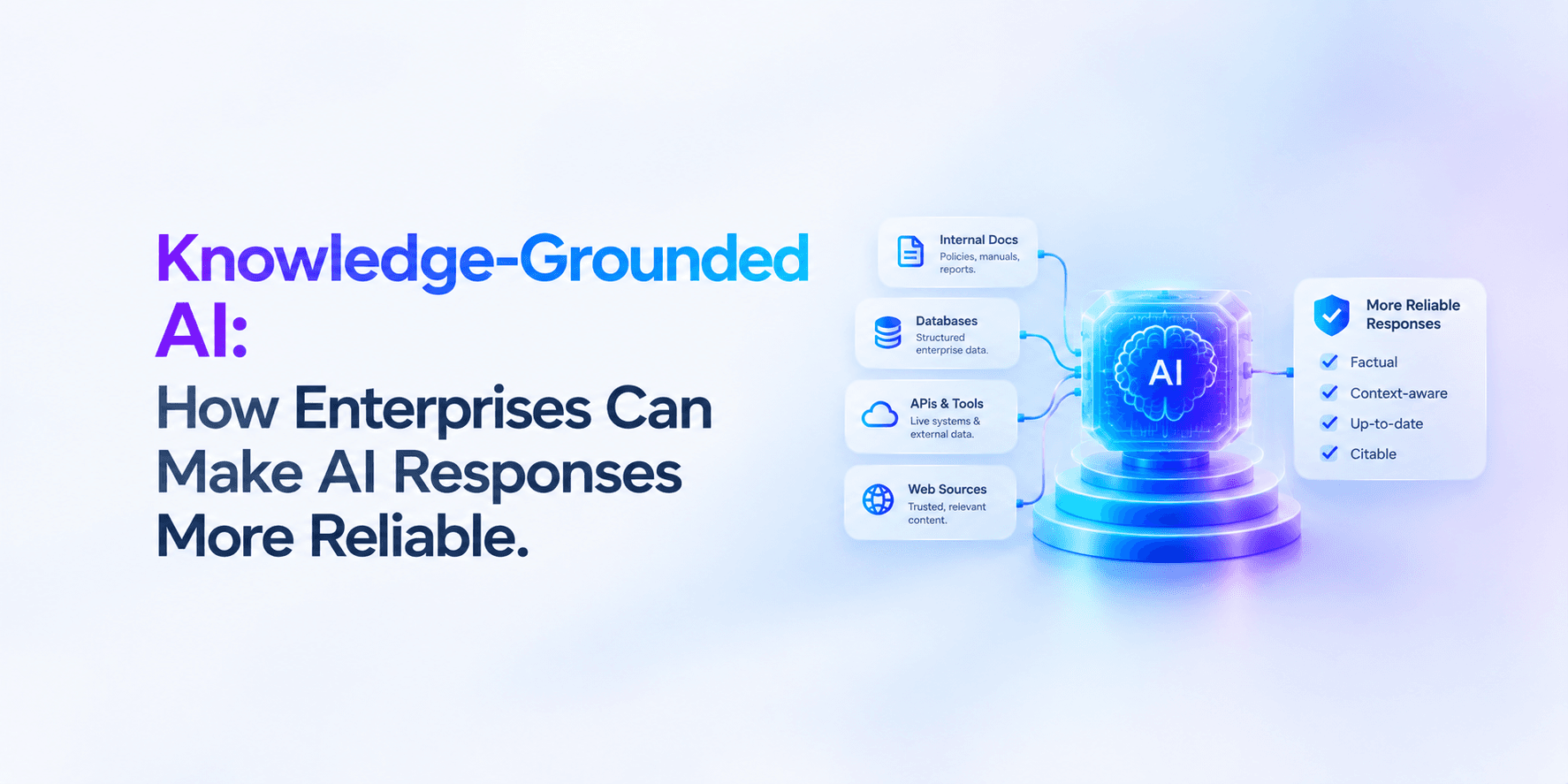
Knowledge-Grounded AI: How Enterprises Can Make AI Responses More Reliable
TL;DR , Key Takeaways:
- Knowledge-grounded AI connects models to trusted enterprise knowledge instead of relying only on model memory.
- RAG is one of the most common ways to ground an AI application, but retrieval quality directly affects answer quality.
- Grounding works best when source data is accurate, current, permission-aware, well-structured, and traceable.
- Enterprises should distinguish between documents, structured business data, knowledge graphs, APIs, and business rules rather than treating every source as the same type of knowledge.
- A good grounding architecture should tell the model what to use, what not to use, and what to do when the answer is not available.
- Citations and evidence improve trust, but a citation alone does not prove that an answer is correct.
- Complex questions may require hybrid retrieval, knowledge graphs, or agentic RAG rather than a single retrieval step.
- The best architecture combines knowledge + retrieval + models + permissions + business rules + evaluation + monitoring.
- The goal is not to make AI answer every question. The goal is to make it reliably answer the questions it has enough evidence to answer.
Enterprise AI is increasingly being used for questions that have real business consequences.
Employees ask AI about company policies. Customers ask about products, payments, benefits, contracts, and support. AI agents are asked to retrieve information, make recommendations, and increasingly take actions inside enterprise systems.
That creates a basic requirement:
The AI needs to answer from what the business actually knows, not simply from what the model learned during training.
This is the idea behind knowledge-grounded AI.
Grounding connects an AI model to trusted, relevant, and current sources so its responses are based on evidence available to the organisation. Google describes grounding as connecting model responses to verifiable sources of information, while Microsoft describes RAG as combining language-model reasoning with trusted, organisation-specific knowledge.
For enterprises, however, grounding is about more than simply adding a vector database.
A reliable system needs to answer several questions:
What information should the AI use?
Where does that information come from?
Is it current and authorised?
Did retrieval find the right evidence?
What should happen when the evidence is incomplete?
Can someone verify where the answer came from?
That is why knowledge grounding is increasingly becoming an architecture problem, not just a prompt-engineering technique.
What is knowledge-grounded AI?
Knowledge-grounded AI is an approach where an AI model generates responses using external, trusted information provided by the system.
Without grounding, a simplified interaction looks like:
User → LLM → Response
The model relies primarily on patterns and knowledge encoded during training.
With grounding, the architecture becomes:
User → Retrieve trusted knowledge → LLM → Grounded response
The retrieved information can come from:
internal documents, databases, APIs, knowledge graphs, product catalogues, policies, SOPs, CRM systems, and other enterprise sources.
Microsoft describes RAG as a design pattern that combines information retrieval with language generation so an AI system can answer using organisation-specific content rather than relying solely on model memory.
Google similarly recommends retrieval-based grounding to connect generative AI responses to verifiable sources.
The important distinction is that the model generates the language, while the enterprise knowledge layer provides the evidence.
Shunya describes this architecture through its enterprise AI platform, where enterprise data, SOPs, APIs, CRM systems, documents, knowledge graphs and business rules can be connected to ground AI responses.
Why do enterprises need grounded AI?
A general-purpose LLM can be very capable while still being a poor source of truth for a specific company.
An employee might ask:
“What is our current travel reimbursement limit?”
The correct answer may exist in an internal policy that was updated last month.
The model does not automatically know that policy.
The same issue appears in customer-facing systems:
“Can I get a refund for this product?”
The answer might depend on:
product type + purchase date + customer segment + region + payment method + current policy
None of these facts should be guessed.
AWS notes that foundation models generally lack awareness of proprietary data, business rules, and recent operational changes unless those are introduced through grounding or other mechanisms.
This is particularly important for enterprise AI agents, because an unsupported answer can become an unsupported action.
Grounding is more than RAG
RAG is one of the most common approaches to knowledge grounding.
A basic RAG system works like this:
Question → search → retrieve context → generate answer
This works well for questions such as:
“What does our leave policy say about parental leave?”
The system can retrieve the relevant section and pass it to the model.
But enterprise knowledge is rarely limited to documents.
A production system may also need:
live customer data
transaction information
business rules
product relationships
permissions
current inventory
workflow state
regulatory requirements
That means a complete grounding architecture may combine several forms of enterprise knowledge.
| Knowledge type | Example | Useful grounding method |
|---|---|---|
| Unstructured content | Policies, manuals, FAQs | RAG |
| Structured data | Customer records, transactions | Database/API |
| Relationships | Product → regulation → region | Knowledge graph |
| Rules | Eligibility, approval thresholds | Business rules |
| Live state | Account balance, appointment status | Real-time API |
| Conversation history | Previous customer interactions | Conversation memory |
| Domain behaviour | Classification, intent routing | Specialised model / SLM |
The architecture should therefore answer a broader question:
What is the authoritative source for each type of information?
The first rule of grounded AI: use the right source
A common mistake is connecting every enterprise source to one giant retrieval system and expecting the model to figure everything out.
That creates ambiguity.
Imagine the AI has access to:
- last year’s pricing PDF
- this year’s pricing sheet
- a sales presentation
- a customer FAQ
- an internal product document
- a CRM record
All of these may mention the same product.
The problem is no longer whether the AI can find information.
The problem is which source should count as the truth?
AWS explicitly recommends source-data quality controls, data classification, and traceability as part of production RAG because grounded answers are only as reliable as the underlying sources.
This means enterprise grounding should include metadata such as:
- owner
- effective date
- version
- region
- department
- access level
- source type
- status
A document being relevant is not enough.
It also needs to be authoritative and current.
Better retrieval leads to better AI responses
Grounding does not automatically make an AI response reliable.
The system first needs to retrieve the right information.
Microsoft’s RAG evaluation guidance separates retrieval evaluation from response evaluation, measuring whether the system actually retrieves documents that match the expected evidence.
That distinction is important.
Suppose the correct policy exists in the knowledge base.
If the system retrieves the wrong policy, the LLM can still produce a highly fluent answer.
This is why enterprise AI teams should measure:
Did we retrieve the right source?
before asking:
Did the model answer well?
A reliable grounding pipeline therefore evaluates at least two things:
retrieval quality
and
answer groundedness
What makes an AI response truly grounded?
A grounded answer is not simply an answer that happens to mention a document.
The response should be supported by the evidence the system retrieved.
Microsoft’s grounding guidance describes groundedness in terms of how closely the generated response adheres to the provided information and avoids unsupported speculation or fabrication.
A useful enterprise grounding pipeline therefore needs to make a distinction between: supported information, inference, missing information, conflicting information
For example:
“The policy states that refunds are available within 30 days.”
is different from:
“The customer should therefore receive a refund.”
The second statement may require additional information about the customer’s purchase, eligibility, or account.
The system should not silently turn an incomplete fact into a complete decision.
Citations make grounded AI easier to verify
Citations are becoming an important part of enterprise AI because they allow users to inspect the evidence behind an answer.
Microsoft’s current enterprise grounding work emphasises traceable, cited answers rather than answers that merely sound convincing.
But there is an important distinction:
- A citation does not automatically make an answer correct.
- A system can cite the wrong document.
- It can cite a document that only partially supports the answer.
- It can retrieve two conflicting sources and fail to resolve the conflict.
Recent research on enterprise assistants has highlighted problems such as citation drift and unsupported content, where the answer appears sourced but does not accurately map back to the underlying evidence.
This is why a mature grounding architecture needs to evaluate the relationship between answer and evidence, not just whether a citation exists.
Grounding needs permissions too
Enterprise knowledge is not universally accessible.
An employee may be authorised to access one set of documents while another department has access to something completely different.
The grounding system therefore needs to respect the user’s identity and permissions before information enters the model context.
This is particularly important for:
- HR information
- financial records
- customer data
- healthcare information
- legal documents
- confidential contracts
- internal strategy
Access control should therefore happen at the retrieval layer, not merely at the user-interface layer.
A model should never receive sensitive information simply because it is semantically relevant.
The architecture should first establish:
Who is asking?
What are they allowed to see?
Which source can be retrieved?
What actions are they allowed to take?
This turns security into part of the grounding architecture, rather than a separate layer added later.
Knowledge graphs make grounding more useful for complex questions
RAG works particularly well when the answer can be found in relevant document passages.
But enterprise questions increasingly involve relationships.
For example:
“Which products are affected by the new regulation in India?”
The system may need to connect:
Regulation → applies to → product category
Product → sold in → India
Customer → uses → product
A knowledge graph can represent those relationships explicitly.
Shunya’s enterprise platform describes a knowledge graph layer that encodes products, regulations, SOPs, and workflows, allowing responses to be grounded in structured enterprise knowledge rather than relying only on generic model knowledge. (Shunya Labs)
This can be particularly useful for:
BFSI
healthcare
insurance
supply chains
complex product catalogues
regulatory workflows
enterprise operations
The point is not to replace RAG.
It is to provide the model with the right representation of enterprise context.
Hybrid grounding can handle complex enterprise questions
Modern enterprise AI may therefore combine:
RAG + knowledge graphs + structured databases + APIs + business rules
A complex question might follow this path:
User question
↓
Identify entities and intent
↓
Query knowledge graph
↓
Retrieve relevant documents
↓
Fetch current information from enterprise APIs
↓
Apply business rules
↓
Generate response
↓
Attach supporting evidence
Google’s 2026 work on agentic RAG describes systems that go beyond single-step retrieval by breaking complex enterprise questions into multiple searches and iteratively gathering sufficient context before answering.
That is important because not every enterprise question can be answered by one search query.
What happens when the knowledge is incomplete?
This is one of the most important design decisions in grounded AI.
A system should know what to do when the knowledge base does not contain enough evidence.
Microsoft’s recent work on confidence-aware RAG highlights a common failure mode: RAG systems can produce confident answers even when retrieved information is incomplete, irrelevant, contradictory, or absent.
A grounded architecture therefore needs explicit fallback behaviour.
It might: ask a clarification, retrieve from another source, state that evidence is insufficient, show conflicting sources, escalate to a human, avoid taking an action.
Microsoft’s RAG prompt guidance explicitly recommends defining fallback behaviour for cases where the retrieved context does not contain enough information to answer the question.
This is one of the clearest differences between a demo and a production system.
A demo asks:
“Can the AI answer?”
A production system also asks:
“Does the AI know when it should not answer?”
Business rules should remain deterministic
Another important grounding principle is separating knowledge from rules.
Consider:
“Approve this refund if the customer is eligible and the amount is below the approval threshold.”
The LLM can help understand the request.
But the threshold itself should not depend on probabilistic text generation.
Business-critical logic should live in:
- application logic
- policy engines
- workflow systems
- or structured business rules
The model can then use the result as context.
This makes the architecture more predictable.
The same principle applies to:
- KYC
- credit workflows
- insurance eligibility
- appointment booking
- refunds
- payment processes
- clinical workflows
The model should help interpret language and navigate the workflow, while deterministic systems control critical conditions.
Custom SLMs can strengthen domain-specific grounding
Grounding is not only about retrieval.
The model itself also needs to understand the domain it is operating in.
A customer-support system handling financial terminology may need different behaviour from an internal HR assistant.
This is where custom Small Language Models can become useful.
Instead of expecting one general-purpose LLM to understand every enterprise workflow equally well, organisations can use specialised models for tasks such as:
intent classification
entity extraction
routing
domain terminology
workflow decisions
structured extraction
Shunya’s platform describes purpose-trained SLMs built around enterprise-specific data, workflows, terminology, and decision-making.
The important point is that a specialised model does not replace grounding.
It works alongside grounding.
Grounded AI for voice agents
The same principles apply when the AI interface is voice.
A voice agent may need to understand:
- what the customer said
- which account they are referring to
- which policy applies
- what information is current
- which tool should be called
- what action is authorised
Shunya’s enterprise voice agent platform describes voice agents built using knowledge graphs and purpose-trained Small Language Models, with integrations into telephony, CRM, e-commerce, and messaging systems.
The underlying architecture still needs a reliable knowledge layer.
The difference is that voice adds another requirement:
the grounding has to happen fast enough to feel like a natural conversation.
For voice systems, evaluation can therefore include speech recognition accuracy, latency, multilingual performance, interruption handling, tool execution, and task completion in addition to groundedness.
Shunya also publishes speech AI benchmarks covering its speech models and evaluation methodology.
How to build a knowledge-grounded AI system
A practical implementation can follow a simple sequence.
Start with the questions the AI needs to answer
Do not begin with a model.
Start with real questions from employees, customers, agents, and operations teams.
Group them into:
- factual questions
- policy questions
- relationship questions
- workflow questions
- action requests
This tells you what type of knowledge the architecture actually needs.
Identify the source of truth
For every important answer, determine:
Which system owns this information?
A document might be the source of truth for a policy.
A database might be the source of truth for a customer record.
An API might be the source of truth for account status.
A knowledge graph might represent relationships.
A rules engine might determine eligibility.
Do not force every problem into one retrieval method.
Improve retrieval before increasing model size
If the system retrieves the wrong documents, moving to a larger LLM may not solve the root problem.
Evaluate: relevance, recall, freshness, metadata filters, permissions and source authority
Microsoft’s RAG evaluation framework explicitly treats document retrieval as a measurable component of system quality.
Add citations and evidence
Make important responses traceable.
Where appropriate, show the source document, section, record, or evidence used to produce the response.
Build an abstention path
Define what happens when evidence is insufficient.
This should be part of the architecture, not an afterthought.
Evaluate the complete system
Test:
retrieval
groundedness
answer relevance
completeness
citation accuracy
latency
cost
permissions
business outcomes
The model should be evaluated together with the knowledge and retrieval layers.
What does a reliable enterprise AI architecture look like?
A practical architecture looks something like:
User
↓
Application / Agent / Voice Interface
↓
Query Understanding
↓
Knowledge Layer
- RAG
- Knowledge graph
- Enterprise search
- Structured data
↓
Context & Governance
- Permissions
- Freshness
- Business rules
- User context
↓
Model Layer
- LLM
- Custom SLM
- Specialised models
↓
Tools & Enterprise Systems
- CRM
- ERP
- APIs
- Databases
- Workflow systems
↓
Validation & Evidence
↓
Grounded Answer or Action
↓
Evaluation & Monitoring
Shunya’s enterprise AI platform follows this broader intelligence-layer approach, combining enterprise knowledge, knowledge graphs, custom SLMs, business rules, integrations, testing, monitoring, and multiple deployment environments.
The goal is not maximum grounding. It is useful grounding.
It is tempting to think that the most reliable AI system is the one with the most documents, the largest context window, or the biggest knowledge base.
That is not necessarily true.
More information can also mean:
more irrelevant retrieval
more conflicting sources
higher latency
higher cost
more ambiguity
The goal should instead be:
the smallest amount of trusted, relevant context needed to answer correctly.
That is why good grounding is as much about selection and governance as it is about retrieval.
Why knowledge-grounded AI is becoming the standard for enterprise AI
Enterprise AI is moving from general-purpose chat toward systems that work with real business knowledge and real business workflows.
That makes grounding increasingly fundamental.
Microsoft’s current enterprise AI guidance positions RAG as a way to combine model capabilities with trusted organisational knowledge, while Google describes grounding as a method for making model responses more trustworthy and factual.
The next generation goes further by combining:
RAG
knowledge graphs
structured data
agentic retrieval
business rules
enterprise APIs
permissions
evaluation
The model remains important.
But the architecture around the model increasingly determines whether the AI can be trusted.
Final thoughts
Knowledge-grounded AI is not about making an LLM magically more accurate.
It is about giving the model the right evidence, from the right source, at the right time, with the right constraints.
For enterprises, that means treating knowledge as an architectural layer.
Start with the business questions.
Identify the authoritative sources.
Build retrieval around those sources.
Represent relationships where they matter.
Keep critical rules deterministic.
Respect permissions.
Show evidence.
Evaluate retrieval and groundedness separately.
And, most importantly, give the system a way to say:
“I don’t have enough information to answer that reliably.”
That is not a weakness.
For enterprise AI, knowing when not to guess is part of what makes a system trustworthy.
Frequently Asked Questions
What is knowledge-grounded AI?
Knowledge-grounded AI connects an AI model to trusted external knowledge so responses are based on enterprise information rather than only the model’s pretraining. RAG is one of the most common grounding techniques.
How does knowledge grounding reduce AI hallucinations?
Grounding can reduce hallucinations by giving the model relevant evidence to use when generating a response. However, the quality of the result still depends on retrieval quality, source quality, freshness, permissions, and model behaviour.
Is RAG enough for enterprise AI?
RAG is often enough for straightforward document-based questions. More complex enterprise workloads may require knowledge graphs, structured databases, APIs, business rules, or agentic retrieval in addition to RAG.
What makes an AI response reliable?
Reliable AI responses need relevant and authoritative evidence, good retrieval, clear grounding instructions, access controls, appropriate business rules, citations or traceability, and evaluation.
Can knowledge-grounded AI use private company data?
Yes. Grounding architectures can connect models to private enterprise documents, databases, APIs, CRM systems, knowledge graphs, and other controlled sources, provided the appropriate security and access controls are in place.
What happens when the AI cannot find the answer?
A production grounding system should have explicit fallback behaviour. It can ask for clarification, retrieve additional information, state that evidence is insufficient, show conflicting sources, or escalate to a human.
Can knowledge graphs improve AI grounding?
Yes. Knowledge graphs can provide structured relationships between entities, which is especially useful when enterprise questions depend on connections between products, policies, customers, regulations, or workflows.
How should enterprises evaluate grounded AI?
Evaluate the entire pipeline, including document retrieval, groundedness, relevance, completeness, citation accuracy, latency, cost, and business outcomes. Microsoft provides dedicated RAG evaluators for retrieval and groundedness as part of its current evaluation tooling.
Learn More
Explore Shunya’s enterprise AI platform, custom SLMs, enterprise voice agents, enterprise speech-to-text, enterprise AI solutions, and speech AI benchmarks.

Bio: Navvya works at the intersection of product strategy and applied AI research at Shunya Labs. With a background in human behaviour and communication, she writes about the people, markets, and technology behind voice AI, with a particular focus on how speech interfaces are reshaping access across emerging markets.