

Prompt Engineering, RAG, and Fine-Tuning for Enterprise AI: How to Choose the Right Approach
TL;DR , Key Takeaways:
- Start with prompt engineering when you mainly need to change instructions, tone, format, or task behavior.
- Use RAG when the model needs access to private, current, or frequently changing enterprise information.
- Use fine-tuning when you need the model to consistently perform a specific task, follow a particular behavior, or understand specialized patterns.
- Fine-tuning is usually not the best way to keep a frequently changing knowledge base current. RAG is better suited to retrieving updated information at inference time.
- Prompt engineering is usually the best first step because it requires no model-weight changes and creates a fast baseline.
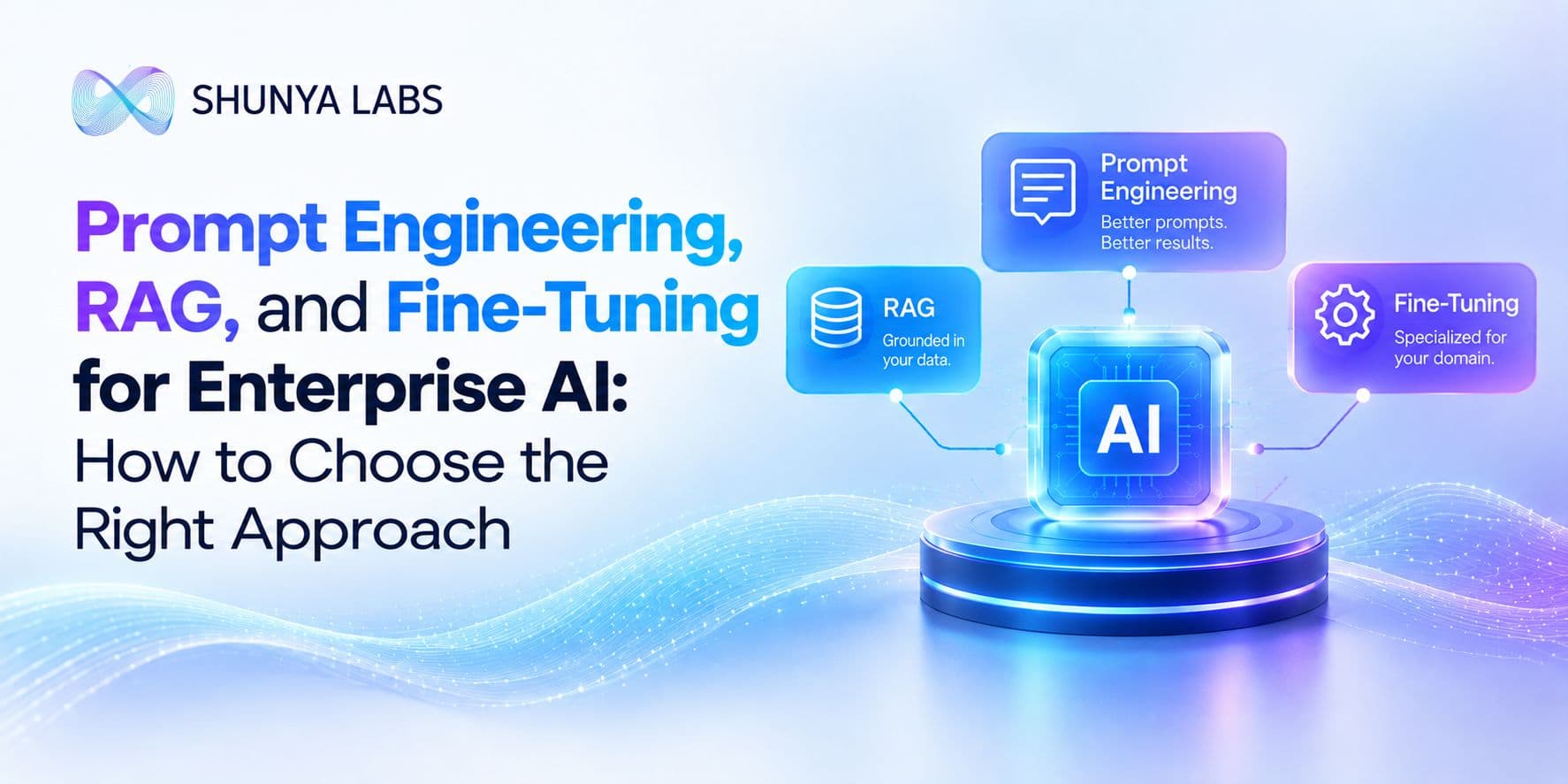
- RAG changes what information the model sees. Fine-tuning changes how the model behaves. Prompting changes how you ask it to perform.
- A hybrid architecture can use RAG for knowledge, fine-tuning for specialized behavior, and prompts for runtime instructions.
- For high-volume, latency-sensitive enterprise tasks, a custom SLM can sometimes be a better target for fine-tuning than a large general-purpose model. Shunya’s Custom SLM offering is built around this model-specialization approach.
When an enterprise starts building with a large language model, one question appears quickly:
Should we improve the prompt, add RAG, or fine-tune the model?
These approaches are often treated as competing technologies, but they solve different problems.
Prompt engineering changes the instructions and examples the model receives.
Retrieval-Augmented Generation (RAG) gives the model relevant information from an external knowledge source at runtime.
Fine-tuning changes the model itself by training it on task-specific examples.
For many enterprise applications, the best architecture is not one of the three.
It can be:
Prompt engineering + RAG + fine-tuning
with each used for the part of the problem it actually solves.
This guide explains when to use prompt engineering, when to use RAG, when fine-tuning makes sense, and how enterprises can combine them with custom models and business systems.
What does each approach actually change?
The easiest way to understand the three approaches is to ask:
What changes?
| Approach | What changes? | Best suited to |
|---|---|---|
| Prompt engineering | Instructions sent to the model | Behaviour, format, tone, task framing |
| RAG | Context retrieved at runtime | Current and private knowledge |
| Fine-tuning | Model parameters | Consistent task behavior and specialization |
Prompt engineering
Prompt engineering means improving the instructions given to a model without changing its underlying weights. It can be used for classification, question answering, structured outputs, writing style, reasoning instructions, and many other tasks.
RAG
RAG retrieves relevant information from an external source and places that information into the model’s context before generating a response. This allows the application to use current enterprise information without retraining the model every time the information changes.
Fine-tuning
Fine-tuning continues training a pretrained model on task-specific data, changing some or all of the model’s parameters. It is useful when the goal is to make the model more consistent at a particular task or behavior.
When should enterprises use prompt engineering?
Prompt engineering should usually be the starting point.
It is useful when the model already has the necessary capability and simply needs better instructions.
For example:
“Classify this customer request as billing, technical support, account access, or escalation. Return only JSON.”
You may not need RAG.
You may not need fine-tuning.
You may simply need:
Clear instructions
Examples
Output constraints
Role definition
Decision rules
AWS recommends prompt engineering as the first customization approach before moving to fine-tuning or RAG when more adaptation is required.
Prompt engineering is particularly useful for:
Formatting
Tone
Classification
Simple routing
Few-shot examples
Output structure
Guardrails
Its biggest advantage is speed.
You can test a new prompt in minutes.
Its limitation is that the model itself has not become specialized.
When should enterprises use RAG?
Use RAG when the problem is primarily:
“The model needs information it does not reliably have.”
That information may include:
Internal policies
Product documentation
SOPs
Customer records
Regulations
Pricing
Knowledge bases
Technical documentation
RAG retrieves relevant information at runtime, which makes it useful when the underlying information changes.
For example:
“What is our current refund policy for orders over ₹50,000?”
Rather than training the policy into model weights, the application can retrieve the current policy and provide it as context.
This gives the enterprise another important capability:
The knowledge layer can be updated independently of the model.
That is particularly useful for:
Customer support
Enterprise search
Internal assistants
Compliance
Policy systems
Knowledge-grounded voice agents
Microsoft’s current Azure AI Search guidance also emphasizes retrieval quality, hybrid search and semantic ranking as important parts of building effective RAG systems.
When should enterprises use fine-tuning?
Fine-tuning becomes interesting when the problem is:
“The model knows what it needs to do, but it doesn’t do it consistently enough.”
Typical examples include:
Classification
Structured extraction
Specialized terminology
Consistent output formats
Brand-specific style
Domain-specific workflows
Google’s current guidance lists task accuracy, domain jargon, style, edge cases, and potentially lower inference cost at scale as reasons to consider fine-tuning.
Imagine an insurance company needs every claim classified using the same internal taxonomy.
You can provide thousands of examples:
Input → Correct classification
The model can then learn that organization’s specific patterns.
This is different from RAG.
RAG says:
Here is the information you need.
Fine-tuning says:
Here is how we expect you to behave.
RAG and fine-tuning solve different problems
This is where many enterprise AI projects become unnecessarily complicated.
Suppose an enterprise wants an AI assistant that answers questions using its latest policies.
The policy changes every month.
Fine-tuning the model on the policy creates a maintenance problem because the model would need to be updated as the information changes.
RAG is better suited because the current policy can be retrieved at runtime. AWS and Google both describe this distinction in their current guidance.
Now consider another requirement:
“Always classify customer complaints into our 18 internal categories and return exactly this JSON structure.”
That is a behavior problem.
Fine-tuning may be useful.
The enterprise may therefore use:
Fine-tuned model
RAG
The model learns how to perform the task, while RAG supplies what it needs to know right now.
The role of prompt engineering doesn’t disappear
Even after RAG or fine-tuning, prompts remain useful.
A production architecture might use:
Prompt
→ defines the current task
RAG
→ supplies relevant enterprise information
Fine-tuned model
→ performs the specialized behavior
This is why these technologies should not be treated as mutually exclusive.
Google explicitly notes that prompt engineering, RAG and tuning can be combined and recommends starting simple before adding complexity.
A practical enterprise decision framework
Use this sequence before investing in model customization.
Start with prompting
Ask:
Can a well-designed prompt solve the problem?
If yes, keep the architecture simple.
Add RAG when knowledge is the problem
Ask:
Does the model need private or frequently changing information?
If yes, introduce a retrieval layer.
Fine-tune when behavior is the problem
Ask:
Does the model need to consistently perform a specialized task that prompting hasn’t solved?
If yes, evaluate fine-tuning.
Consider a custom SLM at scale
Ask:
Is this task narrow, high-volume, latency-sensitive and important enough to justify a purpose-trained model?
If yes, a Custom SLM can become part of the architecture.
Prompt engineering, RAG, and fine-tuning by use case
| Requirement | Prompt engineering | RAG | Fine-tuning |
|---|---|---|---|
| Change tone or format | Strong fit | ||
| Add current company knowledge | Strong fit | ||
| Use private documents | Strong fit | ||
| Frequent knowledge updates | Strong fit | ||
| Classification | Good starting point | Strong fit at scale | |
| Structured extraction | Good starting point | Strong fit | |
| Specialized terminology | Possible | Useful | Strong fit |
| Consistent behavior | Possible | Strong fit | |
| New information every day | Strong fit | ||
| High-volume narrow task | Potentially strong fit | ||
| Need source-grounded answers | Strong fit | ||
| Open-ended reasoning | Strong fit with capable model | Useful when knowledge matters | Task-dependent |
| Fastest way to prototype | Strong fit |
This is a decision framework, not a fixed rule for every model or workload.
What about enterprise knowledge graphs?
RAG is often implemented with vector search, but enterprise knowledge is not always just a collection of documents.
Some problems depend on relationships.
For example:
Customer → account → product → policy → eligibility → action
or:
Employee → role → department → permission → resource
A knowledge graph can represent these relationships explicitly.
Shunya’s Enterprise AI Platform combines knowledge graphs, purpose-trained SLMs and speech AI in a unified intelligence layer. Its platform describes knowledge graphs as a way to represent products, regulations, SOPs and workflows as connected enterprise knowledge.
That means an enterprise architecture can go beyond:
Prompt + LLM
and instead become:
Prompt
Knowledge
Rules
Specialized model
Tools
This is particularly useful when the application needs to reason about the business, not just retrieve text.
Fine-tuning, RAG, and custom SLMs
Fine-tuning does not necessarily mean fine-tuning a huge model.
For a narrow workload, enterprises can train a smaller model specifically for the task.
This can make sense for:
Intent classification
Routing
Entity extraction
Policy decisions
Fraud signals
Customer-service categorization
Voice-agent state detection
A custom SLM can then be deployed more efficiently than a large general-purpose model.
Shunya’s Custom SLM approach focuses on training purpose-built intelligence around enterprise data, terminology, intents, workflows and SOPs, rather than simply using a generic model for every task.
This creates an architecture such as:
User
→ Custom SLM
→ RAG / Knowledge Graph
→ Business rules
→ Enterprise system
→ Response
For voice AI, this can become:
→ Custom SLM
→ Business action
→ TTS
This is one of the areas where model customization and enterprise grounding work particularly well together.
The architecture most enterprises should evaluate
For many enterprise applications, a layered approach makes more sense than picking one technique.
A practical architecture can look like:
1. Prompt engineering
Define what the model should do.
↓
2. RAG / knowledge retrieval
Provide current enterprise information.
↓
3. Business rules
Control what the application is allowed to do.
↓
4. Fine-tuned model or custom SLM
Handle repeatable specialized behavior.
↓
5. Tools and APIs
Take the actual business action.
This creates separation between:
Instructions
Knowledge
Behavior
Rules
and Actions.
That separation makes the system easier to evaluate and update.
How to decide what your application actually needs
Before building anything, answer five questions:
1. Is the problem knowledge or behavior?
If the problem is missing information, look at RAG.
If the problem is inconsistent behavior, look at fine-tuning.
2. Does the information change frequently?
If yes, keep it outside model weights and retrieve it dynamically.
3. Can success be measured clearly?
Fine-tuning is much easier to justify when you can define a measurable target.
4. How much traffic will the system handle?
At high volume, inference efficiency can become a major economic consideration.
5. What happens when the model is wrong?
The architecture for a marketing assistant can be very different from one handling:
Payments
Healthcare
Fraud
Customer identity
Regulatory decisions
The higher the consequence of failure, the more important grounding, evaluation, rules and human escalation become.
How to evaluate the final system
Don’t evaluate only the model.
Evaluate the complete application.
Measure:
| Metric | What to test |
|---|---|
| Accuracy | Correct output |
| Groundedness | Supported by the right source |
| Task completion | Business action completed |
| Latency | End-to-end response time |
| Consistency | Same behavior across repeated inputs |
| Cost | Cost per completed task |
| Reliability | Performance under real traffic |
| Freshness | Ability to use updated information |
| Safety | Failure and escalation behavior |
Google’s current RAG guidance similarly emphasizes retrieval quality and evaluation metrics such as groundedness, instruction following, question-answering quality and safety.
The goal is not to find the most sophisticated architecture.
It is to find the simplest architecture that meets the business requirement reliably.
Final words
Prompt engineering, RAG and fine-tuning are not three steps on a ladder where every enterprise eventually needs all three.
They are different tools for different problems.
Use prompt engineering when the model already has the required capability and needs better instructions.
Use RAG when the model needs access to current, private or external enterprise knowledge.
Use fine-tuning when the model needs to learn consistent specialized behavior.
Use a custom SLM when that specialized behavior is narrow, high-volume, latency-sensitive or important enough to justify a purpose-trained model.
And combine them when the application genuinely needs all of those layers.
A modern enterprise architecture can therefore look like:
Prompt → Knowledge → Specialized Intelligence → Rules → Action
rather than:
Prompt → LLM → Answer
Shunya’s approach brings these components together through its Enterprise AI Platform, Custom SLMs, Knowledge Graph, Voice Agents, and Speech Intelligence.
The most important question is therefore not:
“Should we use RAG or fine-tuning?”
It is:
“Is our problem missing knowledge, inconsistent behavior, unclear instructions, or a combination of all three?”
Once that is clear, the architecture usually becomes much easier to design.
Frequently asked questions
What is prompt engineering?
Prompt engineering is the process of designing and optimizing the instructions provided to a language model to improve its output for a specific task.
What is RAG?
Retrieval-Augmented Generation retrieves relevant information from an external knowledge source at runtime and provides it to the language model as context.
What is fine-tuning?
Fine-tuning continues training a pretrained model on task-specific data, changing model parameters so that the model becomes better adapted to a particular task or behavior.
Should I use RAG or fine-tuning?
Use RAG when the main problem is access to changing or private information. Use fine-tuning when the main problem is consistent specialized behavior. In many enterprise systems, they can be combined.
Is prompt engineering enough for enterprise AI?
Sometimes. It is often the right starting point for straightforward tasks involving instructions, formatting, tone or task framing. AWS recommends starting with prompt engineering before moving to more involved customization.
Does RAG change the model?
No. RAG generally leaves the model weights unchanged and provides additional information through the application context at inference time.
Does fine-tuning add company knowledge to a model?
Fine-tuning can help a model learn domain language, patterns and behavior, but it should not automatically be treated as a replacement for a live knowledge layer. For frequently changing enterprise information, RAG can keep the model connected to current data without retraining.
Can RAG and fine-tuning be used together?
Yes. An enterprise can fine-tune a model for specialized behavior while using RAG to provide current information at runtime. Google explicitly describes combining tuning with prompt engineering and RAG.
When should an enterprise consider a custom SLM?
Consider a custom SLM when the task is narrow, high-volume, domain-specific, latency-sensitive and measurable, particularly when efficient or private deployment matters.
Can custom SLMs use RAG?
Yes. A custom SLM can use RAG to retrieve current enterprise knowledge while the model handles specialized reasoning, classification or workflow decisions.
Is RAG enough for a voice agent?
RAG can provide knowledge, but a production voice agent may also need speech recognition, reasoning, business rules, tools, TTS, telephony and human escalation. Shunya’s Voice Agent architecture combines these layers into an enterprise voice workflow.
How should enterprises evaluate these approaches?
Start with the simplest architecture, establish a baseline, then measure accuracy, groundedness, latency, task completion, reliability, cost and failure rates on real enterprise workloads.

Bio: Navvya works at the intersection of product strategy and applied AI research at Shunya Labs. With a background in human behaviour and communication, she writes about the people, markets, and technology behind voice AI, with a particular focus on how speech interfaces are reshaping access across emerging markets.