

Shunya TTS and Deepgram Aura-2: Enterprise Voice AI Comparison
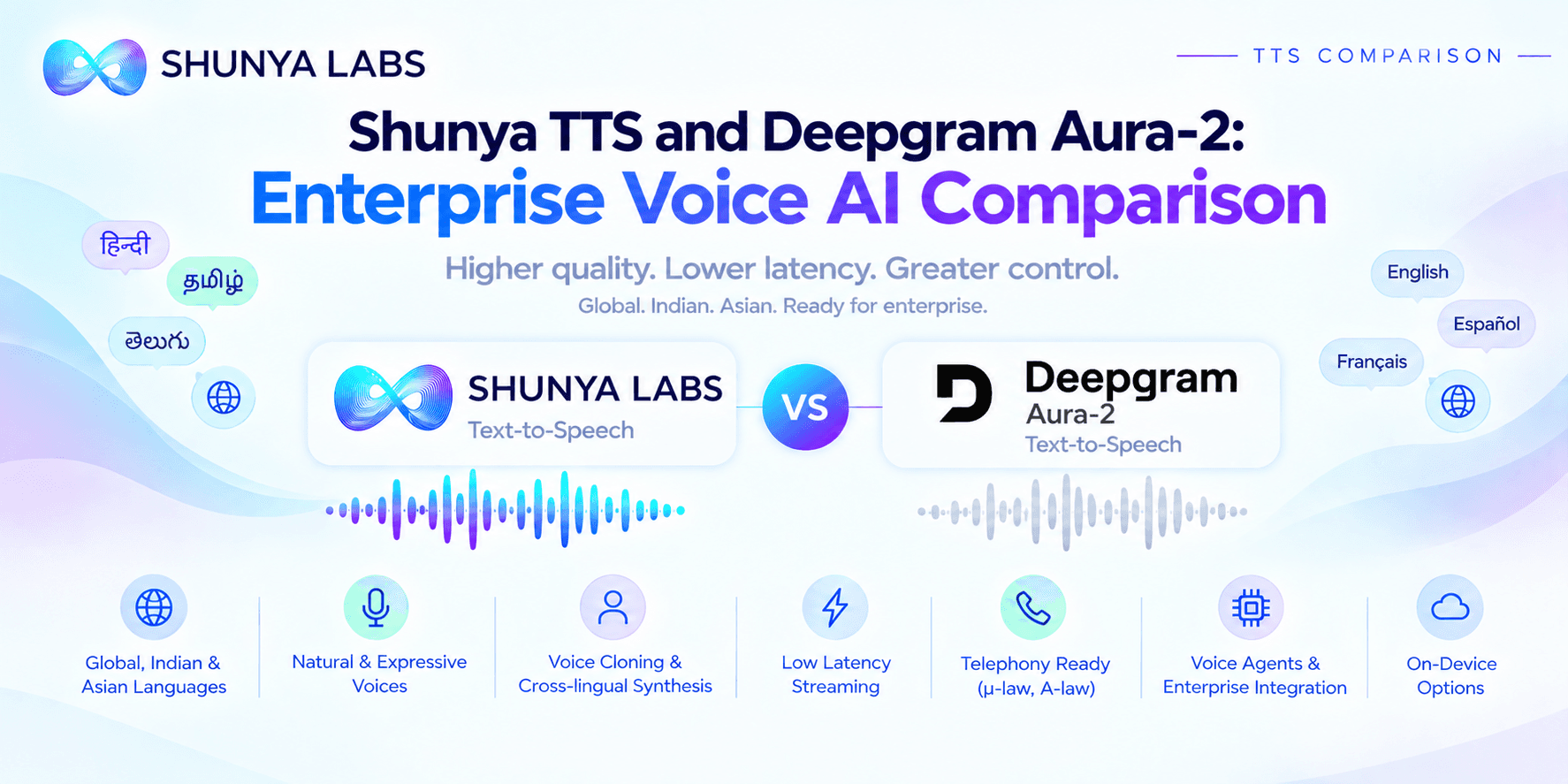
TL;DR , Key Takeaways:
- Deepgram Aura-2 is Deepgram’s widest-language TTS model, covering seven languages, while newer Flux TTSis currently Deepgram’s recommended model for English voice-agent applications.
- Aura-2 provides multiple voices across English, Spanish, German, French, Dutch, Italian, and Japanese, with Spanish voices supporting English-Spanish code-switching.
- Deepgram’s current Aura-2 pricing is $0.030 per 1,000 characters, or roughly $30 per 1 million characters on pay-as-you-go.
- Shunya Zero TTS provides global, Asian, and 23 Indic language applications, with 46 voices across 23 Indic languages plus English.
- Shunya supports 11 expression styles, cross-lingual voice synthesis, 3–6 second voice-cloning reference audio, and first audio in under 350 ms for its documented streaming TTS path.
- Deepgram provides fine-grained speed and pronunciation controls for Aura-2 in English and Spanish.
- Deepgram’s newer Flux TTS is streaming-first and voice-agent-first, with turn lifecycle management, cross-turn voice consistency, interruption handling, and raw telephony-friendly audio formats.
- Shunya is especially relevant when Indic languages, multilingual enterprise voice identity, telephony, and broader voice-AI infrastructure are important.
- Deepgram is particularly compelling when low-latency conversational English, Deepgram’s STT + TTS stack, and voice-agent infrastructure are central to the application.
Deepgram Aura was originally introduced as a real-time, conversational text-to-speech system for voice AI agents, with a strong emphasis on the three things that matter most in production voice: speed, quality, and efficiency.
Since then, the Deepgram TTS stack has evolved.
Today, Aura-2 is Deepgram’s broadest-language TTS model, supporting English, Spanish, German, French, Dutch, Italian, and Japanese, while Flux TTS is now Deepgram’s newest voice-agent-first model for English and became generally available in August 2026.
That makes a current comparison with Deepgram a little more nuanced.
For multilingual TTS, Aura-2 is the relevant Deepgram model.
For English-first realtime voice agents, Deepgram now recommends Flux.
Shunya approaches the problem from a different direction. Its TTS stack combines global, Asian, and 23 Indic language applications, with 46 voices across 23 Indic languages plus English, cross-lingual synthesis, expressive styles, voice cloning, streaming, and telephony support.
The useful question for an enterprise is therefore not simply which TTS model sounds better.
It is:
Which speech stack fits your languages, conversations, infrastructure, and production requirements?
Deepgram Aura has evolved beyond the original model
The original Deepgram Aura was designed around real-time conversational speech, especially for AI agents, customer service, and high-throughput voice applications.
The current Deepgram architecture separates that offering into two generations.
Aura-2 is the multilingual model.
Flux TTS is the newer conversational model for English.
Deepgram describes Flux as streaming-first, turn-based, expressive by default, and designed specifically for voice-agent pipelines. It can maintain voice consistency across turns and report exactly what was spoken before an interruption, which is useful for barge-in handling.
Aura-2 remains important because it supports the languages that Flux does not currently cover.
So when someone searches for Deepgram Aura, there are effectively two things to understand today:
Aura-2 for multilingual synthesis
and
Flux for the newest English realtime voice-agent experience.
Shunya approaches TTS as part of a wider voice stack
Shunya’s Zero TTS is built around production voice applications rather than only standalone speech generation.
The current documentation lists:
46 speaker voices
23 Indic languages plus English
11 expression styles
Cross-lingual synthesis
Voice cloning
Batch and streaming TTS
and support for common web and telephony formats.
Shunya also supports an extended set of world languages, including Japanese, Korean, Chinese, Arabic, French, German, Italian, and others, beyond its named Indic voice catalogue.
The broader Shunya Platform connects TTS with STT, speech intelligence, voice agents, and custom SLMs.
That distinction matters when speech is not an isolated API call.
For example:
Customer speaks → STT → reasoning → TTS → phone call
or:
Customer speaks → STT → enterprise knowledge → voice agent → TTS
In these systems, the TTS model has to fit into the complete conversation loop.
Voice quality is about difficult production text
A basic TTS test is easy:
“Welcome to customer support.”
A production workload is not.
Consider:
“Your payment of ₹1,25,499.50 for order AX-2047 has been successfully processed.”
Now the system needs to correctly handle:
Currency
Numbers
Order IDs
Punctuation
Pronunciation
Pausing
Deepgram explicitly provides pronunciation controls in Aura-2, including the ability to override pronunciation using IPA, and speed controls for English and Spanish. These controls are designed for brand names, industry terminology, and other difficult text.
Deepgram’s prompting documentation also covers pronunciation strategies for numbers, acronyms, foreign words, and custom pronunciations.
Shunya’s TTS API also exposes a language parameter specifically to improve preprocessing of numbers, dates, and script-specific rules, which becomes particularly important for languages such as Hindi and Marathi that share scripts.
For enterprise TTS, this is more important than a generic “human-like” claim.
Indic voice quality is a different requirement
Deepgram currently supports English, Spanish, German, French, Dutch, Italian, and Japanese through Aura-2.
Its English voice catalogue includes a range of accents and characteristics, and its current Flux catalogue includes an Indian-accented English voice, Priya.
But Indian English is not the same problem as Indian-language TTS.
An enterprise serving India may need:
Hindi
Tamil
Telugu
Bengali
Marathi
Gujarati
Punjabi
and many other regional languages and mixed-language conversations.
Shunya’s Zero TTS Indic is specifically designed around Indian phonetics, regional pronunciation, accents, dialects, and mixed-language speech. Its current TTS documentation lists 23 Indic languages with 46 named voices.
That makes this a key architectural difference.
Deepgram has a strong multilingual TTS catalogue.
Shunya puts much more emphasis on Indic voice infrastructure within a broader global and Asian TTS system.
Multilingual voice identity matters for global enterprises
Suppose a company creates a recognizable customer-support voice.
The application starts in English.
The customer switches to Hindi.
Later, the same customer switches to Tamil.
A multilingual voice system should ideally preserve:
Timbre
Speaking personality
Prosody
Brand identity
Shunya explicitly supports this model. Its documentation states that every voice can speak every supported language, enabling cross-lingual synthesis using the same speaker identity.
Deepgram’s multilingual model coverage is broader than a single-language system, and selected Aura-2 Spanish voices support English-Spanish code-switching.
But its current Aura-2 language architecture is still a collection of language-specific model and voice options rather than a 23-language Indic voice system.
For an enterprise with a primarily European or English-speaking audience, that distinction may not matter.
For an enterprise serving India and Asian markets, it can matter considerably.
Expression and conversational delivery
Deepgram’s newer Flux TTS is explicitly described as expressive by default and built around conversation. Its architecture supports turn lifecycle, cross-turn voice consistency, and interruption-aware voice agents.
That is an important shift from conventional TTS.
The goal is no longer only:
Text → Speech
It becomes:
Conversation → Context → Speech
Shunya provides a more explicit style system with 11 expression styles, including Happy, Sad, News, Narrative, Conversational, and Enthusiastic, alongside other emotional styles.
That makes the two approaches somewhat different.
Deepgram Flux: conversation-native generation.
Shunya Zero TTS: structured expression and voice control.
For an AI voice agent, the most important test is whether a voice responds appropriately when the conversation changes.
A customer saying:
“That’s great, thank you!”
should not receive the same delivery as:
“I’ve already called twice about this.”
Prosody needs to change with context.
Realtime TTS is where Deepgram has a strong architecture
Deepgram’s current Flux TTS is specifically designed for realtime voice agents.
Its /v2/speak WebSocket supports:
Streaming
Turn-based lifecycle
Cross-turn voice consistency
Interruption handling
Raw PCM
μ-law
A-law
This makes the model particularly suitable for voice agents and telephony.
Aura-2 also supports streaming and can be used in Voice Agent workflows.
Shunya provides WebSocket streaming TTS, with its documentation reporting first audio in under 350 ms and describing a direct LLM → TTS pipeline for low-latency voice agents.
The key point is that raw TTS latency isn’t the final metric.
Measure:
User stops speaking
→ STT detects the turn
→ LLM starts producing
→ TTS receives text
→ First audio reaches the user
That’s the latency that matters in a real conversation.
Telephony is a major production consideration
Voice AI often ends up on a phone call.
That changes the technical requirements.
Deepgram Flux’s streaming transport directly supports μ-law and A-law, along with multiple PCM sample rates, making it well suited to realtime audio and telephony pipelines.
Aura also supports compressed and containerized output formats, which Deepgram specifically describes as one of Aura’s strengths inside the Voice Agent API.
Shunya provides PCM, WAV, MP3, OGG Opus, FLAC, μ-law, and A-law through its TTS API.
For a contact center or IVR, don’t benchmark TTS only through headphones.
Test it through the actual:
SIP / telephony provider
Codec
Audio pipeline
Network
and measure customer-perceived latency and intelligibility.
Pronunciation controls can make or break enterprise TTS
Deepgram provides particularly useful controls here.
Aura-2 supports:
Speed control
Pronunciation override
and pronunciation overrides can use IPA notation for difficult words.
This is especially useful for:
Drug names
Company names
Acronyms
Product names
Technical terminology
Deepgram’s documentation explicitly positions these controls for enterprise use cases requiring precise pronunciation of industry-specific terminology and brand names.
Shunya’s TTS API also provides language-aware preprocessing, speed control, and voice selection, while its broader Indic stack is designed around regional pronunciation.
For a production evaluation, create a pronunciation test set rather than relying on generic sentences.
Include:
Customer names
Indian place names
Drug names
Bank names
Acronyms
Currency
Product SKUs
Order IDs
Then score exact pronunciation.
Voice cloning is another major difference
Shunya provides voice cloning from a short 3–6 second reference clip, with the clone available across its supported Indic language set.
This can be useful when the requirement is:
One brand voice
Across multiple languages
Without recording separate voices for each language
Deepgram’s current Aura documentation focuses on its pre-built voice catalogue rather than presenting Aura-2 as a self-service voice-cloning platform.
That distinction is useful when voice identity is a core product requirement.
For enterprises, cloning also needs a proper governance process.
The important questions are:
Who owns the source voice?
Was consent obtained?
Where is the reference audio stored?
Can the voice be used across languages?
Can the voice be deployed privately?
These questions matter as much as similarity.
Deployment can change the buying decision
Deepgram provides self-hosting options for Aura-2, with deployment configurations for English and Spanish services and GPU-based deployment requirements documented for its self-hosted TTS stack.
That is important for enterprises that need greater control over infrastructure.
Shunya also offers self-hosted and on-device deployment options on Enterprise, alongside cloud APIs.
This creates a useful evaluation axis beyond model quality:
Cloud only
Private infrastructure
Self-hosted
Edge / on-device
The right architecture depends on the application’s latency, data, regulatory, and connectivity requirements.
Pricing
Deepgram’s current published TTS pricing is:
| Model | Pay-as-you-go |
|---|---|
| Flux TTS | $0.045 / 1K characters |
| Aura-2 | $0.030 / 1K characters |
| Aura-1 | $0.015 / 1K characters |
Deepgram states that these standard rates apply from September 13, 2026, following the introductory Flux pricing period.
That puts Aura-2 at roughly:
$30 per 1 million characters
Shunya currently lists:
$5.26 per 1 million characters
for Zero TTS pay-as-you-go, with $4.74 per million characters at volume pricing. Enterprise plans have custom pricing and self-hosted options.
Pricing alone should not determine the platform.
A production voice system also incurs:
STT
LLM / SLM
TTS
Telephony
Infrastructure
Concurrency
Voice cloning
The meaningful metric is cost per completed interaction, not simply cost per million characters.
Where Deepgram stands out
Deepgram is particularly compelling when you need:
A strong speech infrastructure provider
Deepgram combines STT and TTS within a broader speech platform.
Realtime voice agents
Flux is explicitly designed around streaming, turns, interruptions, and conversational consistency.
English conversational voice
Deepgram currently positions Flux as its recommended model for English voice-agent applications.
Pronunciation control
Aura-2 provides runtime pronunciation and speed controls for English and Spanish.
Multilingual European and Asian TTS
Aura-2 currently supports English, Spanish, German, French, Dutch, Italian, and Japanese.
Self-hosted speech
Deepgram documents self-hosted Aura-2 deployments for supported languages.
Where Shunya fits differently
Shunya is particularly relevant when you need:
Global, Asian, and 23 Indic language applications
The documented TTS catalogue includes 46 voices across 23 Indic languages plus English, while the broader service supports additional world languages.
Indic voice specialization
Zero TTS Indic is built around Indian phonetics, regional pronunciation, accents, and local speech patterns.
One voice across languages
Shunya’s TTS architecture supports cross-lingual synthesis with the same voice identity across supported languages.
Short-reference voice cloning
Voice cloning uses a 3–6 second reference clip in the documented TTS workflow.
Enterprise telephony
μ-law and A-law are available directly through the TTS API.
Broader voice AI
TTS can sit alongside STT, speech intelligence, voice agents, and custom SLMs through the Shunya Platform.
Private and edge deployment
Enterprise plans include self-hosted and on-device options.
Shunya TTS and Deepgram by use case
| Use case | Deepgram | Shunya |
|---|---|---|
| General enterprise TTS | Strong fit | Strong fit |
| English realtime voice agents | Flux | Strong fit |
| Multilingual TTS | Aura-2 | Strong fit |
| Indic languages | Limited current Aura-2 coverage | Core capability |
| Asian language TTS | Japanese | Broader Asian coverage |
| Cross-lingual voice identity | More model-dependent | Core capability |
| Pronunciation controls | Strong | Strong |
| Voice cloning | Not an Aura-2 focus | Yes |
| Expressive styles | Flux / voice controls | 11 styles |
| Turn-aware voice agents | Flux | Voice-agent integration |
| Telephony | Strong | Strong |
| Self-hosting | Aura-2 | Enterprise |
| On-device | Product dependent | Available through Enterprise |
| STT + TTS stack | Deepgram | Shunya |
| Indian enterprise voice | Limited Aura-2 language coverage | Core use case |
This table describes documented capabilities and intended positioning. Actual speech quality should be validated with your own workload.
How to benchmark Deepgram Aura-2 against Shunya
Start with real production text, not benchmark sentences designed to make every system sound good.
Build a test set with:
Indian names
Currency
Dates
Numbers
Product names
Acronyms
Medical terms
Order IDs
Long customer responses
English + Indian-language code-switching
For each platform, measure:
Naturalness
Does speech remain natural during both short responses and longer conversations?
Pronunciation
Are names, numbers, brands, and technical terms pronounced correctly?
Expression
Does the voice respond appropriately to the emotional context?
Multilingual consistency
Does the voice retain its identity when the language changes?
TTS latency
Measure time to first audio, but also measure full voice-agent latency.
Interruption handling
For realtime agents, measure how naturally the system handles:
barge-in
stop speaking
resume
new turn
Telephony quality
Test through your actual phone stack.
Cost
Calculate your expected spend at:
1 million characters
10 million characters
100 million characters
and your expected concurrent calls.
The resulting benchmark will be much more useful than a single “most human TTS” score.
Final words
Deepgram Aura remains an important part of the modern conversational TTS landscape, but its current architecture is different from when Aura was first launched.
Today, Aura-2 is Deepgram’s broadest-language TTS model, covering seven languages, while Flux TTS is the newer streaming-first model designed specifically for English voice agents, with turn management, interruption handling, and cross-turn voice consistency.
Deepgram’s strengths are particularly visible in realtime speech infrastructure, English conversational voice, pronunciation control, telephony-friendly streaming, and tight integration between speech recognition and speech synthesis.
Shunya takes a different route.
Its TTS stack combines global, Asian, and 23 Indic language applications, 46 voices across 23 Indic languages plus English, cross-lingual voice identity, 11 expression styles, short-reference voice cloning, streaming, telephony formats, and a wider voice-AI platform.
For an enterprise whose primary requirement is English-first realtime voice agents, Deepgram’s current Flux architecture deserves serious evaluation.
For an enterprise that needs Indic speech, Asian and multilingual voice experiences, cross-lingual brand identity, telephony, voice cloning, and a broader speech platform, Shunya presents a different production architecture.
The right evaluation should therefore start with your workload.
Take the same:
Text
Language
Voice
Agent
Telephony path
and traffic profile
and test both systems.
Because the best production TTS is not necessarily the voice that sounds most impressive in a demo.
It is the voice that stays natural, accurate, responsive, and reliable when your customers actually start talking to it.
Frequently asked questions
What is Deepgram Aura?
Deepgram Aura is Deepgram’s text-to-speech family originally built for real-time conversational AI agents. The current family includes Aura-2, while Deepgram’s newer Flux TTS is now its recommended English voice-agent model.
Is Shunya an alternative to Deepgram Aura?
Yes. Shunya provides production TTS for global, Asian, and 23 Indic language applications, with 46 documented voices across 23 Indic languages plus English, cross-lingual synthesis, voice cloning, expression styles, streaming, and telephony support.
How many languages does Deepgram Aura-2 support?
Aura-2 currently supports English, Spanish, German, French, Dutch, Italian, and Japanese.
Does Deepgram support Indian languages?
Aura-2’s current listed language set does not include Hindi or other Indic-language TTS. Deepgram’s newer Flux catalogue does include an Indian-accented English voice, Priya, but Indian-accented English is different from Indic-language TTS.
Does Shunya support Indian languages?
Yes. Shunya’s current TTS documentation lists 23 Indic languages and 46 voices, with named male and female voices for each language.
Does Deepgram Aura support pronunciation control?
Yes. Aura-2 provides runtime speed and pronunciation controls in English and Spanish, including IPA-based pronunciation overrides.
Does Shunya support pronunciation control?
Yes. Shunya provides language-aware preprocessing and controls for speed and output behavior, with its Indic stack designed around regional pronunciation and language-specific speech rules.
Does Deepgram support voice cloning?
Voice cloning is not presented as a core Aura-2 capability in Deepgram’s current Aura documentation. Its current TTS documentation primarily focuses on its built-in voice catalog and language models.
Does Shunya support voice cloning?
Yes. Shunya documents 3–6 second reference audio for voice cloning, with cross-lingual synthesis across its supported Indic languages.
Does Deepgram support realtime TTS?
Yes. Deepgram’s current Flux TTS is explicitly designed for realtime voice agents and streams through WebSocket, while Aura-2 remains available through the Aura TTS interfaces.
Does Shunya support realtime TTS?
Yes. Shunya provides WebSocket streaming TTS and documents first audio in under 350 ms for its streaming TTS path.
Does Deepgram support telephony?
Yes. Flux TTS directly supports μ-law and A-law streaming output, while Aura supports compressed and containerized audio formats within the Voice Agent API.
Does Shunya support telephony?
Yes. Shunya supports μ-law and A-law in addition to PCM, WAV, MP3, OGG Opus, and FLAC.
What is Deepgram Aura-2 pricing?
Deepgram currently lists Aura-2 at $0.030 per 1,000 characters, or approximately $30 per million characters on pay-as-you-go pricing.
What is Shunya TTS pricing?
Shunya currently lists Zero TTS at $5.26 per million characters on pay-as-you-go pricing, with volume pricing at $4.74 per million characters and custom Enterprise plans.
Which should enterprises evaluate?
The practical choice depends on your languages, voice-agent architecture, pronunciation requirements, latency, telephony setup, deployment model, and usage volume. Benchmark both against the actual workload rather than relying on generic TTS rankings.

Bio: Navvya works at the intersection of product strategy and applied AI research at Shunya Labs. With a background in human behaviour and communication, she writes about the people, markets, and technology behind voice AI, with a particular focus on how speech interfaces are reshaping access across emerging markets.