

Shunya TTS and Murf AI: Enterprise Text-to-Speech Comparison
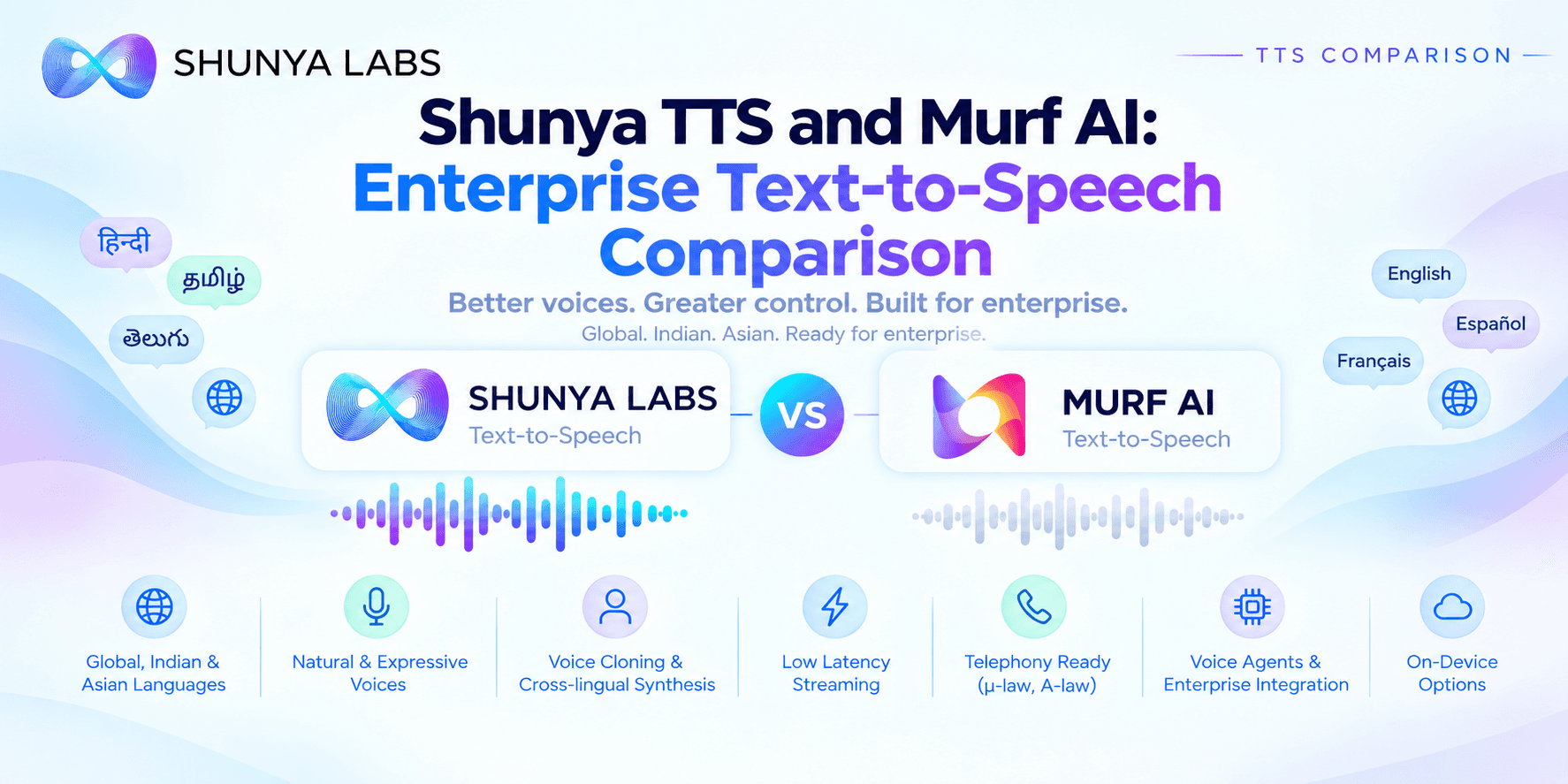
TL;DR , Key Takeaways:
- Murf currently offers 150+ voices across 35+ languages and 20+ expressive styles, with Falcon 2 for realtime TTS and Gen2 for studio-quality synthesis.
- Falcon 2 is Murf’s current streaming model and is designed for voice agents, customer support, IVR, and other conversational applications, with Murf documenting time-to-first-audio around 100 ms.
- Murf supports multilingual voices, allowing a voice to switch between supported locales while preserving language-specific pronunciation patterns.
- Murf’s current API supports MP3, WAV, FLAC, ALAW, ULAW, OGG, and PCM, making it suitable for both web and telephony workflows.
- Murf’s Enterprise API now supports instant voice cloning from a short reference recording of up to 30 seconds, and cloned voices can be used across Falcon 2’s supported locales.
- Shunya provides global, Asian, and 23 Indic language applications, with 46 voices across 23 Indic languages plus English, 11 expression styles, and cross-lingual synthesis.
- Shunya documents 3–6 second voice-cloning reference audio, WebSocket streaming, and first audio in under 350 ms for its streaming TTS path.
- Murf’s current Falcon 2 pricing is $0.01 per 1,000 characters, while Shunya’s current Zero TTS pricing is $5.26 per 1 million characters on pay-as-you-go.
- Murf is particularly relevant when you need large voice choice, polished voiceover controls, multilingual delivery, and very low-latency Falcon streaming.
- Shunya is particularly relevant when Indic speech, global + Asian + Indic voice deployment, cross-lingual voice identity, telephony, and a broader enterprise voice stack are central.
Murf has become a well-known AI voice platform for voiceovers, multilingual speech, expressive narration, and conversational AI. Its current API combines a large voice catalogue with Falcon 2, a newer streaming model built specifically for realtime applications, and Gen2 for more customizable studio-style synthesis.
The biggest recent change is Falcon 2. Murf positions it as an ultra-low-latency model for voice agents, customer support, IVR, and other realtime applications, with time-to-first-audio around 100 ms.
Shunya approaches TTS from a different angle.
Its Zero TTS stack is designed for global, Asian, and 23 Indic languages, with 46 voices across 23 Indic languages plus English, cross-lingual synthesis, expressive styles, voice cloning, streaming, telephony formats, and integration with a wider voice-AI platform.
For enterprise teams, the question is therefore not simply:
Which platform has more voices?
It is:
Which platform fits the languages, latency, pronunciation, voice identity, and deployment requirements of your production application?
Murf is now two different TTS experiences
Murf’s current API effectively has two different jobs.
Falcon 2 is the realtime option.
Gen2 remains the more customizable option for non-streaming synthesis.
Falcon 2 is designed around live conversations. Murf describes it as optimized for customer support agents, IVRs, sales qualification, healthcare assistants, and other realtime applications.
Gen2, meanwhile, offers more detailed controls over voice, style, pitch, rate, locale, and variation, making it useful for voiceovers and other recorded content.
That division matters.
A TTS system for:
YouTube narration
does not have the same constraints as one powering:
a live customer-support call.
Murf gives developers a model for each.
Shunya takes a speech-first enterprise approach
Shunya’s Zero TTS is similarly designed around different production modes.
The TTS documentation supports both batch and streaming synthesis, while the streaming layer is built specifically for low-latency voice applications.
The current documented TTS stack includes:
46 speaker voices
23 Indic languages plus English
11 expression styles
Cross-lingual synthesis
Voice cloning
Streaming
Telephony audio formats
Shunya is also integrated with broader voice infrastructure, including STT, speech intelligence, voice agents, and custom SLMs.
That makes it particularly useful when TTS isn’t a standalone feature.
Voice catalogue: Murf has scale, Shunya focuses on multilingual identity
Murf currently advertises 150+ voices across 35+ languages and 20+ speaking styles.
Its catalogue spans different accents, genders, ages, and styles. The API also allows developers to choose specific voices and supported locales.
This is useful when teams want a large selection.
Shunya’s catalogue is smaller, with 46 named voices across 23 Indic languages plus English.
But its key differentiator is not catalogue size.
Shunya documents the ability for the same voice to speak across supported languages, allowing the vocal identity to remain consistent while the language changes.
For a global enterprise, these are different priorities.
Murf gives you:
more voice choice
Shunya gives you:
a strong multilingual identity architecture
Multilingual TTS is about more than switching languages
Murf’s multilingual technology is designed to let voices speak across supported locales while maintaining pronunciation patterns that are specific to the target language.
That is especially useful for global content teams.
Shunya’s system is more explicitly centered on global, Asian, and Indic use cases, with 23 Indic languages and a voice architecture where every supported voice can speak across the language set.
This becomes particularly important for Indian enterprise applications.
Consider:
“Aapka payment of ₹24,500 has been successfully processed.”
A real production TTS system needs to handle:
Hindi
English
Currency
Numbers
Code-switching
Natural pacing
Shunya’s documentation specifically describes mixed-language handling and notes that its model can process code-switched text without requiring a language tag.
For Indian customer-service applications, that can be more important than a simple count of supported languages.
Indian speech deserves its own benchmark
Murf has a meaningful Indian-language offering.
Its current voice catalogue includes Indian English voices and Hindi voices, alongside multilingual voices that can support Indian locales.
Shunya’s Zero TTS Indic is designed specifically around Indian phonetics, regional pronunciation, accents, dialects, and local speech patterns.
Its voice set covers, among others:
Hindi
Tamil
Telugu
Bengali
Marathi
Gujarati
Punjabi
Malayalam
and other Indic languages, with male and female voices for each of the 23 documented languages.
So when evaluating Murf against Shunya for India, don’t ask only:
“Does it support Hindi?”
Test:
Indian names
Indian places
Currency
Dates
Hinglish
Regional terminology
Mixed scripts
That produces a much more meaningful comparison.
Falcon 2 makes Murf highly relevant to realtime voice agents
Murf’s current Falcon 2 release is one of the most important parts of this comparison.
Murf reports around 100 ms time-to-first-audio, and specifically positions Falcon 2 for conversational AI and realtime voice agents.
It also supports WebSocket streaming and regional endpoints, including India, South Korea, Japan, Europe, and other regions.
Murf says Falcon 2 can support 10,000+ concurrent calls in parallel, although actual enterprise capacity depends on deployment and account configuration.
Shunya’s current documentation reports under 350 ms first audio for streaming TTS and describes an LLM → TTSsentence-first streaming pipeline.
Those numbers aren’t directly interchangeable.
One vendor’s time-to-first-audio measurement may use a different test setup from another’s.
For a production voice agent, benchmark:
User stops speaking
→ STT
→ Reasoning
→ TTS
→ First audible response
That end-to-end number is what users experience.
Expression and voice control
Murf has traditionally been strong on voice customization.
Its Gen2 system exposes controls for:
Style
Pitch
Rate
Variation
Locale
and multiple voice-specific styles such as conversational, narration, promo, newscast, calm, sad, and more.
Falcon 2 also supports voice, style, pitch, speed, and locale controls in streaming mode.
Shunya takes a more structured expression approach with 11 styles, including:
Conversational
Narrative
News
Happy
Sad
Angry
Fearful
Surprised
Enthusiastic
and others.
Both can produce expressive speech.
The difference is more about how your application controls it.
Murf: detailed voice customization and style controls.
Shunya: structured expressions combined with multilingual voice identity.
Voice cloning
Murf’s current Enterprise API supports instant voice cloning from a short reference recording of up to 30 seconds. Murf’s current documentation says the cloned voice can then be used with Falcon 2, and the clone can speak across Falcon 2’s supported locales.
That’s useful for:
Brand voices
Customer-service agents
Digital presenters
Localized content
Shunya documents a shorter 3–6 second reference clip for voice cloning and says the clone works across its supported Indic languages.
So the architectures differ.
Murf:
short recording → enterprise clone → Falcon 2
Shunya:
3–6 second reference → multilingual clone
The important benchmark is not how quickly a clone is created.
Measure:
Timbre similarity
Pronunciation
Prosody
Accent
Long-form consistency
Cross-lingual consistency
And voice cloning should always be used with the appropriate speaker consent and rights.
Telephony support
Murf provides a strong telephony-oriented stack.
Its streaming API supports:
ALAW
ULAW
PCM
WAV
MP3
FLAC
OGG
It also provides regional streaming endpoints, including an India endpoint, and directly positions Falcon 2 for IVR and voice-agent applications.
Shunya supports the same key telephony formats, including μ-law and A-law, alongside PCM, WAV, MP3, OGG Opus, and FLAC.
For contact centers, the better test is an actual call.
Measure:
first response latency
clarity
pronunciation
barge-in
turn-taking
audio quality after telephony encoding
A TTS demo in a browser does not tell you how the voice behaves on a phone call.
Deployment and data residency
Murf provides regional endpoints and says Enterprise customers can use isolated regional environments for its streaming and WebSocket TTS APIs.
Murf’s Falcon 2 documentation also describes regional deployment as useful for data residency and compliancerequirements.
Shunya provides cloud, private infrastructure, and edge deployment through its Enterprise offering. Its platform documentation describes cloud deployment, private infrastructure, and lightweight edge voice packs.
This matters for enterprises in:
BFSI
Healthcare
Government
Telecom
where deployment architecture can be as important as the model itself.
Pricing
Murf currently lists Falcon 2 at $0.01 per 1,000 characters, which works out to approximately:
$10 per 1 million characters
Murf also offers a 100,000-character free API trial. Its pay-as-you-go plan is currently listed at $0.03 per 1,000 characters, while Falcon 2 itself is separately documented at $0.01 per 1,000 characters.
Shunya currently lists:
$5.26 per 1 million characters for Zero TTS
with volume pricing of:
$4.74 per 1 million characters.
The meaningful comparison isn’t just the headline number.
Calculate:
Cost per million characters
Cost per generated minute
Voice-agent concurrency
STT
LLM / SLM
Telephony
Deployment
The real metric is cost per completed customer interaction.
Where Murf stands out
Murf is particularly relevant when you need:
A large voice library
Murf offers 150+ voices across 35+ languages and 20+ styles.
Realtime voice agents
Falcon 2 is specifically built for low-latency conversational applications, with around 100 ms time-to-first-audio according to Murf.
Detailed voice customization
Gen2 provides style, rate, pitch, locale, and variation controls.
Multilingual voice identity
Murf’s multilingual technology lets supported voices speak multiple locales while preserving language-specific pronunciation patterns.
Enterprise voice cloning
Murf now supports short-reference instant voice cloning through Falcon 2 for Enterprise customers.
Regional infrastructure
Murf provides geographically distributed streaming endpoints, including India, South Korea, Japan, Europe, and other regions.
Where Shunya fits differently
Shunya is particularly relevant when you need:
Global, Asian, and 23 Indic languages
The documented Zero TTS stack provides 46 voices across 23 Indic languages plus English, while the broader platform supports global and Asian voice applications.
Indic-focused speech
Zero TTS Indic is designed around Indian phonetics, regional pronunciation, accents, dialects, and local speech patterns.
Cross-lingual voice identity
The same voice can speak across the supported language set while maintaining its vocal identity.
Short-reference cloning
Shunya documents voice cloning using a 3–6 second reference clip.
Telephony
μ-law and A-law are directly supported.
Broader voice AI
TTS integrates with STT, speech intelligence, voice agents, and custom SLMs through the wider Shunya platform.
Private and edge deployment
Shunya offers cloud, private infrastructure, and edge deployment options through Enterprise.
Shunya TTS and Murf by use case
| Use case | Murf | Shunya |
|---|---|---|
| General enterprise TTS | Strong fit | Strong fit |
| Voiceover and narration | Strong fit | Strong fit |
| Realtime voice agents | Falcon 2 | Strong fit |
| Large voice catalogue | 150+ voices | 46 documented voices |
| Global languages | 35+ languages | Global + Asian + Indic |
| Indic languages | Available | Core focus |
| Asian languages | Available | Strong focus |
| Cross-lingual identity | Supported | Core capability |
| Voice cloning | Enterprise | 3–6 sec reference |
| Expressive styles | 20+ styles | 11 styles |
| Telephony | Strong | Strong |
| μ-law / A-law | Yes | Yes |
| Regional endpoints | Yes | Yes |
| Private deployment | Enterprise | Enterprise |
| Edge deployment | Product-dependent | Available |
| Broader STT + TTS stack | Primarily TTS/voice | STT + TTS + intelligence + agents |
The table reflects documented capabilities and product positioning rather than an overall ranking.
How to benchmark Murf against Shunya
Use your actual production text.
Don’t benchmark only:
“Welcome to customer support.”
Create a test set containing:
Indian names
Currency
Dates
Order IDs
Acronyms
Product names
Medical terminology
Hindi-English code-switching
Regional words
Long conversational responses
Then test:
Naturalness
Does the voice remain natural for short and long conversations?
Pronunciation
Does it correctly pronounce names, brands, numbers, currency, and technical terminology?
Multilingual consistency
Does the same voice remain recognizable when the language changes?
Expression
Can the system distinguish between:
happy
apologetic
concerned
urgent
neutral
Streaming latency
Measure first audio, but also measure complete user-turn latency.
Telephony
Test the actual audio through your production phone provider.
Voice cloning
Use the same speaker reference and compare:
timbre
accent
prosody
cross-lingual consistency
Cost
Calculate the actual cost at:
1M characters
10M characters
100M characters
and at your expected concurrency.
That gives you a much more useful answer than a generic “best AI voice” list.
Final words
Murf and Shunya are both serious enterprise TTS platforms, but they approach the problem from somewhat different directions.
Murf has a broad voice catalogue and a mature voiceover ecosystem, while its current Falcon 2 model moves strongly into realtime voice AI with around 100 ms time-to-first-audio, streaming, multilingual delivery, regional endpoints, and enterprise-scale voice-agent positioning.
Murf is therefore particularly relevant for organizations that need large voice choice, expressive production controls, multilingual content, and fast realtime synthesis.
Shunya is more focused on speech infrastructure for multilingual enterprise applications.
Its TTS stack combines global, Asian, and 23 Indic languages, 46 voices across 23 Indic languages plus English, cross-lingual voice identity, 11 expression styles, short-reference voice cloning, streaming, telephony support, and broader integration with STT, speech intelligence, voice agents, and SLMs.
That distinction becomes important when an enterprise’s voice strategy extends beyond English.
A customer may switch from:
English → Hindi → Hinglish → Tamil
during the same customer journey.
The system needs to keep the voice recognizable, pronounce the content correctly, handle names and numbers, and respond quickly enough to feel conversational.
For applications centered on large voice selection, production narration, and Falcon 2’s realtime performance, Murf offers a strong stack.
For applications where Indic speech, global + Asian multilingual voice experiences, cross-lingual identity, telephony, and a broader voice-AI architecture matter, Shunya offers a different approach.
The most reliable way to compare them is to use the same:
text
languages
voices
agent workflow
telephony stack
and traffic profile.
Because the right enterprise TTS platform isn’t just the one with the most voices.
It is the one that keeps sounding right when the application gets real.
Frequently asked questions
What is Murf AI?
Murf is an AI voice platform offering text-to-speech, voice generation, multilingual speech, voice cloning, streaming, and voice customization. Its current API includes Falcon 2 for realtime applications and Gen2 for more customizable synthesis.
Is Shunya an alternative to Murf?
Yes. Shunya provides TTS for global, Asian, and 23 Indic language applications, with 46 documented voices across 23 Indic languages plus English, cross-lingual synthesis, expression styles, voice cloning, streaming, and telephony support.
How many voices does Murf have?
Murf currently advertises 150+ voices across 35+ languages and 20+ speaking styles.
How many voices does Shunya have?
Shunya’s current TTS documentation lists 46 voices across 23 Indic languages plus English.
Does Murf support realtime TTS?
Yes. Falcon 2 is Murf’s current realtime streaming model and is designed for voice agents, conversational AI, and IVR. Murf documents time-to-first-audio of around 100 ms.
Does Shunya support realtime TTS?
Yes. Shunya supports WebSocket streaming TTS and documents first audio in under 350 ms for its streaming path.
Does Murf support voice cloning?
Yes. Murf currently offers Enterprise Instant Voice Cloning using a short reference recording of up to 30 seconds, with clones available through Falcon 2.
Does Shunya support voice cloning?
Yes. Shunya documents voice cloning from a 3–6 second reference clip with cross-lingual support across its 23 supported Indic languages.
Does Murf support Indian voices?
Yes. Murf’s current catalogue includes Indian English and Hindi voices, alongside multilingual voices supporting multiple locales.
Does Shunya support Indic TTS?
Yes. Shunya’s Zero TTS Indic stack is specifically designed for Indian phonetics, regional pronunciation, accents, dialects, and local speech patterns, with 23 documented Indic languages and 46 voices.
Does Murf support telephony?
Yes. Murf supports ALAW, ULAW, PCM, WAV, MP3, FLAC, and OGG, and its Falcon 2 streaming stack is designed for realtime voice applications and IVR.
Does Shunya support telephony?
Yes. Shunya supports μ-law and A-law alongside PCM, WAV, MP3, OGG Opus, and FLAC.
What is Murf Falcon 2 pricing?
Murf currently lists Falcon 2 at $0.01 per 1,000 characters, or approximately $10 per million characters.
What is Shunya TTS pricing?
Shunya currently lists Zero TTS at $5.26 per million characters pay-as-you-go, with volume pricing at $4.74 per million characters.
Which platform should enterprises evaluate?
Evaluate both using your actual languages, production text, voice requirements, latency targets, telephony stack, deployment model, concurrency, and monthly volume. Those factors are more useful than a generic TTS ranking.

Bio: Navvya works at the intersection of product strategy and applied AI research at Shunya Labs. With a background in human behaviour and communication, she writes about the people, markets, and technology behind voice AI, with a particular focus on how speech interfaces are reshaping access across emerging markets.