

Shunya TTS and OpenAI TTS: A Production Comparison for Enterprise Voice AI
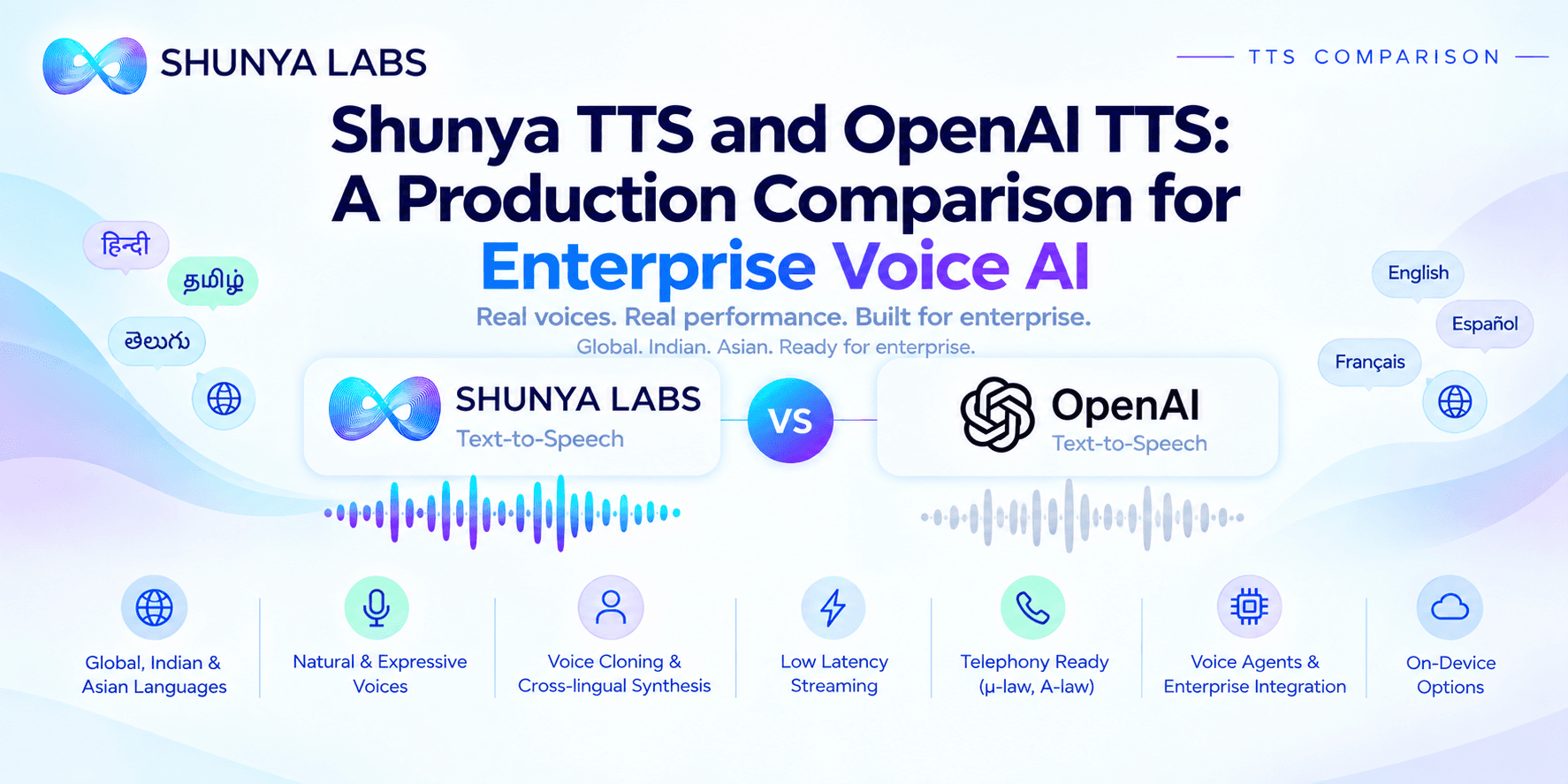
TL;DR , Key Takeaways:
- OpenAI TTS currently offers TTS-1 for speed, TTS-1 HD for quality, and GPT-4o Mini TTS for steerable speech generation.
- GPT-4o Mini TTS lets developers provide natural-language instructions for tone, delivery, and speaking style. Those instructions are not supported by TTS-1 and TTS-1 HD.
- OpenAI’s current Speech API exposes 13 built-in voices, including newer voices such as marin and cedar, plus a custom-voice mechanism for eligible customers.
- Shunya Zero TTS supports global, Asian, and 23 Indic language applications, with 46 named voices across 23 Indic languages plus English, cross-lingual synthesis, expressive styles, voice cloning, and streaming.
- OpenAI’s Speech API accepts inputs up to 4,096 characters and supports MP3, Opus, AAC, FLAC, WAV, and PCM output.
- Shunya’s TTS API supports inputs up to 10,000 characters and adds μ-law and A-law output for telephony alongside common audio formats.
- OpenAI’s published pricing is $15 per 1 million characters for TTS-1 and $30 per 1 million characters for TTS-1 HD. GPT-4o Mini TTS uses token-based pricing.
- Shunya currently lists $5.26 per 1 million characters for Zero TTS on pay-as-you-go pricing, with volume and enterprise pricing available separately.
- OpenAI is especially compelling when the TTS layer needs to sit naturally inside an OpenAI-based application stack.
- Shunya is particularly relevant when multilingual production speech, Indic pronunciation, cross-lingual voice identity, telephony, and a broader enterprise voice stack are central requirements.
OpenAI TTS has become one of the most accessible ways to add speech generation to an AI product. Its current speech-generation API includes TTS-1, TTS-1 HD, and GPT-4o Mini TTS, with the newer GPT-4o Mini TTS model adding natural-language control over how a voice speaks, not just what it says.
That makes OpenAI particularly interesting for developers already building with the OpenAI API.
But production TTS is bigger than generating a natural-sounding sentence.
Enterprise applications may need global, Asian, and Indic languages, regional pronunciation, voice cloning, expressive speech, streaming, telephony audio, predictable costs, and integration with a broader voice-AI stack.
That creates a different comparison.
OpenAI TTS is deeply integrated into a broader AI platform. Shunya is built around production speech and multilingual voice AI.
The right choice depends on what your application needs from the voice layer.
What OpenAI TTS actually offers today
OpenAI’s speech-generation API currently exposes three main TTS model families:
TTS-1, optimized for speed and realtime-oriented text-to-speech.
TTS-1 HD, optimized for higher-quality synthesis.
GPT-4o Mini TTS, powered by GPT-4o Mini and designed for more flexible, instruction-driven speech generation.
That model split is important.
With TTS-1 and TTS-1 HD, the basic workflow is straightforward: provide text, select a voice, and generate audio.
With GPT-4o Mini TTS, developers can also describe the intended delivery using natural-language instructions. OpenAI introduced this specifically to let developers control how the model speaks, enabling use cases such as customer service and expressive narration.
For example, an application can ask for a response to be delivered in a calm customer-support tone rather than relying entirely on fixed SSML-style controls.
That puts OpenAI firmly in the modern LLM-conditioned TTS category.
Shunya approaches TTS from the speech layer
Shunya’s Zero TTS takes a more speech-first approach.
The documented TTS stack provides 46 voices across 23 Indic languages and English, with every named voice able to speak supported languages for cross-lingual synthesis. Shunya also documents 11 expression styles, voice cloning from a short reference recording, streaming synthesis, and multiple audio formats.
Beyond the Indic catalogue, Shunya’s documentation describes support for an extended set of world languages, including Japanese, Korean, Chinese, French, German, Spanish, Arabic, Russian, Vietnamese, and others.
That makes the Shunya proposition less about choosing one generic English voice and more about building multilingual voice experiences that preserve identity across markets.
The biggest difference is how you think about voice
OpenAI starts from a broad AI platform and adds speech generation.
Shunya starts from speech and voice infrastructure and builds outward into voice AI.
That difference becomes visible in the architecture.
A typical OpenAI application might look like:
User → GPT model → TTS
A production Shunya system can be structured as:
User → STT → intelligence / SLM / LLM → TTS → telephony or application
Shunya’s broader platform includes speech-to-text, speech intelligence, voice agents, custom SLMs, and deployment options alongside TTS.
That matters when TTS is only one part of the product.
Voice variety versus voice identity
OpenAI currently exposes 13 built-in voices through the Speech API:
alloy, ash, ballad, coral, echo, fable, onyx, nova, sage, shimmer, verse, marin, and cedar.
These voices are designed to cover different speaking personalities and use cases without requiring users to create or train a voice from scratch.
OpenAI also now exposes custom voices through its audio voice API. Creating one requires an audio sample and a previously uploaded consent recording, and OpenAI notes that custom voices are limited to eligible customers.
Shunya’s model is more language-and-identity oriented.
Its TTS documentation lists 46 named voices across 23 Indic languages plus English, with male and female voices across the catalogue. The same voice can be used across supported languages, which is central to its cross-lingual design.
For an enterprise brand, that creates a useful distinction.
You may want:
Many general-purpose voice personalities
or
One consistent brand voice that travels across languages.
Those are different requirements.
Language support is not the same as language depth
OpenAI’s current TTS API can generate speech with its available voice set and supports multilingual use, but the product is fundamentally organized around a fixed set of synthetic voices rather than a language-specific voice catalogue.
Shunya organizes its TTS around global, Asian, and Indic voice applications, with a documented set of 23 Indic languages plus English and additional world-language synthesis.
This becomes important for applications where language quality is part of the user experience.
Consider:
Hindi with English product names
Tamil with numeric values
Japanese customer support
Korean onboarding
Indian names and place names
The useful test isn’t simply whether the API accepts the language.
The useful test is whether it handles:
Pronunciation
Pacing
Names
Numbers
Currency
Mixed-language text
Regional speech patterns
For Indian enterprise applications, this distinction can matter significantly.
Instruction-based expression is one of OpenAI’s strongest features
GPT-4o Mini TTS introduces a particularly useful interface:
Tell the model how to speak.
OpenAI explicitly supports instructions for controlling the delivery of generated speech.
That makes it natural to build prompts such as:
Speak like a warm but professional customer-support agent.
or:
Read this announcement with confident, energetic delivery.
This approach works well for applications where the LLM already understands the conversational context and should also influence the speech style.
Shunya takes a more structured approach with 11 expression styles, including conversational, narrative, news, happy, sad, angry, fearful, surprised, and enthusiastic delivery.
That can make style control easier to standardize across enterprise applications.
The distinction is essentially:
OpenAI: natural-language steerability.
Shunya: structured production voice styles plus multilingual identity.
Streaming matters when TTS is part of a voice agent
OpenAI’s Speech API supports audio streaming, including SSE streaming for supported models. The API reference also notes that SSE streaming is not supported for TTS-1 and TTS-1 HD.
For full conversational systems, OpenAI also has separate realtime models and APIs designed for live voice interactions. That is important because standalone TTS and realtime speech-to-speech systems are not the same thing.
Shunya provides WebSocket streaming TTS and explicitly documents the architecture for feeding LLM output into TTS at sentence boundaries. Its current documentation reports first audio in under 350 ms for its streaming TTS path.
For a voice agent, however, the benchmark should still be end-to-end:
User stops speaking → STT → reasoning → first TTS audio
That’s the latency the customer actually experiences.
Telephony is a major practical difference
Standard web audio is one thing.
A production IVR or contact center is another.
Telephony systems frequently require audio formats such as μ-law and A-law.
OpenAI’s Speech API currently supports:
MP3
Opus
AAC
FLAC
WAV
PCM
Shunya supports those common formats and also explicitly supports μ-law and A-law, including telephony-oriented workflows.
That matters for:
IVR systems
Contact centers
Outbound calling
Voice bots
Telecom applications
The important question isn’t whether a TTS model sounds great in a browser.
It is whether it still sounds right after passing through the phone network.
Input limits also matter in production
OpenAI’s Speech API currently limits the input field to 4,096 characters.
Shunya’s current TTS documentation lists an input limit of 10,000 characters for the synthesis endpoint.
This isn’t a deciding factor for every application.
For short conversational turns, neither limit is likely to matter.
For:
Long-form narration
Announcements
Education
Document reading
Long customer responses
the difference can affect how your application chunks text.
Voice cloning and consent
OpenAI now provides a custom voice API, but its implementation uses a formal consent recording plus audio sampleworkflow and is restricted to eligible customers.
That approach places clear emphasis on voice ownership and consent.
Shunya’s current TTS API supports cloning from a short reference recording, with the reference audio supplied as part of the synthesis request. Shunya’s documentation describes a 3 to 6 second reference clip and notes that the reference can be used for the request without a separate stored voice registration step.
For enterprise voice cloning, the important evaluation criteria are:
Consent workflow
Voice similarity
Cross-lingual consistency
Reference-audio requirements
Production access
Data handling
The technical quality and governance requirements should be evaluated together.
Pricing is substantially different
OpenAI currently publishes:
| Model | Published pricing | Positioning |
|---|---|---|
| TTS-1 | $15 / 1M characters | Speed-oriented |
| TTS-1 HD | $30 / 1M characters | Quality-oriented |
| GPT-4o Mini TTS | $0.60 / 1M input text tokens + $12 / 1M audio output tokens | Instruction-steerable TTS |
The important point is that GPT-4o Mini TTS is not directly comparable to TTS-1 using a simple per-million-character calculation, because its pricing is token based.
Shunya currently lists:
$5.26 / 1M characters for Zero TTS on pay-as-you-go pricing.
The volume rate is $4.74 / 1M characters, while enterprise customers can receive custom pricing and deployment options.
At large volumes, the difference can become meaningful.
But enterprises should calculate full cost per interaction, including:
STT
LLM or SLM
TTS
voice-agent infrastructure
telephony
concurrency
deployment
rather than comparing TTS unit pricing in isolation.
OpenAI fits naturally when the rest of your stack is OpenAI
There is a clear architectural advantage to keeping multiple layers with the same provider.
OpenAI developers can build around:
GPT models
Speech generation
Realtime models
Transcription
Audio APIs
and related platform infrastructure.
That can simplify development when the application already depends heavily on OpenAI.
For example, an AI assistant that primarily operates through text and occasionally reads responses aloud may have little reason to introduce another speech provider.
Shunya fits naturally when speech is the product
Shunya becomes particularly relevant when the application is fundamentally about voice.
That includes:
Voice agents
Contact centers
IVRs
BFSI
Healthcare
Telecom
Retail
Multilingual assistants
Accessibility
Shunya’s broader stack combines STT, TTS, voice agents, speech intelligence, SLMs, and deployment options, allowing TTS to sit inside a larger voice architecture rather than functioning as an isolated endpoint.
That is particularly useful when you need one speech stack across multiple parts of the application.
Where OpenAI TTS stands out
OpenAI is a particularly strong fit when you need:
OpenAI-native integration
Speech can sit directly alongside GPT models and OpenAI’s realtime and audio capabilities.
Instruction-driven voice control
GPT-4o Mini TTS lets developers specify how speech should be delivered using natural language.
Simple developer workflow
The Speech API provides a straightforward text-to-audio interface with multiple built-in voices and standard audio formats.
Realtime AI infrastructure
OpenAI has a wider realtime audio stack beyond standalone TTS.
Custom voices for eligible customers
OpenAI supports consent-backed custom voice creation through its voice APIs.
Where Shunya fits differently
Shunya is particularly relevant when you need:
Global, Asian, and Indic voice applications
The TTS stack combines broader world-language support with 23 Indic languages plus English and a named voice catalogue.
Cross-lingual voice identity
The same voice can speak across supported languages while maintaining a consistent vocal identity.
Indic-focused pronunciation
Shunya’s TTS stack is specifically built around Indic-language speech and regional pronunciation requirements.
Telephony-ready formats
μ-law and A-law are supported directly.
Voice cloning from short reference audio
Shunya documents short-clip voice cloning as part of the TTS workflow.
A broader enterprise voice stack
TTS can be combined with STT, intelligence, voice agents, custom SLMs, and deployment options.
OpenAI TTS and Shunya by use case
| Use case | OpenAI TTS | Shunya |
|---|---|---|
| OpenAI-native application | Strong fit | Available |
| General-purpose TTS | Strong fit | Strong fit |
| Instruction-driven delivery | Strong fit | Structured styles |
| Global voice applications | Strong fit | Strong fit |
| Asian voice applications | Available | Strong fit |
| Indic voice applications | Available | Strong fit |
| Cross-lingual voice identity | Available | Core capability |
| Voice cloning | Eligible custom voices | Short-reference cloning |
| Realtime applications | Strong realtime stack | Streaming TTS |
| Telephony audio | Requires compatible integration | μ-law / A-law supported |
| OpenAI SDK compatibility | Native | Compatible API surface |
| Broader speech stack | OpenAI audio ecosystem | STT + TTS + intelligence + voice agents + SLMs |
| On-device / private deployment | Depends on product and model | Enterprise deployment options |
The table describes documented platform capabilities, not an overall winner. Actual output quality should be measured using your own production workload.
How to benchmark OpenAI TTS against Shunya
A meaningful benchmark should not use a single sentence.
Create a test set containing:
“Your refund of ₹24,850 will be credited within three to five working days.”
Indian names
Bank names
Product names
Dates
Phone numbers
Order IDs
Medical terms
English mixed with Hindi
English mixed with other Asian languages
Long conversational responses
Then measure:
Naturalness
Does the voice remain natural across short and long responses?
Pronunciation
Does it pronounce names, numbers, brands, currency, and technical terms correctly?
Expression
Can the system communicate calm, reassuring, excited, concerned, or conversational delivery reliably?
Voice consistency
Does the same voice remain recognizable across languages?
Latency
Measure:
time to first audio
and, for a voice agent:
end-to-end user-turn latency.
Telephony quality
Run the same responses through the actual telephony stack rather than evaluating only studio-quality audio.
Cost
Calculate the actual monthly cost at:
1M characters
10M characters
100M characters
and at your expected concurrency.
That benchmark will tell you far more than a generic “most human TTS” comparison.
Final words
OpenAI TTS and Shunya are built around different strengths.
OpenAI offers a highly accessible speech layer inside a broader AI platform, with multiple speech-generation models, built-in voices, natural-language control through GPT-4o Mini TTS, streaming capabilities, and a growing custom-voice system.
That makes it a natural choice for teams already building deeply around OpenAI.
Shunya takes a more speech-first enterprise approach.
Its TTS stack brings together global, Asian, and 23 Indic language applications, 46 named voices across 23 Indic languages plus English, cross-lingual voice identity, expression styles, short-reference voice cloning, streaming, telephony formats, and integration with a broader voice-AI platform.
The difference becomes especially relevant when voice is not an accessory to the application.
It is the application.
For a text-first AI product that occasionally speaks, OpenAI’s integrated ecosystem can make the architecture straightforward.
For multilingual voice agents, contact centers, IVRs, enterprise assistants, and applications where Indic, Asian, telephony, and cross-lingual voice requirements matter, Shunya offers a speech-specific architecture designed around those workloads.
The best way to make the decision is to test the same production text, the same voice-agent workflow, and the same telephony path on both systems.
Because enterprise TTS is not just about how good a voice sounds.
It is about how reliably that voice performs when your customers depend on it.
Frequently asked questions
What is OpenAI TTS?
OpenAI TTS is the speech-generation layer available through the OpenAI API. The current Speech API includes TTS-1, TTS-1 HD, and GPT-4o Mini TTS.
Is Shunya an OpenAI TTS alternative?
Yes. Shunya provides production TTS across global, Asian, and 23 Indic language applications, with multilingual voice identity, expression styles, voice cloning, streaming, and enterprise voice-AI capabilities.
Does OpenAI TTS support voice cloning?
OpenAI currently provides custom voice APIs that require an audio sample and consent recording, with access limited to eligible customers.
Does Shunya support voice cloning?
Yes. Shunya supports voice cloning from a short reference recording, with its documentation describing a 3 to 6 second reference clip for the TTS workflow.
How many voices does OpenAI TTS have?
The current Speech API lists 13 built-in voices, including alloy, ash, ballad, coral, echo, fable, onyx, nova, sage, shimmer, verse, marin, and cedar.
How many voices does Shunya TTS have?
Shunya’s current documentation lists 46 named voices across 23 Indic languages and English. Every named voice can speak supported languages for cross-lingual synthesis.
Does OpenAI TTS support expressive speech?
Yes. GPT-4o Mini TTS supports natural-language instructions that control how generated speech should be delivered.
Does Shunya support expressive speech?
Yes. Shunya provides 11 expression styles, including conversational, narrative, news, happy, sad, angry, fearful, surprised, and enthusiastic delivery.
Does Shunya support telephony TTS?
Yes. Shunya supports μ-law and A-law output in addition to PCM, WAV, MP3, Opus, and FLAC formats.
What is OpenAI TTS pricing?
OpenAI currently lists $15 per million characters for TTS-1 and $30 per million characters for TTS-1 HD. GPT-4o Mini TTS uses token-based input and audio-output pricing.
What is Shunya TTS pricing?
Shunya currently lists $5.26 per million characters for Zero TTS on pay-as-you-go pricing, with lower volume pricing and custom enterprise plans available.
Which should enterprises evaluate?
Evaluate both against your actual languages, production text, latency requirements, voice strategy, telephony stack, deployment requirements, and expected volume. A short voice demo does not capture the requirements of a production voice system.

Bio: Navvya works at the intersection of product strategy and applied AI research at Shunya Labs. With a background in human behaviour and communication, she writes about the people, markets, and technology behind voice AI, with a particular focus on how speech interfaces are reshaping access across emerging markets.