

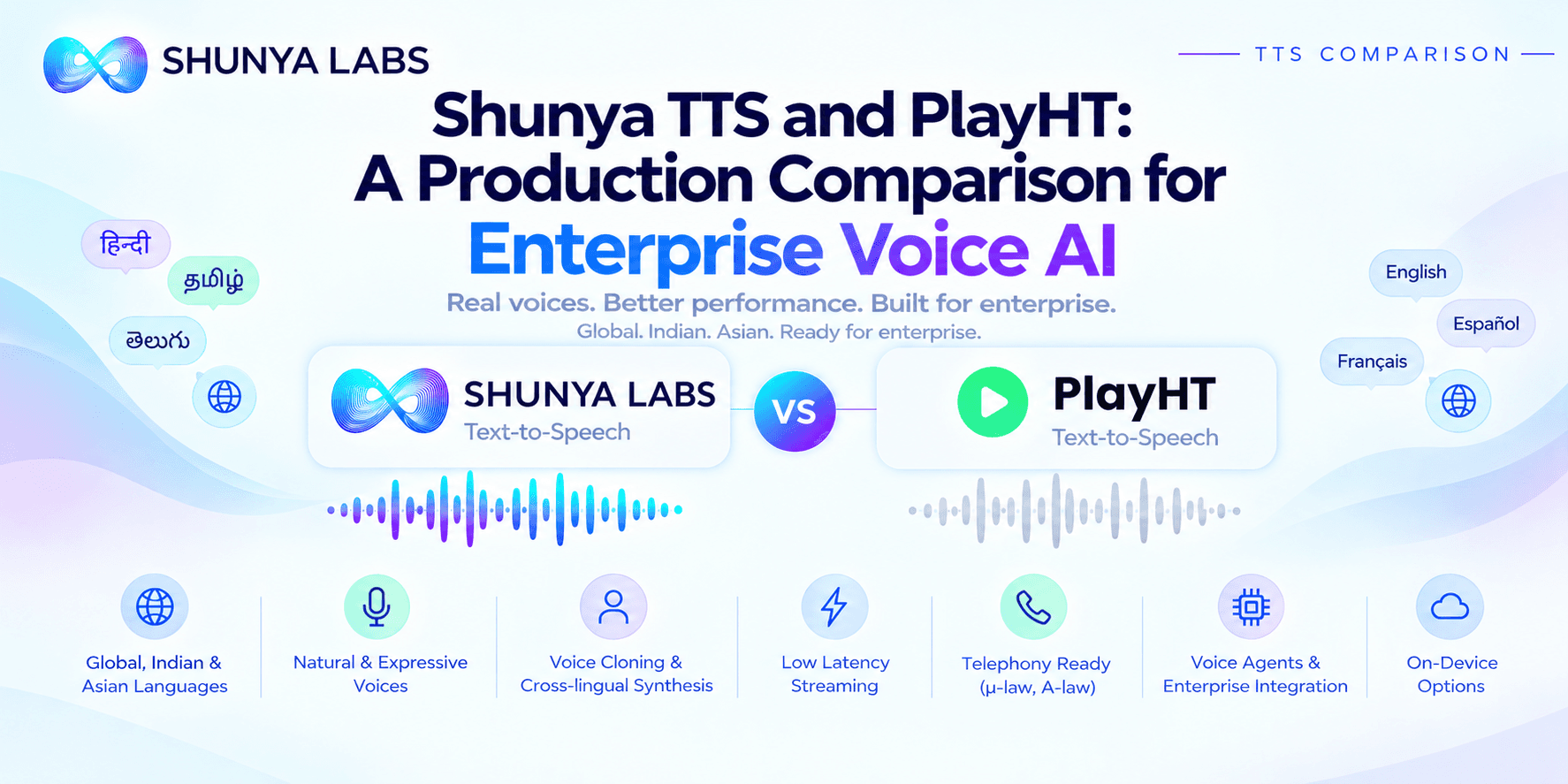
Shunya TTS and PlayHT: A Production Comparison for Enterprise Voice AI
TL;DR , Key Takeaways:
- PlayHT offers several TTS engines, with Play3.0-mini focused on fast multilingual generation and PlayDialog focused on expressive, context-aware conversations.
- Play3.0-mini supports 36 languages, native 48 kHz output, streaming, and a claimed sub-200 ms streaming latency target in the current documentation.
- PlayDialog is designed for multi-turn dialogue, using conversational context to influence prosody, intonation, emotion, and pacing.
- PlayHT supports realtime HTTP streaming, WebSocket/SDK workflows, telephony integrations, multiple audio formats, and voice cloning.
- PlayHT’s current cloning documentation says an instant voice clone can be created from around 30 seconds of speech, with longer audio recommended for higher fidelity.
- Shunya provides global, Asian, and 23 Indic languages, with 46 voices across 23 Indic languages plus English, 11 expression styles, and cross-lingual voice synthesis.
- Shunya supports 3–6 second reference clips for voice cloning and documents first audio in under 350 ms for its streaming TTS path.
- PlayHT has a particularly strong proposition for expressive dialogue, multilingual generation, and voice cloning.
- Shunya is particularly relevant for Indic voice quality, cross-lingual enterprise voices, telephony, and broader voice-AI infrastructure.
- The most meaningful comparison is based on your actual languages, production text, latency, voice strategy, and deployment requirements.
PlayHT has built a strong position in AI voice generation around natural speech, voice cloning, realtime streaming, and conversational audio. Today, its developer stack includes Play3.0-mini for fast multilingual synthesis and PlayDialog for more expressive, context-aware dialogue generation.
That makes PlayHT an interesting choice for applications that need more than basic text-to-speech.
But enterprise TTS has a different set of requirements.
A production voice system may need to handle global, Asian, and 23 Indic languages, regional pronunciation, code-switching, voice identity, realtime conversations, telephony, voice cloning, and deployment across different environments.
This is where Shunya TTS enters the comparison.
Shunya’s TTS platform combines global, Asian, and 23 Indic languages, with 46 voices across 23 Indic languages plus English, cross-lingual synthesis, expressive styles, short-reference voice cloning, streaming, and enterprise voice-AI integration.
The question, therefore, is not simply which platform generates a more human-sounding voice.
It is:
Which TTS architecture fits the way your enterprise actually uses voice?
PlayHT is built around multiple voice-generation engines
One of PlayHT’s biggest strengths is that it does not force every application into a single TTS model.
Its current API exposes multiple engines, including:
Play3.0-mini
PlayDialog
PlayHT2.0
The current PlayHT documentation positions Play3.0-mini as the fast, multilingual option, while PlayDialog is designed for highly expressive and context-aware speech.
The difference is meaningful.
Play3.0-mini is optimized for applications where latency, multilingual generation, and throughput matter.
PlayDialog is designed for situations where the model should understand a conversation’s context and use that context to influence emotion, pacing, prosody, and intonation. It can also generate turn-based dialogue with two voices.
That gives PlayHT a useful range:
Fast TTS
→ Multilingual TTS
→ Expressive dialogue
→ Voice cloning
Shunya approaches the stack somewhat differently, with Zero TTS centered around production multilingual speech and enterprise voice applications.
PlayHT’s realtime proposition is one of its strongest features
For conversational AI, TTS cannot behave like a batch audio renderer.
It needs to start talking while the system is still working.
PlayHT’s HTTP streaming endpoint allows text to be converted into audio bytes in realtime and can stream audio directly to a browser, application, or telephony system.
Its current model documentation reports approximately:
Play3.0-mini: 190 ms time to first audio
PlayDialog: 350 ms time to first audio
PlayHT 2.0: 230 ms time to first audio
These are useful reference points, but they should not be confused with end-to-end voice-agent latency.
A real application looks more like:
User speaks
↓
STT
↓
Reasoning / LLM
↓
TTS
↓
First audio reaches the user
The actual customer experience depends on the entire chain.
Shunya’s current TTS documentation reports first audio in under 350 ms for its streaming path and supports WebSocket streaming designed specifically for realtime voice applications.
For production benchmarking, measure the entire pipeline rather than comparing isolated model latency.
PlayDialog changes the TTS conversation
PlayDialog is one of the more interesting parts of the PlayHT platform.
Instead of treating every sentence independently, PlayDialog uses conversation history to influence the way speech is generated. PlayHT describes its Adaptive Speech Contextualizer as helping control prosody, intonation, emotion, and pacing based on the conversation.
This is particularly relevant for:
AI customer-service agents
Interactive characters
Conversational assistants
Podcasts
Dialogue generation
A response such as:
“I understand. Let me check that for you.”
shouldn’t sound identical whether the previous sentence was a routine question or an angry complaint.
Context-aware synthesis can help make that distinction.
Shunya’s approach is more structured around expression styles. Its current TTS stack provides 11 styles, including Conversational, Narrative, News, Happy, Sad, Angry, Fearful, Surprised, and Enthusiastic.
So the difference is not simply expressive versus non-expressive.
It is more about contextual dialogue generation versus controlled voice styling.
Voice quality has to be tested on difficult text
A TTS benchmark that uses:
“Welcome to our company.”
doesn’t tell you much.
Enterprise speech gets difficult when it contains:
Numbers
Currency
Product names
Addresses
Acronyms
Technical terminology
Names
Mixed languages
PlayHT specifically highlights improvements in numbers and alphanumeric sequences in Play3.0-mini. Its documentation describes improved accuracy for those cases alongside reduced hallucinations.
The model also exposes a text guidance control that influences how closely generated speech adheres to the supplied text.
For enterprise applications, this is particularly important for content such as:
₹1,25,499.50
Order ID AX-49281
AB-POS-2047
500 mg
12 October 2026
The best benchmark is always your actual application data.
Multilingual support needs to go deeper than a language list
Play3.0-mini currently supports 36 languages. PlayHT’s API can also select a language explicitly for supported multilingual models.
PlayHT also has voice cloning capabilities designed for multilingual output. Its public cloning documentation says cloned voices can be used across 40+ languages.
Shunya’s TTS positioning is different.
It is built around global, Asian, and 23 Indic languages, with 46 documented voices across 23 Indic languages plus English. Importantly, Shunya documents the same voice identity being used across supported languages.
For example, Shunya’s documentation describes voices such as:
Rajesh / Sunita for Hindi
Murugan / Thangam for Tamil
Vishnu / Lakshmi for Telugu
Arjun / Priyanka for Bengali
alongside English voices.
That matters when an enterprise isn’t simply translating content.
It is building one recognizable voice experience across different markets.
Cross-lingual voice identity is a different problem
Imagine a customer-support assistant with one brand voice.
In English, it sounds like one person.
The user switches to Hindi.
The application shouldn’t suddenly sound like an unrelated speaker.
Then the user switches to Tamil.
The same problem appears again.
Shunya explicitly supports cross-lingual synthesis, where voice identity and language can be handled separately. Its documentation states that every TTS voice can speak the supported language set.
This is particularly relevant for enterprises building:
Multilingual customer support
BFSI assistants
Healthcare applications
Government services
Retail assistants
Telecom voice bots
PlayHT also offers multilingual voice cloning and multilingual TTS.
The useful test is not simply:
“Can both systems speak Hindi?”
It is:
“Does the same voice remain recognizable, natural, and correctly pronounced when the conversation changes language?”
Shunya has a more explicit Indic voice architecture
This is one of the biggest areas where the platforms differ.
PlayHT’s current multilingual models provide broad language coverage, but Play3.0-mini is documented around a 36-language set.
Shunya’s Zero TTS Indic is built specifically around Indian speech.
Its documentation emphasizes:
Indian phonetics
Regional pronunciation
Local speech patterns
Mixed-language speech
Indic voices
and currently documents 23 TTS languages with 46 voices in its speech stack.
This can matter enormously for voice products serving India.
For example:
“Aapka refund ₹5,499 ka hai.”
That isn’t just an English sentence translated into Hindi.
The voice needs to handle:
Hindi rhythm
Indian names
Currency
English terms inside Hindi
Natural pauses
Appropriate pronunciation
Shunya’s TTS documentation also explicitly demonstrates Hinglish, Tanglish, and other code-switched speech.
That is a particularly relevant requirement for Indian customer conversations.
Voice cloning: PlayHT uses a longer reference, Shunya uses a short clip
Voice cloning is another important difference.
PlayHT’s current public voice-cloning documentation says an instant clone can be created using around 30 seconds of speech, with longer recordings recommended when higher fidelity is required.
Its API also supports cloned voices through the same streaming TTS infrastructure.
Shunya documents a 3–6 second reference clip for voice cloning.
That difference matters for product design.
A short reference workflow can be useful when:
Onboarding needs to be fast
Users generate custom voices
Agents need branded voices quickly
Voice creation happens inside an application
But reference length isn’t enough to judge cloning quality.
Benchmark:
Timbre
Accent
Prosody
Pronunciation
Cross-lingual consistency
Stability over long outputs
And always implement cloning with clear consent and appropriate rights. PlayHT publicly describes a consent-first approach to voice cloning and states that voices should not be cloned or published without explicit permission.
PlayHT is strong for multi-speaker and dialogue generation
PlayDialog has another capability that makes it stand out.
It supports two voices in a single generation request and can generate turn-based conversations using prefixes to identify each speaker.
That makes it useful for:
Podcasts
Interactive dialogue
Training simulations
Character conversations
Narrative content
Shunya’s current TTS positioning is more focused on single-assistant production voice applications, especially customer-facing and realtime enterprise workloads.
So these platforms overlap, but they are not optimized around exactly the same product priorities.
Telephony changes what “good TTS” means
For web applications, high-quality WAV or MP3 audio can be sufficient.
For a contact center, the requirements are different.
A production telephony system may need:
μ-law
A-law
8 kHz audio
Low-latency streaming
Stable turn-taking
PlayHT’s streaming API supports μ-law among its output formats, and PlayHT documents direct streaming to telephony systems.
Shunya supports μ-law and A-law alongside PCM, WAV, MP3, OGG Opus, and FLAC.
For contact centers and IVRs, the benchmark should therefore happen over the actual phone stack.
Measure:
First audio
Clarity
Pronunciation
Interruptions
Turn-taking
Audio artifacts
A beautiful studio sample doesn’t guarantee a good phone conversation.
PlayHT supports large streaming chunks
PlayHT’s current streaming API allows up to 20,000 characters per request when using Play3.0-mini, compared with a lower limit for several other engines.
Play3.0-mini also uses 48 kHz native sampling by default and is designed for efficient streaming.
Shunya’s current TTS API accepts up to 10,000 characters per synthesis request.
For normal conversational turns, neither is likely to be a bottleneck.
For long-form narration, document reading, education, and generated media, the input window can become more important.
Pricing should be evaluated at production scale
PlayHT’s commercial plans and API limits vary by plan, and its current API documentation exposes different request and character-per-minute limits across Pro, Startup, Growth, and Enterprise tiers. Enterprise limits are customizable.
That means an enterprise TTS evaluation shouldn’t look only at a monthly subscription price.
Instead calculate:
Characters per month
Concurrent requests
Peak characters per minute
Voice cloning usage
Realtime traffic
Telephony traffic
Enterprise support
Shunya also offers usage-based and enterprise pricing through its pricing model.
For either platform, the better business metric is:
cost per successful customer interaction
rather than simply cost per million characters.
Where PlayHT stands out
PlayHT is particularly compelling for applications that need:
Expressive conversational generation
PlayDialog uses conversation history to influence prosody, pacing, emotion, and intonation.
Fast multilingual TTS
Play3.0-mini is designed for fast streaming and supports 36 languages.
Multi-speaker dialogue
PlayDialog can generate turn-based conversations with two voices.
Voice cloning
PlayHT supports instant cloning and realtime use of cloned voices.
Simple streaming integration
The API supports HTTP streaming and SDK-based workflows for realtime audio.
Content and conversational applications
Its current model mix makes it useful for podcasts, narration, assistants, dialogue, customer service, and voice agents.
Where Shunya fits differently
Shunya is particularly relevant when you need:
Global, Asian, and 23 Indic languages
The current TTS stack documents 23 Indic languages and 46 voices, alongside broader global and Asian voice applications.
Indic-focused speech
Zero TTS Indic is built specifically around Indian phonetics, pronunciation, and regional speech patterns.
Cross-lingual voice identity
The same voice can be used across supported languages while preserving vocal identity.
Short-reference voice cloning
Shunya documents cloning with a 3–6 second reference clip.
Realtime enterprise voice
Shunya provides WebSocket streaming and documents first audio in under 350 ms for its streaming TTS path.
Telephony-ready speech
μ-law and A-law are available directly in the TTS stack.
A broader speech platform
Through the Shunya Platform, TTS can sit alongside STT, speech intelligence, voice agents, custom SLMs, and enterprise deployment options.
Shunya TTS and PlayHT by use case
| Use case | PlayHT | Shunya |
|---|---|---|
| General TTS | Strong fit | Strong fit |
| Expressive dialogue | Strong fit | Strong fit |
| Context-aware dialogue | PlayDialog | Voice-agent integration |
| Multi-speaker generation | Strong fit | More focused on single-agent voices |
| Fast streaming | Strong fit | Strong fit |
| Global languages | Strong fit | Strong fit |
| Asian languages | Available | Strong fit |
| Indic languages | Available | Core capability |
| Cross-lingual voice identity | Available | Core capability |
| Voice cloning | Strong fit | Short-reference cloning |
| Telephony | Supported | μ-law / A-law supported |
| Voice agents | Strong fit | Strong fit |
| Broader STT + TTS stack | TTS-focused platform | Speech + TTS + intelligence + agents |
| Indian enterprise voice | Available | Core use case |
| On-device / private deployment | Product dependent | Deployment options |
The table compares documented product capabilities and intended use cases. It is not an overall ranking.
How to benchmark PlayHT against Shunya
The strongest comparison isn’t a marketing benchmark.
Build a test set from your real application.
Include:
₹1,25,499.50
Customer names
Bank names
Product names
Order numbers
Dates
Addresses
Technical terminology
Hindi-English code-switching
Long conversational responses
Then compare the same text and same conditions across both platforms.
Voice quality
Evaluate naturalness, pacing, pauses, prosody, and consistency.
Pronunciation
Look specifically at names, numbers, currency, acronyms, technical terms, and regional words.
Multilingual quality
Test English, Asian languages, and Indic languages separately rather than treating “multilingual” as one score.
Code-switching
Use real mixed-language sentences rather than isolated translated sentences.
Voice identity
Clone the same speaker and measure how consistently the identity is maintained across multiple outputs and languages.
Realtime latency
Measure:
LLM token arrives → first TTS audio
and then:
user stops speaking → first audible response
Telephony
Run the exact generated audio through the production phone system.
Cost
Measure at the volume your application will actually reach.
A platform that looks inexpensive at 100,000 characters may behave differently at 100 million characters and hundreds of concurrent calls.
Final words
PlayHT and Shunya are both built for modern TTS, but their strengths are shaped by different priorities.
PlayHT’s current stack is centered around fast multilingual synthesis, expressive speech, voice cloning, streaming, and context-aware dialogue generation. Play3.0-mini targets low-latency multilingual applications, while PlayDialog adds conversational context and multi-speaker generation.
That makes PlayHT particularly interesting for voice agents, dialogue systems, content generation, podcasts, and expressive conversational experiences.
Shunya takes a more speech-specific enterprise approach.
Its TTS platform combines global, Asian, and 23 Indic languages, 46 voices across 23 Indic languages plus English, cross-lingual voice identity, expressive styles, short-reference voice cloning, realtime streaming, telephony formats, and integration with a larger voice-AI stack.
The difference becomes especially important for enterprises serving multilingual markets.
A voice assistant in India may need to switch between:
English
Hindi
Tamil
Telugu
Bengali
and back to English within the same conversation.
The voice shouldn’t lose its identity.
It shouldn’t mispronounce names or numbers.
And it has to remain natural when the output goes through a telephone call rather than a browser.
That’s the kind of workload where speech architecture matters as much as raw voice quality.
For applications centered on expressive dialogue, multi-speaker audio, and PlayHT’s conversational generation capabilities, PlayHT offers a strong production stack.
For applications centered on Indic voice quality, multilingual brand identity, telephony, and a broader enterprise voice platform, Shunya offers a different architecture built around those requirements.
The most useful evaluation is still the simplest one:
Take your real text.
Use your real languages.
Use your real voices.
Run the real voice-agent and telephony workflow.
Then compare what your customers actually hear.
Because enterprise TTS isn’t about producing one impressive demo.
It’s about producing the right voice, in the right language, with the right pronunciation, every time your product speaks.
Frequently asked questions
What is PlayHT?
PlayHT is an AI speech platform offering text-to-speech, voice cloning, realtime streaming, and conversational voice generation. Its current API includes Play3.0-mini and PlayDialog among its newer engines.
Is Shunya an alternative to PlayHT?
Yes. Shunya provides TTS for global, Asian, and 23 Indic languages, with 46 documented voices across 23 Indic languages plus English, expression styles, cross-lingual synthesis, voice cloning, streaming, and enterprise voice-AI integration.
Does PlayHT support realtime TTS?
Yes. PlayHT provides HTTP streaming, SDK streaming, and telephony-oriented streaming workflows.
Does Shunya support realtime TTS?
Yes. Shunya provides WebSocket streaming TTS and documents first audio in under 350 ms for its streaming path.
How many languages does PlayHT support?
Play3.0-mini currently supports 36 languages according to PlayHT’s developer documentation.
How many TTS languages does Shunya support?
Shunya’s current TTS documentation lists 23 Indic languages with 46 voices, while its broader platform supports additional global and Asian language applications.
Does PlayHT support voice cloning?
Yes. PlayHT offers instant voice cloning and says approximately 30 seconds of speech can be used for an instant clone, with longer samples recommended for higher fidelity.
Does Shunya support voice cloning?
Yes. Shunya documents voice cloning using a 3–6 second reference clip.
Does PlayHT support expressive speech?
Yes. PlayDialog is specifically designed for emotion, prosody, intonation, pacing, and context-aware conversational speech.
Does Shunya support expressive TTS?
Yes. Shunya currently provides 11 expression styles, including Conversational, Narrative, News, Happy, Sad, Angry, Fearful, Surprised, and Enthusiastic.
Does PlayHT support multi-speaker dialogue?
Yes. PlayDialog can generate turn-based dialogue using two voices.
Does Shunya support multilingual voice identity?
Yes. Shunya’s documentation describes cross-lingual synthesis, where voices can speak supported languages while retaining the same vocal identity.
Does PlayHT support telephony?
Yes. PlayHT’s streaming API supports μ-law output and its documentation includes direct streaming workflows for telephony.
Does Shunya support telephony?
Yes. Shunya supports μ-law and A-law, as well as PCM, WAV, MP3, OGG Opus, and FLAC.
Which should enterprises choose?
The useful way to compare them is by production workload, not by a generic voice-quality claim. Test the same text, languages, voices, streaming path, telephony setup, and expected volume across both platforms.

Bio: Navvya works at the intersection of product strategy and applied AI research at Shunya Labs. With a background in human behaviour and communication, she writes about the people, markets, and technology behind voice AI, with a particular focus on how speech interfaces are reshaping access across emerging markets.