

Why Shunya is a stronger choice than Cartesia for production text-to-speech (TTS)
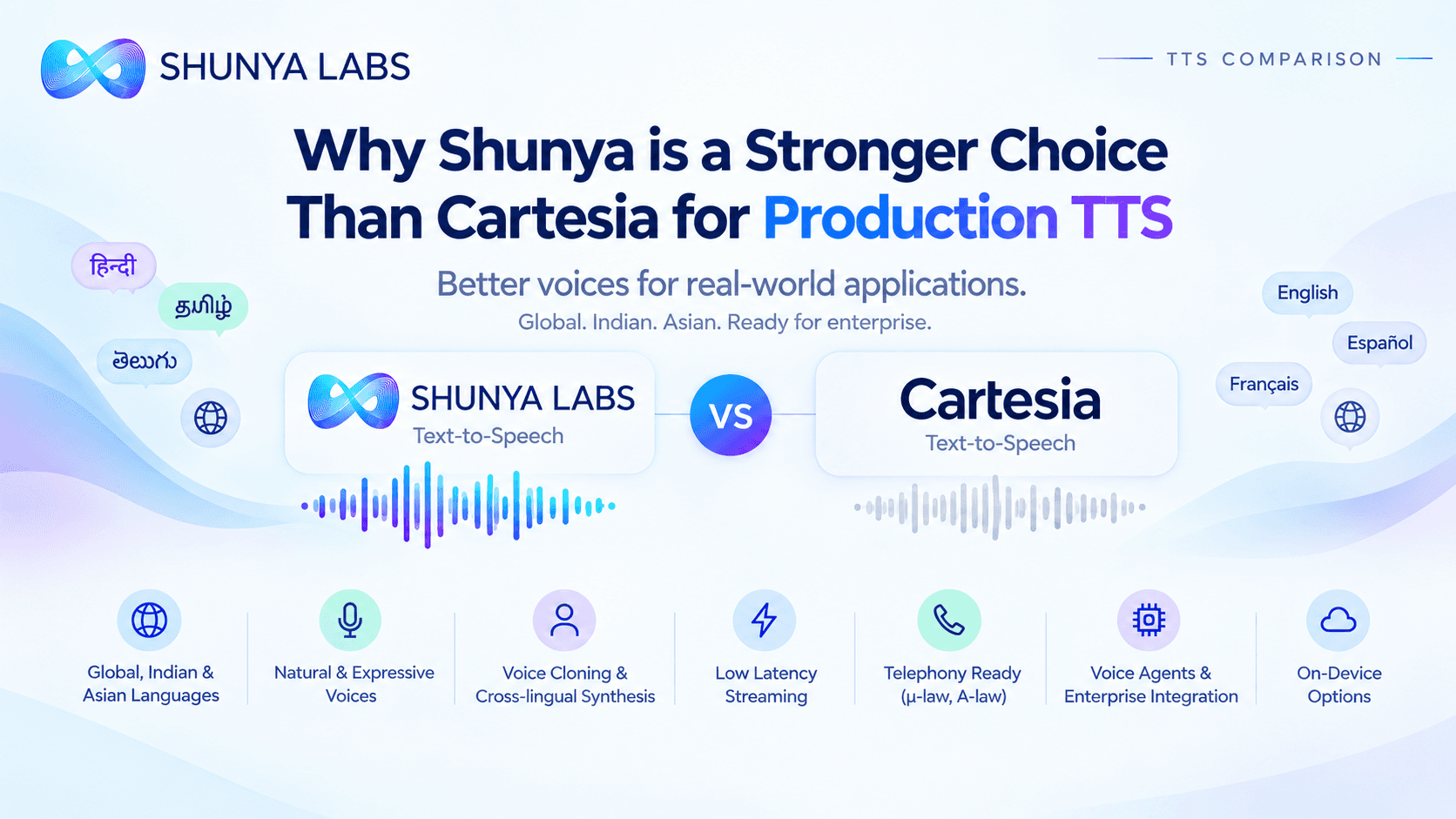
TL;DR , Key Takeaways:
- Cartesia is especially strong for real-time voice agents, low-latency streaming, conversational speech, and efficient developer workflows.
- Shunya is designed around production voice applications across global, Indian, and Asian language environments, with dedicated Indic voices and enterprise-focused capabilities.
- Shunya’s documented TTS stack includes 46 voices across 23 Indic languages + English, 11 expression styles, cross-lingual synthesis, voice cloning, and streaming.
- Cartesia’s current Sonic 3.5 documentation highlights 42 languages, natural conversational speech, and strong handling of alphanumeric text such as IDs, phone numbers, order numbers, and emails.
- Both platforms support voice cloning, streaming, expressive speech, and real-time voice applications.
- Cartesia has a strong advantage in low-latency conversational TTS and voice-agent infrastructure.
- Shunya has a stronger story around Indic voice coverage, cross-lingual voice identity, telephony, enterprise deployment, and a broader STT + TTS + voice-agent stack.
- The right choice depends on whether the priority is ultra-fast conversational generation or broader production voice infrastructure with deeper Indic specialization.
Cartesia has built a strong reputation around real-time voice AI. Its Sonic family is designed for fast, natural speech generation, with a particular focus on conversational applications, voice agents, low latency, and efficient streaming.
Cartesia’s current pricing page lists Sonic-3.6 as its TTS model, while its documentation highlights capabilities such as natural expressive speech, accurate transcript following, multilingual support, voice cloning, pronunciation dictionaries, and streaming through WebSocket, SSE, or HTTP.
That makes Cartesia a good choice for real-time voice agents.
Shunya approaches TTS from a broader production perspective.
Shunya Zero TTS combines natural and expressive voices, global and Asian language coverage, dedicated Indic voices, cross-lingual synthesis, voice cloning, streaming, and enterprise voice applications. Its current documentation lists 46 voices, 11 expression styles, and voice cloning from a short reference clip.
The real comparison is therefore not simply which model is faster.
It is:
Which TTS platform gives your application the right combination of voice quality, pronunciation, latency, language capability, voice identity, deployment, and production infrastructure?
Shunya and Cartesia at a glance
| Capability | Shunya Zero TTS | Cartesia Sonic |
|---|---|---|
| Language focus | Global, Indian and Asian languages | Global multilingual |
| Indic specialization | Core focus | Growing coverage |
| Documented voice catalogue | 46 voices | Voice library + custom voices |
| Indic voice catalogue | 23 Indic languages + English | Selected Indic languages |
| Expression | 11 styles | Emotion and generation controls |
| Voice cloning | Yes | Yes |
| Cross-lingual voice | Yes | Voice localization available |
| Streaming | Yes | Yes |
| Real-time focus | Yes | Core strength |
| Pronunciation controls | Yes | Yes, including pronunciation dictionaries |
| Telephony formats | μ-law, A-law and more | Supported |
| Voice-agent integration | Broader STT + TTS + agent stack | Core strength |
| On-device options | Yes | Yes |
| Enterprise deployment | Cloud, private, on-premise, edge | Cloud, on-premise, on-device |
| Best fit | Enterprise multilingual voice AI | Real-time conversational voice |
Cartesia’s current documentation recommends Sonic 3.5 for most TTS use cases, while its latest pricing page lists Sonic-3.6.
Cartesia is built around real-time interaction
One of Cartesia’s clearest strengths is its focus on interactive voice.
Its documentation provides three streaming options:
HTTP bytes
Server-Sent Events
WebSocket
All stream audio as it is generated. WebSockets support long-lived sessions, text arriving incrementally, timestamps, and multiple utterances on the same connection.
That architecture is particularly useful for:
Voice agents
Assistants
Games
Telephony
Interactive applications
A voice agent may not know the entire response before generation begins.
The LLM may produce:
“Sure, I can help you with that…”
and continue generating the rest.
A TTS system that can begin speaking while the response is still being generated can make the interaction feel substantially faster.
Cartesia has designed its TTS around exactly this use case.
Shunya is also designed for conversational TTS
Shunya’s TTS documentation provides streaming synthesis over WebSockets, with a persistent session that can stream audio chunks back as speech is generated.
This is important because Shunya’s TTS is also designed for voice agents and conversations, not just offline narration.
The difference lies in the broader platform.
Shunya’s Voice Agent connects STT, reasoning, and TTS, while the broader Platform combines speech recognition, speech synthesis, voice agents, SLMs, and edge speech intelligence.
Cartesia has made real-time interaction itself the centerpiece of its platform.
Shunya’s proposition is broader:
Generate speech → understand speech → reason → generate speech
That can matter when TTS is part of a larger enterprise voice system.
Latency is not just one number
TTS latency can mean several different things.
Time to first byte
When the server starts returning audio.
Time to first audio
When the user can actually hear the first sound.
Time to complete
How long until the full response is generated.
Cartesia’s documentation explicitly discusses this distinction and recommends WebSocket connections for long-lived real-time sessions because they avoid repeatedly paying TCP/TLS connection overhead.
This is an important engineering advantage.
Shunya provides WebSocket streaming as well, allowing persistent real-time synthesis sessions.
So instead of comparing one latency number from each vendor, benchmark the actual experience:
User stops speaking → LLM produces text → TTS starts → user hears the response
That is end-to-end conversational latency.
For voice agents, this matters much more than isolated model inference speed.
Voice quality: naturalness, pacing and context
Cartesia’s current Sonic documentation emphasizes natural, expressive speech, strong pacing, emotional expression, and accurate transcript following.
Cartesia also highlights natural alphanumeric handling, including confirmation codes, order numbers, phone numbers, IDs, and emails.
This is particularly relevant for enterprise voice systems.
Shunya’s TTS product similarly focuses on natural pacing, pauses, emphasis, pronunciation, and conversational delivery. Its current product positioning is specifically around voices for conversations rather than narration alone.
Shunya also provides 11 expression styles, including Conversational, Narrative, News, Happy, Sad, and Enthusiastic.
Both platforms therefore have a serious quality story.
The more important question is how each handles difficult production text.
Difficult text is one of the best ways to evaluate TTS
Try asking either model to speak:
“Your payment of ₹1,25,499.50 has been received.”
Then:
“Your reference ID is AB-2047-X.”
Then:
“Your appointment is scheduled for 12 October at 10:30 AM.”
These reveal problems that a simple:
“Hello, how can I help you today?”
will never expose.
Cartesia explicitly highlights its improved handling of confirmation codes, order numbers, phone numbers, IDs, and emails in Sonic 3.5.
Shunya’s TTS API provides language selection, speed controls, silence trimming, multiple audio formats, and pronunciation-aware processing, which are useful when building production voice workflows.
For enterprise TTS, test:
Numbers
Currency
Dates
Acronyms
Names
URLs
Product codes
Medical terminology
That is often a better quality benchmark than a generic “human likeness” score.
Indian voices are a key Shunya differentiator
Cartesia supports several Indian languages, including Hindi, Tamil, Bengali, Telugu, Gujarati, Kannada, Malayalam, and Marathi in its current Sonic language set.
But Shunya takes a more dedicated approach to Indic TTS.
The Zero TTS Indic model provides 46 voices across 23 Indic languages plus English, with dedicated male and female voices.
Shunya’s documentation also states that any available voice can speak any supported language, allowing the vocal identity to be separated from the output language.
That is useful when building a multilingual Indian assistant.
For example:
English voice identity
↓
Hindi
↓
Tamil
↓
Telugu
without forcing the brand to use an entirely different assistant persona for every language.
This makes Indian multilingual voice identity one of the clearest areas where Shunya has a differentiated story.
Cross-lingual voice identity matters for enterprise brands
Imagine a telecom provider with one virtual assistant.
A customer starts in English.
Then switches to Hindi.
Later, another customer speaks Tamil.
The system should ideally still sound like the same assistant.
Shunya’s cross-lingual synthesis architecture allows the same voice identity to be used across supported languages.
Cartesia also supports localization of cloned voices into other languages, allowing voice identities to be adapted across its supported language set.
So again, both offer the capability.
The meaningful benchmark is:
How consistently does the same voice sound across languages?
For a global or Indian brand, that can be more important than the number of voices available.
Voice cloning: both have strong options
Cartesia supports voice cloning through its Clone Voice API and documents different approaches for high similarity and stability. It recommends short, clean recordings for high-similarity cloning and supports localization of voices into other languages.
Shunya supports voice cloning from a short reference clip, with the cloned voice usable across its Indic language voice stack.
The important enterprise questions are:
How much reference audio is needed?
How similar is the clone?
How stable is it over long generations?
Does the identity survive translation or localization?
Does it remain natural over a phone call?
Both platforms should be evaluated using the same source voice and identical scripts.
And, as with any voice-cloning deployment, organizations should ensure they have the necessary consent and rights to use the source voice.
Expression and emotional control
Cartesia’s Sonic family offers controls around emotion and generation behavior, and earlier Sonic models exposed volume, speed, and emotion controls through API parameters and SSML-style controls.
Shunya offers 11 explicit expression styles, including:
Happy
Sad
Angry
Fearful
Surprised
News
Conversational
Narrative
Enthusiastic
This is a difference in control philosophy.
Cartesia gives developers fine-grained generation controls.
Shunya gives developers a set of production-oriented delivery styles.
For a creative application where you want to manipulate every aspect of performance, Cartesia’s lower-level controls can be attractive.
For an enterprise assistant where you want predictable styles such as Conversational, News, or Enthusiastic, Shunya’s simpler style system can be easier to operationalize.
Telephony is an important production test
Both platforms support real-time audio workflows, but enterprise telephony introduces additional requirements.
You may need:
8 kHz output
μ-law
A-law
Fast streaming
Low buffering
Stable speech over compressed audio
Shunya’s TTS API supports μ-law, A-law, PCM, WAV, MP3, OGG Opus, and FLAC.
Cartesia’s streaming endpoints are designed for assistants, telephony-style stacks, and other long-lived conversational sessions, with WebSockets recommended when text arrives incrementally.
For IVR and contact-center systems, benchmark the actual call.
A voice that sounds excellent through studio headphones can behave very differently after 8 kHz telephony encoding.
The broader voice stack matters
Cartesia has expanded from TTS into a broader real-time voice platform.
Its current website presents:
Sonic
Text-to-speech
Ink
Speech-to-text
Managed Agents
Voice-agent development and deployment
The company describes the system as a full stack for interactive intelligence and emphasizes deployment across cloud, on-premise, and on-device environments.
Shunya takes a similarly broad direction.
The Shunya Platform combines:
STT
TTS
Voice agents
Custom SLMs
Edge speech understanding
Knowledge-grounded AI
This makes both vendors more than standalone TTS providers.
The distinction is in positioning.
Cartesia is highly focused on interactive intelligence and low-latency voice agents.
Shunya’s stack adds a stronger Indic and multilingual enterprise layer around that voice architecture.
Pricing: Cartesia has a clear usage model
Cartesia’s current pricing is subscription-based with included credits.
The public plans currently include:
Free: $0/month with 20K credits
Pro: $5/month with 100K credits
Startup: $49/month with 1.25M credits
Scale: $299/month with 8M credits
Enterprise: custom pricing
The current pricing page lists Sonic-3.6 as the TTS model, with concurrency increasing from 2 concurrent requests on Free to 15 on Scale, with custom Enterprise limits.
Shunya’s pricing is structured differently, with enterprise usage and model-specific pricing.
For TTS, the important comparison is not simply subscription price.
Calculate:
Cost per minute
Cost per million characters
Concurrency
Voice cloning
Streaming
Required deployment tier
Downstream voice-agent costs
A provider with a lower headline price can become more expensive if your application requires a higher tier to achieve production concurrency.
Where Cartesia is the better choice
Cartesia is particularly compelling for:
Real-time voice agents
Its entire platform is built around interactive voice and low-latency generation.
Fast streaming
WebSocket sessions are designed for incremental text and low-latency multi-turn interactions.
Natural conversational speech
Sonic is designed specifically for conversational and support-style transcripts.
Fine-grained generation controls
Cartesia exposes detailed model controls and pronunciation dictionaries.
Alphanumeric text
Sonic 3.5 specifically highlights natural handling of IDs, codes, phone numbers, and emails.
Voice-agent infrastructure
Cartesia’s platform includes STT, TTS, and managed agents.
For a company primarily building real-time conversational agents, Cartesia is a very strong option.
Where Shunya makes a stronger case
Shunya becomes particularly compelling when:
Indian voices are central to the application
Use Zero TTS Indic for a dedicated Indic voice catalogue.
You need global, Indian, and Asian voices
Shunya’s TTS stack is designed around these markets rather than a primarily Western-language voice ecosystem.
One voice needs to work across languages
Shunya supports cross-lingual synthesis, keeping voice identity separate from the spoken language.
You need production-focused expression styles
Shunya provides 11 explicit delivery styles for conversational and business use.
Telephony is important
Shunya supports μ-law and A-law among its audio output formats.
TTS is part of a complete voice-AI stack
The Shunya Platform connects STT, TTS, voice agents, SLMs, edge intelligence, and knowledge-grounded AI.
You need edge-oriented voice applications
Shunya On-Device Models provide a path toward local inference.
Shunya vs Cartesia by use case
| Use case | Stronger fit |
|---|---|
| Real-time voice agents | Cartesia / Both |
| Conversational TTS | Both |
| Low-latency streaming | Cartesia |
| Creative narration | Both |
| Indian-language TTS | Shunya |
| Indian multilingual voice agents | Shunya |
| Global multilingual voice agents | Both |
| Cross-lingual brand voice | Shunya / Both |
| Alphanumeric-heavy enterprise TTS | Both |
| Telephony | Both |
| Voice cloning | Both |
| Fine-grained generation controls | Cartesia |
| Enterprise Indic voice catalogue | Shunya |
| Broader STT + TTS + voice-AI stack | Both |
| Edge voice applications | Shunya / Both |
How to benchmark Shunya and Cartesia
Use the same text and equivalent voice profiles.
Your test set should contain:
Conversational responses
Questions
Numbers
Currency
Dates
Names
Acronyms
URLs
Product codes
Indian-language sentences
Code-switched sentences
Then score:
Naturalness
Does the voice sound human over both short and long interactions?
Pronunciation
Are names, numbers, places, acronyms, and domain terms correct?
Prosody
Does the voice pause and emphasize naturally?
Expressiveness
Does it match the intended emotional tone?
Voice consistency
Does the same voice remain stable across repeated generations?
Time to first audio
How quickly does the user hear the first response?
End-to-end latency
For a voice agent, how quickly does the system respond after the user finishes speaking?
Telephony quality
How does the voice sound after the audio is encoded for a phone call?
Cost at scale
What does the system cost at your actual monthly volume and concurrency?
This produces a much more useful evaluation than listening to one polished demo.
Final words
Cartesia is a strong production TTS platform with a clear focus on real-time interaction.
Its current Sonic stack emphasizes natural conversational speech, low-latency streaming, pronunciation controls, voice cloning, multilingual generation, and tight integration with voice agents. Cartesia’s broader platform now brings STT, TTS, and managed voice agents together.
Shunya takes a broader production voice approach.
Its TTS stack combines global, Indian, and Asian voice coverage, dedicated Indic voices, cross-lingual synthesis, voice cloning, 11 expression styles, streaming, and telephony-ready formats. Its documentation currently lists 46 voices across 23 Indic languages plus English.
The strongest Shunya differentiator is not simply language coverage.
It is the combination of:
Indic voice specialization
Cross-lingual voice identity
Production-oriented expression
Telephony support
Voice cloning
and a broader platform connecting STT, TTS, speech intelligence, voice agents, SLMs, and edge AI.
Cartesia may be the stronger choice when the primary requirement is ultra-low-latency conversational voice and real-time agent infrastructure.
Shunya becomes particularly compelling when the application needs Indian and Asian voices, multilingual brand identity, enterprise telephony, and a broader speech-to-voice-AI stack.
The best way to decide is simple:
Take the text your application actually generates and make both systems speak it.
Test the names.
Test the numbers.
Test the currency.
Test the Indian languages.
Test the code-switching.
Test a five-minute conversation.
Then measure first-audio latency, pronunciation, naturalness, consistency, and cost.
Because the best TTS model isn’t the one that sounds impressive in a demo.
It’s the one that still sounds right when it becomes part of your product.
Frequently asked questions
Is Shunya better than Cartesia?
It depends on the use case. Cartesia is particularly strong for real-time voice agents, low-latency streaming, and conversational TTS. Shunya is particularly strong for Indic voice applications, cross-lingual voice identity, enterprise telephony, and broader voice-AI infrastructure.
Which has more voice choices?
The exact voice catalogue changes over time. Cartesia maintains a growing voice library, while Shunya’s documentation lists 46 voices across 23 Indic languages plus English.
Does Cartesia support Indian languages?
Yes. Sonic supports Indian languages including Hindi, Tamil, Bengali, Telugu, Gujarati, Kannada, Malayalam, Marathi, and Punjabi.
Does Shunya support Indian languages?
Yes. Shunya’s Zero TTS Indic model provides dedicated voices across 23 Indic languages plus English.
Does Cartesia support voice cloning?
Yes. Cartesia provides voice cloning through its Clone Voice API and also supports voice localization.
Does Shunya support voice cloning?
Yes. Shunya supports cloning from a short reference clip and cross-lingual synthesis.
Which has lower latency?
Cartesia has a particularly strong low-latency positioning for conversational TTS and persistent WebSocket sessions. Shunya also supports real-time WebSocket streaming. The best comparison is time to first audible response in the complete application, not isolated model latency.
Does Cartesia support difficult text such as IDs and phone numbers?
Yes. Sonic 3.5 specifically highlights natural handling of confirmation codes, order numbers, phone numbers, IDs, and emails.
Does Shunya support telephony?
Yes. Shunya supports μ-law and A-law alongside other audio formats.
Which is better for voice agents?
Both are strong options. Cartesia is particularly optimized around real-time voice-agent infrastructure, while Shunya combines voice agents with STT, TTS, speech intelligence, SLMs, and knowledge-grounded AI.
Which is better for creative control?
Cartesia offers fine-grained model controls and pronunciation dictionaries, while Shunya provides 11 predefined expression styles designed for conversational and enterprise delivery.
Which is cheaper?
Cartesia currently offers subscription plans with included TTS credits, starting with a free tier and moving through Pro, Startup, Scale, and Enterprise. Shunya uses its own usage and enterprise pricing structure. The best comparison should use your actual monthly volume and concurrency.
How should I compare Shunya and Cartesia?
Use the same production text and compare naturalness, pronunciation, prosody, expression, voice consistency, first-audio latency, telephony quality, multilingual performance, and total cost at your expected scale.

Bio: Navvya works at the intersection of product strategy and applied AI research at Shunya Labs. With a background in human behaviour and communication, she writes about the people, markets, and technology behind voice AI, with a particular focus on how speech interfaces are reshaping access across emerging markets.