

Why Shunya is a stronger choice than ElevenLabs for production text-to-speech (TTS)
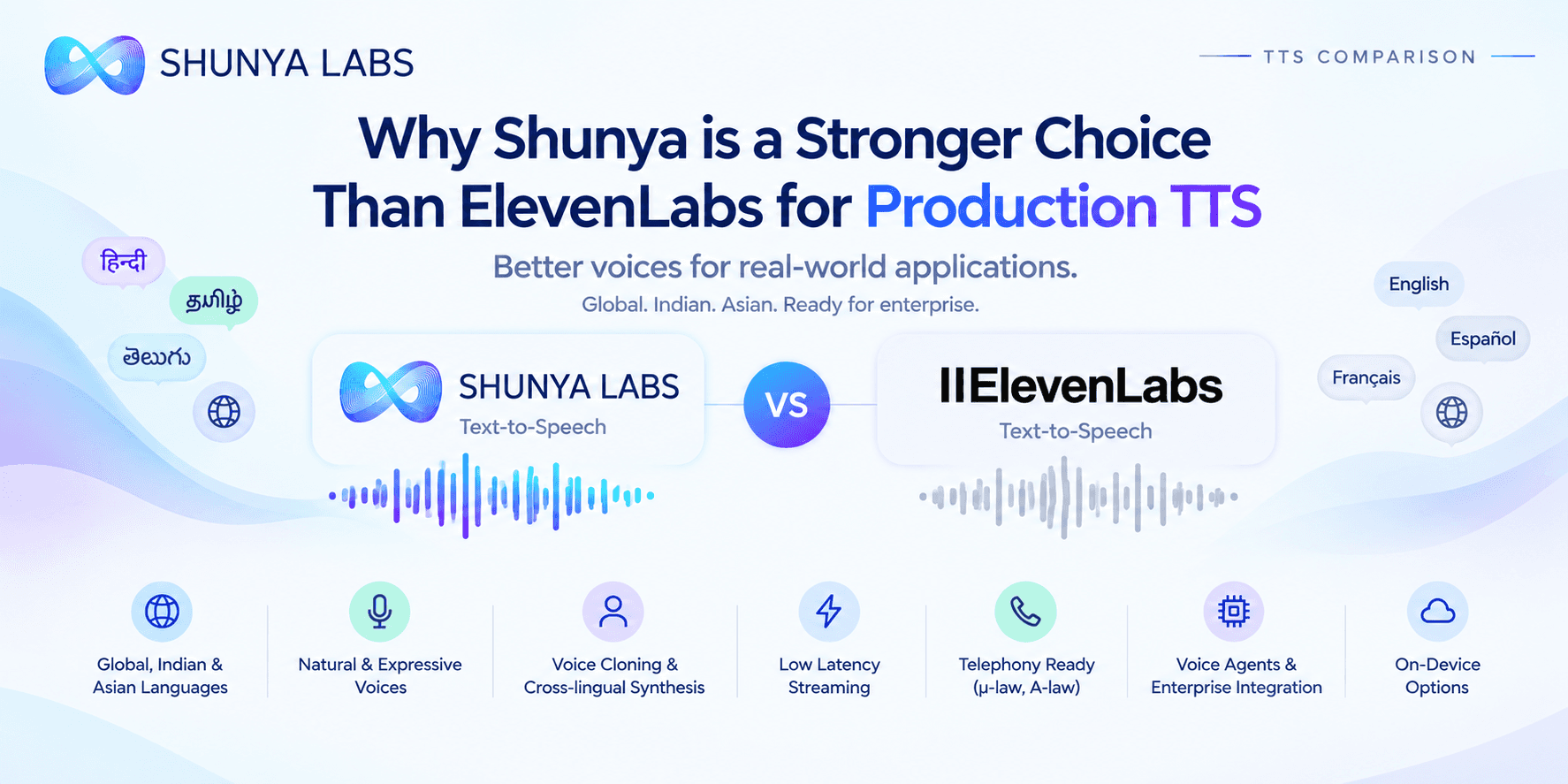
TL;DR , Key Takeaways:
- ElevenLabs is particularly strong for creative voice generation, expressive delivery, voice selection, voice cloning, and long-form content.
- Shunya is built more heavily around production voice applications, including voice agents, IVR, enterprise conversations, and multilingual deployments.
- Shunya provides voices across global, Indian, and Asian languages, with a dedicated Indic voice catalogue rather than relying only on broad multilingual coverage.
- Shunya’s documented TTS stack includes 46 voices across 23 Indic languages plus English and other global and asian languages, 11 expression styles, cross-lingual synthesis, and voice cloning.
- ElevenLabs has a major advantage in voice-library breadth, with thousands of voices and extensive voice creation options.
- Both platforms support voice cloning, expressive speech, streaming, and multilingual generation.
- Shunya has a stronger story around Indian-language TTS, cross-lingual enterprise voices, telephony, and integration with a broader voice-AI stack.
- The right choice depends on whether your priority is creative voice generation or production conversational voice infrastructure.
ElevenLabs is one of the most recognized platforms in AI voice generation. It is particularly strong at natural-sounding voices, expressive delivery, voice cloning, voice selection, and creative audio production. Its latest Eleven v3 model supports 70+ languages, while Flash v2.5 is designed for lower-latency generation at around 75ms model inference latency.
For audiobooks, video narration, characters, content creation, and expressive voice experiences, ElevenLabs is a strong choice.
Production voice applications have a different set of requirements.
A voice powering a contact center, IVR, banking assistant, healthcare application, telecom workflow, or real-time voice agent needs more than an impressive demo. It needs reliable pronunciation, fast first audio, consistent voice identity, multilingual coverage, telephony compatibility, and predictable performance.
This is where Shunya takes a different approach.
Shunya Zero TTS is built for global, Indian, and Asian voice applications, with 46 documented voices across 23 Indic languages plus English, 11 expression styles, voice cloning, cross-lingual synthesis, streaming, and telephony-ready audio formats.
The real question is therefore not simply which platform has the most realistic voice.
It is:
Which TTS platform is better suited to the voice your product actually needs to deliver?
Shunya and ElevenLabs at a glance
| Capability | Shunya Zero TTS | ElevenLabs |
|---|---|---|
| Language focus | Global, Indian and Asian languages | Global multilingual |
| Indic voice coverage | Dedicated Indic voice catalogue | Supported across available languages |
| Documented voices | 46 voices | Thousands of voices |
| Indic voice catalogue | 23 Indic languages + English | Multiple supported languages |
| Voice styles | 11 expression styles | Advanced expressive controls |
| Voice cloning | Yes | Yes |
| Cross-lingual voice | Yes | Yes |
| Streaming | Yes | Yes |
| Latency | Low-latency streaming | Flash ~75ms model inference |
| Telephony formats | μ-law, A-law and more | μ-law, A-law and more |
| Voice-agent integration | Native broader stack | Realtime conversational models |
| On-device options | Yes | Depends on product |
| Best fit | Enterprise and multilingual voice AI | Creative and expressive voice generation |
Current capabilities vary by model and product tier.
Voice quality is more than sounding human
ElevenLabs has built its reputation around lifelike and expressive speech.
Its Eleven v3 model supports emotional direction, audio tags, non-verbal reactions, and multi-speaker dialogue, making it particularly powerful for creative and performance-oriented applications.
That makes it excellent for:
Audiobooks
Characters
Video narration
Games
Creative content
But enterprise TTS has another requirement:
Does the voice remain natural when the text is difficult?
Consider:
“Your payment of ₹24,500 has been received.”
Or:
“Your appointment is scheduled for 12 October at 10:30 AM.”
A voice can sound remarkably human and still fail if it pronounces the important information incorrectly.
For production applications, naturalness and correctness have to be evaluated together.
Pronunciation matters as much as naturalness
The hardest TTS inputs are often not ordinary sentences.
They are:
Names
Numbers
Currencies
Dates
Addresses
Acronyms
URLs
Product names
Medical terminology
Alphanumeric IDs
For a banking application, a wrong amount is worse than slightly imperfect prosody.
For healthcare, a mispronounced medicine can change meaning.
For an IVR, a wrong account number or place name can frustrate the user.
This is why a serious TTS benchmark should include real production text instead of generic phrases such as:
“Hello, how can I help you today?”
A better test would include:
“Take 500 mg of the prescribed medication twice daily.”
The important metric isn’t simply whether the voice sounds good.
It’s whether the voice says the right thing correctly.
Indian-language TTS is where Shunya has a sharper specialization
ElevenLabs supports many Indian languages through its current multilingual models, including Hindi, Bengali, Gujarati, Kannada, Malayalam, Marathi, Punjabi, Tamil, Telugu, Urdu, and others.
That is meaningful coverage.
Shunya approaches Indian TTS more specifically.
Its Zero TTS Indic model provides voices across 23 Indic languages plus English, with dedicated male and female voices for each language.
The model is designed around Indian phonetics and regional pronunciation, rather than treating Indic languages simply as additional translations of an English-first voice.
That matters for:
Indian names
Indian place names
Regional vocabulary
Indian currency
English words embedded in Indian-language sentences
Local pronunciation patterns
For a multilingual Indian assistant, the goal isn’t simply to generate Hindi.
It’s to make the Hindi sound like the right Hindi.
That same principle applies to Tamil, Bengali, Marathi, Telugu, Kannada, Malayalam, and other Indian languages.
One voice across languages
Multilingual voice applications often have a consistency problem.
An assistant may sound one way in English, another way in Hindi, and completely different in Tamil.
Shunya’s TTS architecture supports cross-lingual synthesis, where the voice controls the vocal identity while the input language can change.
That allows a brand to build:
One voice identity
across
multiple languages.
This can be particularly useful for:
Banking assistants
Contact centers
Telecom
Healthcare
Government services
Education
Multilingual customer support
For a brand, consistency can matter more than having hundreds of unrelated voices.
Voice libraries: ElevenLabs wins on breadth
This is an important advantage for ElevenLabs.
Its current platform advertises thousands of voices, along with community voices, professional voice cloning, and voice design.
That makes it particularly useful when you need:
Different characters
Narrators
Personalities
Creative experimentation
Age and style variations
Media voices
Shunya’s catalogue is much smaller, with 46 documented voices across 23 Indic languages plus English.
But the two products are optimized for different outcomes.
ElevenLabs emphasizes:
“Find or create the exact voice you want.”
Shunya emphasizes:
“Deploy a consistent voice across the languages and environments your product needs.”
For creators, ElevenLabs’ library is a major advantage.
For an enterprise deploying one multilingual assistant, the size of the library may matter much less than voice consistency and language quality.
Voice cloning is about more than copying a voice
Both platforms support voice cloning.
ElevenLabs provides Instant Voice Cloning and Professional Voice Cloning, with professional cloning aimed at higher-fidelity replicas.
Shunya also supports voice cloning and cross-lingual synthesis through its TTS API.
So the important questions are:
How much audio is required?
How consistent is the cloned voice?
Does it preserve identity across languages?
Does it sound natural after telephony compression?
How quickly can it be deployed?
For enterprise applications, cross-lingual voice identity can be more valuable than the cloning feature itself.
Any production voice-cloning deployment should use the appropriate consent and rights from the voice owner.
Latency needs to be measured from text to audible speech
TTS vendors don’t always report latency in the same way.
Three useful metrics are:
Time to first byte: when audio data begins returning.
Time to first audio: when the user can actually hear speech.
End-to-end latency: the complete time from generating the text to audible playback.
ElevenLabs currently documents around 75ms model inference latency for Flash v2.5, around 250–300ms for Turbo v2.5, and about 280ms for Eleven v3 Conversational. Its APIs support streaming so playback can begin before generation is complete.
Shunya provides low-latency streaming TTS through WebSockets, with the broader product positioned for real-time voice applications.
These measurements should not be treated as an apples-to-apples comparison.
For an actual voice agent, the more meaningful measurement is:
User stops speaking → first audible response
That includes:
STT
LLM reasoning
TTS
networking
buffering
The TTS model is only one part of the experience.
Real-time voice agents require a different kind of TTS
TTS for an audiobook can prioritize long-form consistency and expressive performance.
TTS for a voice agent needs:
Fast first audio
Streaming
Natural turn-taking
Stable voice identity
Short-response optimization
Appropriate expression
Low end-to-end latency
Shunya’s Voice Agent platform combines TTS with speech recognition and conversational AI, making TTS part of a larger interaction loop.
ElevenLabs is also investing heavily in this area. Eleven v3 Conversational is specifically designed for realtime, expressive conversational speech.
The right benchmark is therefore not just:
“Which TTS model generates audio faster?”
It is:
“Which voice agent feels faster and more natural to the user?”
Telephony changes the requirements
A large amount of enterprise conversational AI runs over:
Phone calls
IVRs
Contact centers
Outbound calling
These environments often need telephony-specific audio formats.
Shunya’s TTS API supports μ-law and A-law alongside PCM, WAV, MP3, OGG Opus, and FLAC.
ElevenLabs also supports μ-law and A-law and documents 8kHz telephony output options.
So both platforms can serve telephony applications.
The important benchmark is what happens after the audio enters the phone network.
Test:
Pronunciation
First-audio latency
Voice clarity
Turn-taking
Interruptions
Audio quality after telephony encoding
For an IVR, that is much more meaningful than studio audio quality alone.
Difficult text is one of the best TTS benchmarks
A good TTS benchmark should contain the text your application actually generates.
Test:
“Your payment of ₹1,25,499.50 has been received.”
“Your appointment is scheduled for 12 October at 10:30 AM.”
Then test those sentences across your real target languages.
This exposes weaknesses in:
Number pronunciation
Currency
Proper nouns
Acronyms
Technical terminology
Indian names
Regional words
Punctuation and pauses
A production TTS system needs to get the content and delivery right.
Where ElevenLabs can be the better choice
ElevenLabs is particularly compelling for:
Creative voice quality
Its current models are heavily focused on natural and expressive speech.
Large voice selection
Its platform offers thousands of voices and multiple voice-creation methods.
Advanced expressive control
Eleven v3 provides audio tags for emotions, delivery direction, and non-verbal reactions.
Creative production
ElevenLabs has expanded into voice design, dubbing, music, and sound effects, making it a broader creative audio platform.
High-fidelity voice cloning
Instant and professional cloning are both available.
For audiobooks, entertainment, gaming, video, media, and creative content, ElevenLabs remains a very strong option.
Where Shunya makes a stronger case
Shunya is particularly compelling when:
Indian languages are central to the application
Use Zero TTS Indic for a dedicated Indic voice experience.
You need voices across global, Indian, and Asian markets
Shunya’s TTS stack extends beyond its Indic catalogue into broader global and Asian language support.
One brand voice needs to work across languages
Shunya supports cross-lingual synthesis, allowing the same vocal identity to speak different languages.
The voice lives inside a real-time agent
The Shunya Voice Agent stack connects speech recognition, reasoning, and TTS.
Telephony is important
Shunya supports μ-law and A-law, alongside other output formats.
You need production-oriented expression
Shunya provides 11 expression styles including Conversational, Narrative, News, Happy, Sad, and Enthusiastic.
You want a broader enterprise voice stack
The Shunya Platform combines STT, TTS, voice agents, SLMs, edge speech understanding, and knowledge-grounded AI.
You need lightweight local voice processing
Shunya also provides on-device models for edge-oriented applications. Contact us to know more.
Shunya vs ElevenLabs by use case
| Use case | Stronger fit |
|---|---|
| Creative voiceovers | ElevenLabs |
| Audiobooks | ElevenLabs |
| Character voices | ElevenLabs |
| Huge voice library | ElevenLabs |
| Advanced expressive performance | ElevenLabs |
| Voice cloning | Both |
| Global multilingual TTS | Both |
| Indian-language TTS | Shunya |
| Indian multilingual voice agents | Shunya |
| Enterprise IVR | Shunya / Both |
| Telephony TTS | Both |
| Real-time voice agents | Both |
| Cross-lingual enterprise voice identity | Shunya |
| Edge voice applications | Shunya |
| Creative audio ecosystem | ElevenLabs |
| Broader enterprise voice-AI stack | Shunya |
How to benchmark Shunya and ElevenLabs
A useful TTS evaluation should use the same text, comparable voice profiles, same language, and same environment.
Build a test set containing:
Conversational sentences
Questions
Long-form speech
Names
Numbers
Currency
Dates
Acronyms
URLs
Technical terminology
Indian-language sentences
Code-switched sentences
Then measure:
Naturalness
Does the speech sound human?
Pronunciation
Are names, numbers, terminology, and local words correct?
Prosody
Does emphasis and pacing feel natural?
Expressiveness
Can the voice communicate the intended emotion and tone?
Voice consistency
Does the same voice remain stable across repeated generations?
First-audio latency
How quickly can the user actually hear the response?
Cost
What does the system cost at your expected volume?
For a voice agent, also measure end-to-end conversational latency, not just TTS generation speed.
Final words
ElevenLabs is one of the strongest platforms for natural, expressive AI voices. Its current offering combines 70+ language support on Eleven v3, thousands of voices, voice cloning, advanced audio tags, multi-speaker generation, streaming, and a broad creative ecosystem.
Shunya takes a more production-oriented approach to TTS.
Its documented stack provides voices across Indian and global language environments, 46 voices across 23 Indic languages plus English, 11 expression styles, cross-lingual synthesis, voice cloning, streaming, and telephony-ready formats.
The strongest Shunya differentiator is therefore not a language-count competition.
It is:
Production-ready voices across global, Indian, and Asian markets.
For an Indian-language application, that means voice quality built around local pronunciation and phonetics.
For a multilingual enterprise, it means consistent voice identity across languages.
For a contact center or IVR, it means streaming and telephony-ready audio.
For a voice agent, it means TTS that sits alongside STT, speech intelligence, and conversational AI.
For edge applications, it means a path toward local voice inference.
ElevenLabs remains the stronger choice for many creative and expressive voice-generation workloads, particularly when the size of the voice library and depth of creative control are the priority.
Shunya becomes particularly compelling when the requirement is to take high-quality synthesis and put it inside a production conversational system.
The best way to decide is simple:
Take the text your application actually generates and make both systems speak it.
Test the names.
Test the numbers.
Test the currency.
Test the Indian languages.
Test the code-switching.
Test the latency.
Then listen to the result.
Because the best TTS platform is not the one that sounds impressive in a demo.
It is the one that sounds right when your users actually hear it.
Frequently asked questions
Is Shunya better than ElevenLabs?
It depends on the application. ElevenLabs is particularly strong for expressive voices, creative production, voice selection, and advanced voice control. Shunya is particularly strong for Indian-language TTS, multilingual enterprise voice applications, cross-lingual voice identity, telephony, and broader voice-agent infrastructure.
Which supports more languages?
Rather than comparing only language counts, Shunya is positioned around global, Indian, and Asian voice coverage, while ElevenLabs offers broad multilingual support through models such as Eleven v3.
Does Shunya support Indian languages?
Yes. Shunya had a separate model for indian languages. Shunya’s Zero TTS Indic provides voices across 23 Indic languages plus English, with dedicated male and female speakers.
Does ElevenLabs support Indian languages?
Yes. Eleven v3 supports multiple Indian languages including Hindi, Bengali, Gujarati, Kannada, Malayalam, Marathi, Punjabi, Tamil, Telugu, and Urdu.
Does Shunya support voice cloning?
Yes. Shunya supports voice cloning and cross-lingual synthesis through its TTS stack.
Which has lower latency?
ElevenLabs currently documents approximately 75ms model inference latency for Flash v2.5, while Shunya provides low-latency streaming TTS through WebSockets. These measurements represent different aspects of the pipeline, so a direct production benchmark is more meaningful.
Does Shunya support telephony?
Yes. Shunya supports μ-law and A-law along with PCM, WAV, MP3, OGG Opus, and FLAC.
Which is better for creative voice generation?
ElevenLabs is generally the stronger fit for creative applications because of its large voice ecosystem, expressive models, audio tags, voice design, and broader creative tools.
Which is better for Indian enterprise voice applications?
Shunya has a particularly strong proposition where the application depends on Indian-language voices, regional pronunciation, cross-lingual voice identity, telephony, and enterprise voice agents.
Which is better for voice agents?
Both support real-time voice applications. ElevenLabs offers dedicated conversational models, while Shunya connects TTS with STT, speech intelligence, voice agents, and other voice-AI components.
How should I compare Shunya and ElevenLabs?
Use the same production text and compare naturalness, pronunciation, prosody, expressiveness, voice consistency, first-audio latency, end-to-end latency, cost, and performance across your target languages.

Bio: Navvya works at the intersection of product strategy and applied AI research at Shunya Labs. With a background in human behaviour and communication, she writes about the people, markets, and technology behind voice AI, with a particular focus on how speech interfaces are reshaping access across emerging markets.