

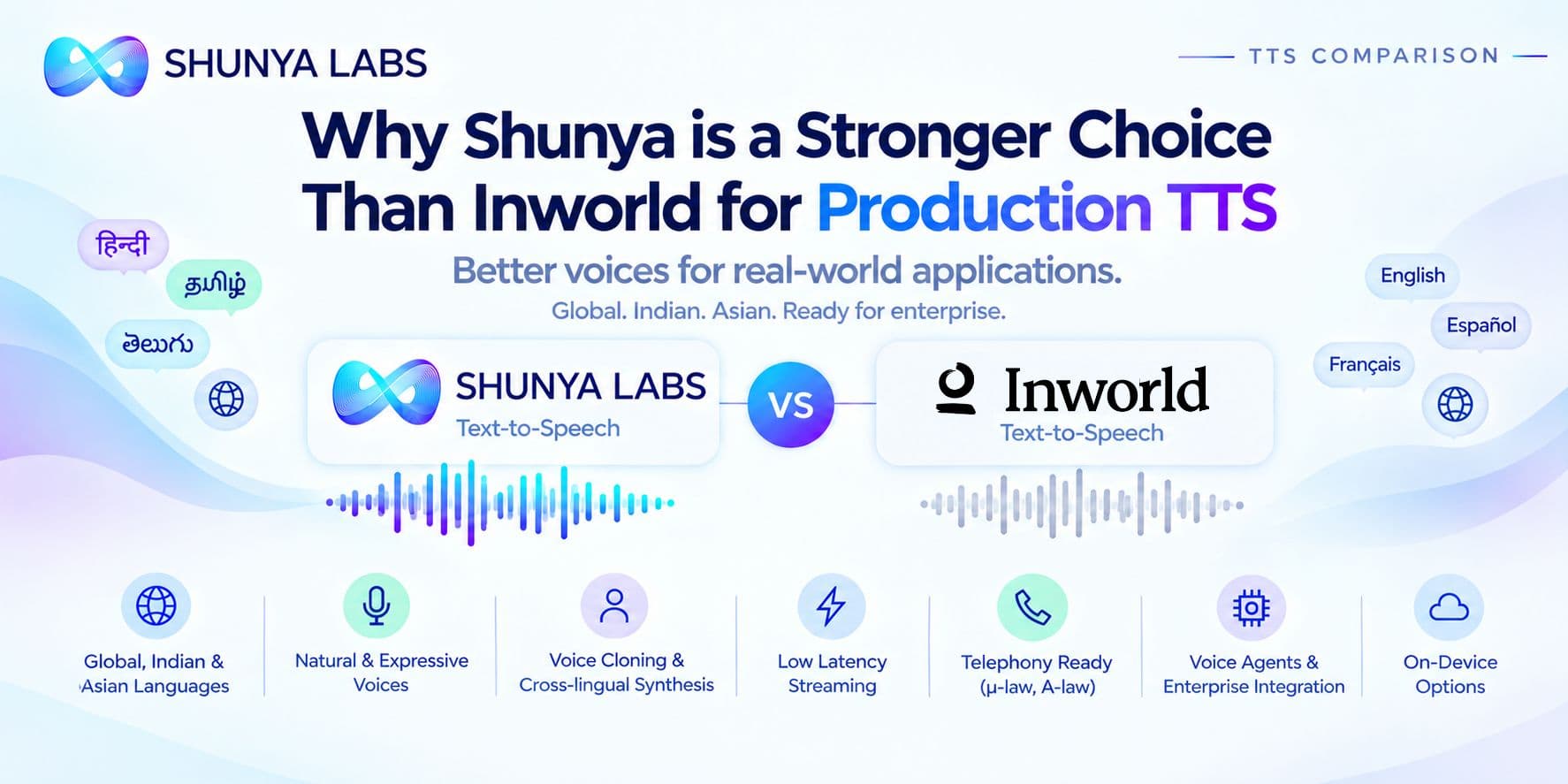
Why Shunya is a stronger choice than Inworld for production text-to-speech (TTS)
TL;DR , Key Takeaways:
- Inworld is particularly strong for real-time TTS, very low latency, natural-language voice steering, voice cloning, and conversational AI.
- Shunya combines TTS with a broader production voice stack spanning global, Indian, and Asian languages, Indic voices, cross-lingual synthesis, voice cloning, streaming, telephony, and voice agents.
- Shunya’s documented TTS catalogue includes 46 voices and 11 expression styles.
- Inworld supports 200+ languages and cross-lingual voice cloning, with a strong focus on maintaining voice identity across languages.
- Inworld has a particularly strong latency and realtime story, with TTS-2 under 100ms TTFB and TTS-2 Flash at 25ms TTFB in its published server-side measurements.
- Shunya differentiates through Indic voice specialization, production-oriented expression styles, telephony support, on-device options, and integration with STT, speech intelligence, voice agents, and SLMs.
- Inworld provides natural-language steering and built-in non-verbal cues such as laughs, breaths, sighs, coughs, and yawns.
- Inworld’s pricing becomes very competitive at scale, reaching $5 per million characters for Realtime TTS-2 at Enterprise and below $5 for TTS-2 Flash.
- For ultra-low-latency conversational AI, Inworld is a strong choice. For Indian voice applications, multilingual enterprise deployments, telephony, and a broader speech-to-voice-AI stack, Shunya has a strong case.
Inworld has built its voice platform around real-time AI interaction. Its latest Realtime TTS-2 models focus on expressive conversational speech, very low latency, natural-language voice steering, voice cloning, multilingual generation, and applications such as voice agents and consumer-facing AI. Inworld currently positions Realtime TTS-2 at under 100ms TTFB and TTS-2 Flash at 25ms TTFB, measured server-side at P99.
That makes Inworld a serious option for teams building realtime voice experiences.
Shunya takes a broader production approach to TTS.
Shunya Zero TTS is designed for global, Indian, and Asian voice applications, with natural and expressive voices, cross-lingual synthesis, voice cloning, streaming, telephony-ready formats, and enterprise deployment. Its current documentation lists 46 voices across 23 Indic languages plus English, with 11 expression styles, while its platform supports the same voice identity across supported languages.
That changes the comparison.
The question is not simply:
Which TTS model has the lowest latency?
It is:
Which platform gives you the right combination of voice quality, pronunciation, expression, language coverage, voice identity, latency, deployment, and production infrastructure for your application?
Shunya and Inworld at a glance
| Capability | Shunya Zero TTS | Inworld Realtime TTS |
|---|---|---|
| Language focus | Global, Indian and Asian languages | Global multilingual |
| Indic specialization | Dedicated Indic voice stack | Supported in multilingual models |
| Documented voices | 46 voices | Custom voices + voice design |
| Indic voice catalogue | 23 Indic languages + English | Supported languages vary by model |
| Expression | 11 styles | Natural-language steering + expressive delivery |
| Voice cloning | Yes | Yes |
| Cross-lingual voice | Yes | Yes |
| Streaming | Yes | Yes |
| Realtime focus | Yes | Core strength |
| Pronunciation | Language-aware controls | Custom pronunciation |
| Non-verbal cues | Expression styles | Built into TTS-2 |
| Telephony formats | μ-law, A-law and more | Standard audio APIs |
| Voice-agent integration | STT + TTS + intelligence + agents | Realtime voice stack + LLM Router |
| On-device options | Yes | Deployment options vary |
| Enterprise deployment | Cloud, private, on-premise, edge | Enterprise deployment options |
| Best fit | Enterprise multilingual voice AI | Realtime conversational AI |
Capabilities can vary by model and plan. Inworld currently distinguishes Realtime TTS-2 and Realtime TTS-2 Flash, while Shunya’s documentation distinguishes its TTS models and deployment paths.
Inworld’s biggest strength is realtime voice
Inworld has made realtime interaction the center of its TTS platform.
Its current flagship Realtime TTS-2 provides under 100ms TTFB, while TTS-2 Flash reaches 25ms TTFB in Inworld’s server-side P99 measurements.
The distinction between the two models is also practical:
Realtime TTS-2 prioritizes expressive quality, steering, and conversational delivery.
TTS-2 Flash prioritizes extremely low latency and cost.
That makes Inworld particularly attractive for:
Voice agents
AI tutors
Interactive characters
Realtime assistants
Consumer conversational products
A voice agent has only a short window between a user’s last word and the assistant’s first word.
Even a small delay becomes noticeable when the system has to:
Listen → transcribe → reason → generate text → synthesize speech
Inworld has optimized heavily for that loop.
Shunya also supports WebSocket streaming TTS specifically for voice agents and IVR, allowing audio chunks to be generated and played before the full response is synthesized.
The difference is that Shunya treats realtime TTS as one part of a broader speech-to-intelligence-to-voice system.
Latency isn’t the only thing that makes a voice feel realtime
A TTS model can be extremely fast and still feel unnatural.
Users notice:
Awkward pauses
Abrupt sentence boundaries
Unnatural emphasis
Voice inconsistency
Poor interruption behavior
Inworld addresses this through natural-language steering, allowing developers to place instructions such as tone, speaking style, volume, speed, and pauses directly into the text. It also supports first-class non-verbal cues such as laughs, breaths, sighs, coughs, and yawns.
This is one of Inworld’s strongest features.
Instead of controlling the voice entirely through a fixed set of parameters, developers can communicate something closer to:
“Speak warmly, but sound slightly concerned.”
or:
“Say this more slowly and quietly.”
Shunya takes a more structured approach, with 11 explicit expression styles, including Conversational, Narrative, News, Happy, Sad, Angry, Fearful, Surprised, and Enthusiastic.
That creates two different philosophies.
Inworld: fine-grained natural-language direction.
Shunya: predictable, predefined production voice styles.
For creative experimentation, Inworld’s steering is powerful.
For enterprise voice systems, predefined styles can be easier to standardize across large deployments.
Voice quality has to survive difficult text
A good TTS demo usually sounds like:
“Hello, how can I help you today?”
A production application sounds more like:
“Your payment of ₹1,25,499.50 has been received.”
or:
“Your appointment is scheduled for 12 October at 10:30 AM.”
Now the TTS system needs to correctly handle:
Numbers
Currency
Dates
Acronyms
Product names
Phone numbers
Technical terminology
Proper nouns
Inworld explicitly supports custom pronunciation, character, word, viseme, and phoneme timestamps on its current realtime TTS models.
Shunya also provides language-aware TTS controls and supports custom pronunciation, speed, language selection, and multiple output formats.
For enterprise TTS, this is an important distinction:
Natural speech is not enough.
The system needs to say the right information correctly.
Indian voices are a core Shunya specialization
Inworld supports 200+ languages, including Hindi, Japanese, Korean, Chinese, and other global languages, with cross-lingual cloning designed to preserve the same identity across languages.
Shunya approaches Indian TTS more deeply.
Its Zero TTS Indic stack is designed specifically around Indian phonetics, regional pronunciations, dialects, and local speech patterns. Its documented voice catalogue includes 46 voices across 23 Indic languages plus English, with dedicated speakers for the supported languages.
That matters for applications using:
Indian names
Indian place names
Regional vocabulary
Indian currency
Local pronunciation
English words embedded in Indian-language sentences
The difference isn’t simply:
“Both support Hindi.”
It’s:
“How natural does the system sound when the text comes from a real Indian application?”
That is particularly important for BFSI, healthcare, telecom, government services, customer support, and education.
One voice across languages
Inworld has a strong proposition here.
Its current platform supports cross-lingual voice cloning, where a custom voice can be localized across 200+ languageswhile maintaining the same identity.
Shunya also supports cross-lingual synthesis.
Its documentation describes voice and language as separate controls, meaning the same voice can speak different supported languages.
This is useful for enterprise brands that want:
One assistant
One voice identity
Multiple markets
For example:
English
→ Hindi
→ Tamil
→ Japanese
The important benchmark is not whether both APIs support this.
It is:
Does the voice still sound like the same person?
Test:
Timbre
Accent
Prosody
Speaking style
Emotional behavior
A multilingual brand voice should not sound like a completely different assistant every time the language changes.
Voice cloning is useful, but cross-lingual cloning is more interesting
Inworld currently supports voice cloning from approximately 15 seconds of audio, and its platform can then localize the cloned voice across its supported languages.
Shunya supports voice cloning from a short reference clip, with its documentation describing a 3–6 second reference sample and cross-lingual use of the resulting voice.
The useful enterprise questions are:
How much audio do you need?
How close is the clone?
How stable is it?
Does it preserve identity across languages?
Does it remain natural over phone audio?
Can it be deployed securely?
For multilingual customer-facing applications, cross-lingual consistency can be more important than the cloning feature itself.
Voice cloning should always be deployed with the appropriate consent and rights of the source speaker.
Non-verbal expression is where Inworld stands out
One of the more distinctive features of Inworld’s current Realtime TTS-2 is its support for non-verbal cues.
Developers can use cues for:
Laughs
Breathing
Sighs
Coughs
Yawns
These are generated as actual vocal events rather than spoken words.
This can make conversational characters and interactive experiences feel significantly more alive.
Shunya’s current expression system instead focuses on delivery styles such as:
Conversational
Narrative
News
Happy
Sad
Enthusiastic
So this is an area where the products have a clear difference.
For character-driven or highly expressive conversational AI, Inworld’s non-verbal controls are valuable.
For enterprise assistants, Shunya’s explicit production styles can provide predictable and repeatable delivery.
Streaming architecture matters when an LLM generates text incrementally
Modern voice agents rarely generate an entire response and then synthesize it.
The LLM may produce:
“Sure, I can help you…”
and then continue:
“…with your account.”
The TTS engine needs to synthesize this without creating unnatural pauses or restarting the voice.
Inworld’s realtime API is built for streaming and supports conversational context, steering, timestamps, and cross-lingual generation.
Shunya’s streaming TTS API uses a persistent WebSocket and streams audio chunks as synthesis happens. Its documentation specifically identifies voice agents and IVR as key streaming use cases.
For a production voice agent, benchmark:
LLM text arrival
→ TTS starts
→ first audio plays
→ response completes
Don’t benchmark only a complete paragraph.
Test incremental LLM output.
That’s much closer to real production behavior.
Telephony is an important enterprise TTS test
Voice AI is increasingly being deployed through:
IVRs
Contact centers
Outbound calling
Phone-based assistants
This introduces requirements that don’t matter as much in studio-quality generation.
You may need:
8 kHz audio
μ-law
A-law
Low buffering
Fast streaming
Shunya’s TTS API supports μ-law and A-law alongside PCM, WAV, MP3, Opus, and FLAC.
Inworld’s TTS APIs support common output formats including MP3, Linear PCM, and Opus, while the exact production telephony path should be evaluated based on the integration architecture.
For a contact center, test the actual call.
A voice that sounds excellent through studio headphones may behave differently after telephony encoding and network transmission.
The broader voice stack changes the equation
Inworld is no longer only a TTS provider.
Its current platform combines TTS, STT, and an LLM Router, and Inworld positions the stack around consumer-facing realtime AI applications.
It also provides access to 220+ LLM models through its Router, allowing developers to build more of the realtime voice application around one provider.
Shunya has a broader voice-AI platform of its own.
The Shunya Platform brings together:
STT
TTS
Voice agents
Custom SLMs
Edge speech understanding
Knowledge-grounded AI
That makes Shunya particularly relevant when the architecture is:
Speech → intelligence → reasoning → speech
rather than TTS being the only speech component.
For a company building a complete enterprise voice system, that distinction matters.
On-device and private deployment
Inworld supports enterprise options around data residency, zero data retention, and compliance, with its current Enterprise plan listing EU and India data residency and options for ZDR, HIPAA, and BAA.
Shunya also provides private, on-premise, and edge-oriented deployment, while its on-device model family is designed for lightweight local inference.
This can matter in:
Healthcare
BFSI
Government
Retail devices
Industrial applications
Offline or constrained environments
The real enterprise questions are:
Where is the audio processed?
Where is it stored?
Can it run privately?
Can it operate locally?
What hardware does it require?
What happens when network connectivity is limited?
These questions become increasingly important as voice AI moves from demos into production systems.
Pricing: Inworld is aggressively optimized for scale
Inworld’s current pricing is one of its strongest commercial differentiators.
Its on-demand pricing starts at:
TTS-2: $25 per million characters
TTS-2 Flash: $15 per million characters
The Developer plan brings these down to $15 and $8, Growth to $12.50 and $7, and Enterprise can reach as low as $5 per million characters for TTS-2 and below $5 for TTS-2 Flash.
Inworld also describes its pricing as becoming progressively cheaper with scale.
Shunya’s pricing is structured around its own model and enterprise usage.
The right enterprise calculation should include:
Characters generated
Voice quality
Model selected
Concurrency
Voice cloning
Streaming
Deployment
STT
LLM
Downstream infrastructure
For a high-volume realtime application, cost per successful conversation is more useful than the standalone cost of one million characters.
Where Inworld is the better choice
Inworld is particularly compelling for:
Ultra-low-latency realtime TTS
Its current published figures of under 100ms TTFB for TTS-2 and 25ms for TTS-2 Flash are a major strength.
Voice agents
Realtime TTS and the broader Inworld stack are designed around conversational AI.
Natural-language voice steering
Developers can control tone, speed, volume, pauses, and style through inline instructions.
Non-verbal expression
Laughs, breaths, sighs, coughs, and yawns are built into the realtime TTS model.
Cross-lingual cloning
A custom voice can be localized across 200+ languages while maintaining identity.
Low-cost realtime TTS at scale
Enterprise pricing reaches $5 per million characters or lower depending on the model and plan.
For teams primarily building consumer-facing realtime AI, these are significant advantages.
Where Shunya makes a stronger case
Shunya is particularly compelling when:
Indian voices are central to the application
Use Zero TTS Indic for an Indic-focused voice stack built around Indian phonetics and regional speech.
You need global, Indian, and Asian voice coverage
Shunya is positioned specifically around these markets, rather than treating Indic voice generation as a secondary language requirement.
One brand voice needs to work across languages
Shunya supports cross-lingual synthesis, allowing voice identity to remain consistent as the language changes.
You need predictable enterprise expression
Shunya’s 11 expression styles provide standardized delivery modes for conversational and business applications.
Telephony is important
Shunya supports μ-law and A-law output formats.
TTS needs to connect to the rest of your voice stack
The Shunya Platform combines STT, TTS, voice agents, SLMs, edge intelligence, and knowledge-grounded AI.
You need lightweight local inference
Shunya On-Device Models provide a path toward local voice processing.
Shunya vs Inworld by use case
| Use case | Stronger fit |
|---|---|
| Ultra-low-latency realtime TTS | Inworld |
| Realtime voice agents | Both / Inworld |
| Natural-language voice steering | Inworld |
| Non-verbal conversational cues | Inworld |
| Creative conversational characters | Inworld |
| Indian-language TTS | Shunya |
| Indian multilingual voice agents | Shunya |
| Cross-lingual enterprise voice identity | Both / Shunya |
| Global multilingual TTS | Both |
| Voice cloning | Both |
| Telephony TTS | Both |
| Enterprise IVR | Shunya / Both |
| Indic voice catalogue | Shunya |
| Broader STT + TTS + enterprise voice stack | Shunya |
| Realtime TTS cost at scale | Inworld |
| On-device voice applications | Shunya / Both |
| Consumer realtime AI | Inworld |
How to benchmark Shunya and Inworld
A serious TTS benchmark should use the same text, equivalent voice profiles, same language, and same environment.
Include:
Conversational responses
Questions
Numbers
Currency
Dates
Names
Acronyms
URLs
Product codes
Indian-language sentences
Code-switched sentences
Longer responses
Then measure:
Naturalness
Does the voice sound human and conversational?
Pronunciation
Are names, numbers, brands, and terminology correct?
Prosody
Are pauses and emphasis natural?
Expression
Does the voice convey the intended tone?
Voice consistency
Does the same voice remain stable across repeated generations and languages?
First-audio latency
How quickly does the user actually hear speech?
Streaming behavior
Does the voice remain natural when text arrives incrementally from an LLM?
Telephony quality
How does the voice sound after phone-network encoding?
Cost
What does the complete system cost at your actual monthly volume and concurrency?
For a voice agent, add the most important metric:
User stops speaking → first audible response
That is the latency users actually experience.
Final words
Inworld has built a very strong platform around realtime conversational voice.
Its current Realtime TTS-2 stack combines sub-100ms TTFB, 25ms TTS-2 Flash performance, natural-language steering, non-verbal cues, cross-lingual voice cloning, custom pronunciation, timestamps, and 200+ language support.
Its pricing is also aggressively designed for scale, reaching $5 per million characters or lower at Enterprise depending on the model.
Shunya’s proposition is broader.
Its TTS stack is designed around global, Indian, and Asian voice applications, with Indic-focused voices, cross-lingual synthesis, voice cloning, expressive styles, streaming, telephony formats, and enterprise deployment. Its documentation currently lists 46 voices across 23 Indic languages plus English and 11 expression styles.
The strongest Shunya differentiator is therefore not simply latency or language coverage.
It is the combination of:
Indic voice specialization
Cross-lingual voice identity
Production-oriented expression
Telephony support
Voice cloning
Enterprise deployment
and a broader platform connecting STT, TTS, speech intelligence, voice agents, SLMs, and edge AI.
Inworld may be the stronger choice when the priority is ultra-low-latency conversational AI and realtime voice interaction.
Shunya becomes particularly compelling when the application needs Indian and Asian voice quality, multilingual enterprise voice identity, telephony, and a broader voice-AI architecture.
The best way to decide is simple:
Take the text your application actually generates and make both systems speak it.
Test the names.
Test the numbers.
Test the currency.
Test Indian languages.
Test code-switching.
Test streaming LLM output.
Then measure first-audio latency, pronunciation, naturalness, consistency, telephony quality, and cost at scale.
Because the best TTS platform is not necessarily the one with the lowest latency.
It is the one that still sounds right when real users interact with it.
Frequently asked questions
Is Shunya better than Inworld?
It depends on the application. Inworld is particularly strong for realtime TTS, very low latency, natural-language steering, and conversational AI. Shunya is particularly strong for Indian-language TTS, cross-lingual enterprise voices, telephony, and a broader voice-AI stack.
Which supports more languages?
Rather than competing only on language count, Shunya is positioned around global, Indian, and Asian voice coverage, while Inworld currently supports 200+ languages through its realtime TTS models.
Does Inworld support Indian languages?
Yes. Inworld’s current multilingual TTS supports languages including Hindi and other Asian languages.
Does Shunya support Indian voices?
Yes. Shunya’s Zero TTS Indic stack provides voices across 23 Indic languages plus English, with an explicit focus on Indian phonetics and regional pronunciation.
Does Inworld support voice cloning?
Yes. Inworld supports voice cloning from approximately 15 seconds of audio and cross-lingual voice localization.
Does Shunya support voice cloning?
Yes. Shunya supports voice cloning from a short reference clip, with its documentation describing a 3–6 second sample and cross-lingual use.
Which has lower latency?
Inworld has a particularly strong published realtime latency story, with under 100ms TTFB for Realtime TTS-2 and 25ms for TTS-2 Flash in its server-side P99 measurements. Shunya also provides WebSocket streaming for low-latency applications.
Does Inworld support emotional control?
Yes. Realtime TTS-2 supports natural-language steering for tone, speed, volume, vocal style, and pauses, as well as non-verbal cues.
Does Shunya support expressive speech?
Yes. Shunya provides 11 expression styles, including Conversational, Narrative, News, Happy, Sad, Angry, Fearful, Surprised, and Enthusiastic.
Does Shunya support telephony?
Yes. Shunya supports μ-law and A-law alongside PCM, WAV, MP3, Opus, and FLAC.
What is Inworld TTS pricing?
Inworld currently lists TTS-2 at $25 per million characters on demand, falling to $15 on the Developer plan and as low as $5 at Enterprise scale. TTS-2 Flash starts at $15 and can fall below $5 at Enterprise scale.
Which is better for realtime voice agents?
Both are strong. Inworld has a particularly strong realtime-first architecture and very low published latency, while Shunya integrates TTS with STT, speech intelligence, voice agents, SLMs, and knowledge-grounded AI.
Which is better for Indian enterprise voice applications?
Shunya has a particularly strong proposition where the application depends on Indic voices, regional pronunciation, cross-lingual voice identity, telephony, and enterprise voice agents.
How should I compare Shunya and Inworld?
Use the same production text and compare naturalness, pronunciation, prosody, expression, voice consistency, first-audio latency, streaming behavior, telephony quality, and cost at your expected scale.
SEO metadata
SEO title: Why Shunya Is a Stronger Choice Than Inworld for Production TTS
Meta description: Compare Shunya and Inworld for production text-to-speech across voice quality, Indian voices, expression, voice cloning, latency, streaming, telephony, multilingual voice AI, deployment, and pricing.

Bio: Navvya works at the intersection of product strategy and applied AI research at Shunya Labs. With a background in human behaviour and communication, she writes about the people, markets, and technology behind voice AI, with a particular focus on how speech interfaces are reshaping access across emerging markets.