

Why Shunya is a stronger choice than Smallest.ai for production text-to-speech (TTS)
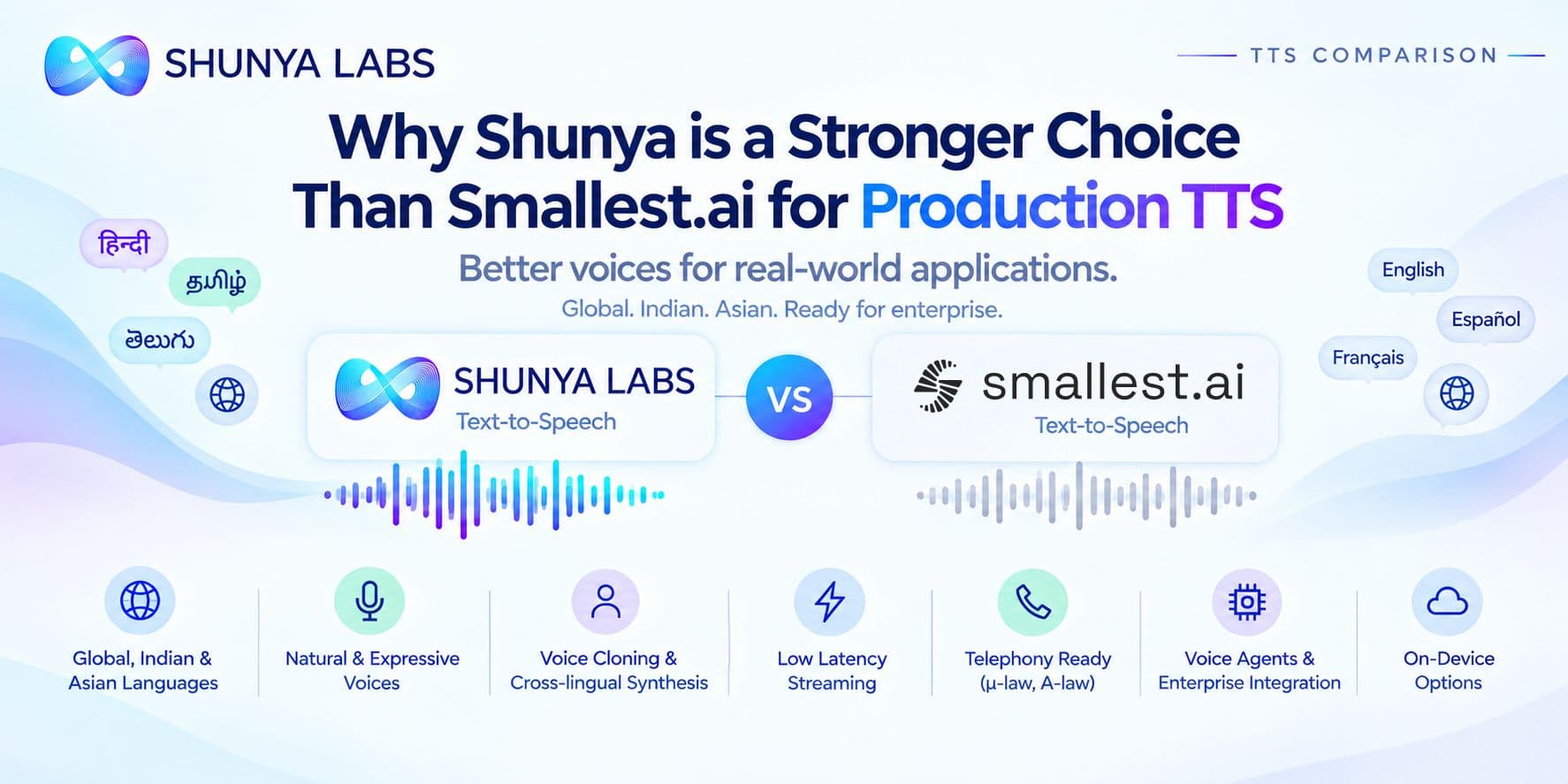
TL;DR , Key Takeaways:
- Smallest.ai is particularly strong for low-latency conversational TTS, streaming, pronunciation control, and real-time voice agents.
- Shunya combines TTS with a broader production voice stack covering global, Indian, and Asian languages, cross-lingual voices, voice cloning, expressive speech, telephony, and voice agents.
- Shunya’s documented TTS catalogue includes 46 voices with 11 expression styles.
- Smallest.ai’s current Lightning platform offers a 217-voice standard catalogue, while its Pro pool provides a smaller curated set of premium voices.
- Smallest.ai publishes approximately 200ms TTFB for Lightning v3.1 Pro and supports persistent WebSocket streaming.
- Shunya’s strongest differentiator is Indic and cross-lingual production voice capability, particularly when one brand voice needs to operate across Indian and Asian markets.
- Both platforms support voice cloning, pronunciation control, streaming, and real-time voice applications.
- Smallest.ai has a strong advantage in real-time TTS optimization and developer-focused streaming controls.
- Shunya has a stronger case for multilingual enterprise voice applications, Indian-language deployment, cross-lingual voice identity, telephony, and a broader STT + TTS + voice-agent platform.
Smallest.ai has built its TTS platform around one clear idea: make high-quality speech fast enough for real-time applications.
Its current Lightning TTS stack supports streaming over HTTP, SSE, and WebSocket, 44.1 kHz audio, voice cloning, pronunciation dictionaries, speed control, and multilingual generation. Its latest Lightning v3.1 Pro model is positioned for premium conversational TTS with a curated voice catalogue and ~200ms time to first byte.
That makes Smallest.ai particularly relevant for voice agents, conversational AI, IVR, and other latency-sensitive applications.
Shunya approaches the problem from a broader production perspective.
Shunya Zero TTS is designed around global, Indian, and Asian voice applications, with 46 documented voices across global, asian and 23 Indic languages, 11 expression styles, cross-lingual synthesis, voice cloning, streaming, and enterprise deployment options.
The difference is therefore not simply about which platform is faster.
It is about the complete system:
How natural does the voice sound?
Does it pronounce real business text correctly?
Can the same voice work across languages?
How well does it perform inside a voice agent?
Can it support telephony and enterprise deployment?
And perhaps most importantly:
Can it scale from TTS into a broader voice-AI stack?
Shunya and Smallest.ai at a glance
| Capability | Shunya Zero TTS | Smallest.ai Lightning |
|---|---|---|
| Language focus | Global, Indian and Asian languages | Global multilingual |
| Indic specialization | Dedicated Indic TTS | Indic + global support |
| Documented voice catalogue | 46 voices | 217 voices on standard pool |
| Indic voice catalogue | 23 Indic languages + English | Multiple Indic voices |
| Expression | 11 styles | Natural, expressive synthesis |
| Voice cloning | Yes | Yes |
| Cross-lingual voice identity | Yes | Yes / cross-language routing |
| Pronunciation controls | Yes | Pronunciation dictionaries + number controls |
| Streaming | HTTP / WebSocket | HTTP / SSE / WebSocket |
| Real-time focus | Yes | Core strength |
| Telephony formats | μ-law, A-law and more | μ-law, A-law and more |
| On-device options | Yes | Available models/options |
| Enterprise deployment | Cloud, private, on-premise, edge | Cloud, on-premise, on-device options |
| Broader voice stack | STT + TTS + voice agents + SLMs | STT + TTS + managed agent stack |
Smallest.ai’s current documentation distinguishes its standard Lightning v3.1 catalogue from Lightning v3.1 Pro, so voice count and language availability depend on the selected model.
Voice quality is more than a low-latency demo
Smallest.ai’s Lightning models are designed for natural prosody, intonation, conversational rhythm, and real-time generation. Its current Pro model is positioned as a premium 44.1 kHz voice pool for conversational applications.
That is exactly what a modern TTS system needs.
But production voice quality has another dimension.
The voice must remain natural when the text becomes difficult.
Consider:
“Your payment of ₹1,25,499.50 has been received.”
Or:
“Your reference number is AB-2047-X.”
Or:
“Your appointment is scheduled for 12 October at 10:30 AM.”
A system can sound excellent on ordinary sentences and still struggle with numbers, acronyms, names, codes, currencies, and technical terminology.
For enterprise TTS, correctness and naturalness have to be evaluated together.
Pronunciation is one of the most important production features
This is an area where Smallest.ai has invested heavily.
Lightning supports custom pronunciation dictionaries for brand names, technical terms, and acronyms. Its newer releases also introduced a dedicated number_pronunciation_language control so developers can determine how numbers, currency, times, and numeric date components are spoken independently of the synthesis voice.
That’s useful for enterprise applications.
Shunya also supports pronunciation controls and language-aware TTS, with its API exposing pronunciation dictionaries, speed controls, multiple output formats, and explicit language selection.
The practical test is simple.
Give both systems:
₹25,499.50
AB-2047-X
12 October 2026
500 mg
Then listen.
The system that sounds more human in a generic demo isn’t necessarily the one that produces the better production voice.
Shunya’s Indic voice specialization is a different proposition
Smallest.ai has significantly expanded its multilingual TTS offering.
Its Lightning v3.1 Pro documentation currently lists 10 Indic languages, 8 Asian and Middle Eastern languages, and 13 European languages in the Pro voice catalogue.
The standard Lightning catalogue also contains a growing set of Indian voices.
Shunya’s approach is more explicitly Indic-first.
The Zero TTS Indic platform is built around Indian languages, dialects, regional pronunciation, and native phonetics, while the main TTS product extends into broader global and Asian voice applications.
Its documented voice catalogue provides dedicated male and female voices across 23 Indic languages plus English.
That makes the distinction less about:
“Who supports Indian languages?”
and more about:
“How deeply is Indian speech integrated into the product?”
For an Indian customer-service application, that can matter when the text contains:
Local names
Indian places
Regional terms
English words inside Indian-language sentences
Indian currency
Regional pronunciation
This is one of the areas where Shunya has a clear specialization.
One brand voice across multiple languages
A multilingual enterprise often wants more than translation.
It wants identity.
Imagine the same assistant speaking:
English
then Hindi
then Tamil
then Japanese.
If the voice changes dramatically each time, the customer experiences what feels like a different assistant.
Shunya’s TTS architecture separates voice identity from language, allowing a voice to speak across supported languages. Its documentation explicitly states that the voice parameter controls vocal character while the text determines the language.
That is useful for:
Global brands
Multilingual customer support
Banking assistants
Telecom
Healthcare
Government services
Smallest.ai also supports cross-language routing and says an English or Hindi voice can be used across supported languages when using its cross-language behavior.
So both support multilingual voice identity.
The important benchmark is how consistent the same voice sounds across languages, especially between English and regional languages.
Voice libraries: Smallest.ai offers more catalogue breadth
Smallest.ai currently exposes a 217-voice standard Lightning catalogue, with a separate curated Pro pool.
That gives developers a substantial amount of choice.
Shunya’s documented catalogue is smaller, at 46 voices across 23 Indic languages plus English.
But this is another example of different product priorities.
Smallest.ai gives developers a broader voice catalogue within its model pools.
Shunya puts more emphasis on purpose-built production voices across Indian and multilingual enterprise use cases.
For applications where you need dozens of voices with different personalities, Smallest.ai’s catalogue can be useful.
For a brand looking for a small set of consistent voices across languages, the catalogue size may matter less than voice quality and cross-lingual consistency.
Voice cloning is becoming standard
Both platforms support voice cloning.
Smallest.ai’s current Lightning documentation says its voice cloning workflow can clone a voice from 5–15 seconds of audio on the standard pool, and its latest updates also added cloning support to the Pro pool.
Shunya also supports cloning from a short reference recording and can use cloned voices across its supported language stack.
So the useful question isn’t:
“Does it clone voices?”
Both do.
Test:
Clone similarity
Voice consistency
Cross-lingual consistency
Long-form stability
Latency
Performance after telephony compression
For enterprise applications, the ability to use the same cloned identity across multiple languages can be more valuable than cloning alone.
Voice cloning should always be used with the appropriate consent and rights from the voice owner.
Latency is one of Smallest.ai’s strongest advantages
Smallest.ai makes latency a central part of the Lightning architecture.
Its current Lightning v3.1 Pro model publishes approximately 200ms TTFB, with 3.3× real-time factor, and supports HTTP, SSE, and WebSocket streaming.
Its WebSocket API is particularly useful when text arrives incrementally from an LLM.
The platform can buffer fragments through a context_id, join them at natural sentence boundaries, and preserve prosody across chunks rather than treating every LLM fragment as a new TTS request.
That is an important real-time capability.
Shunya also provides WebSocket streaming TTS, designed for conversational and voice-agent workloads.
The correct production benchmark is therefore not:
“Which vendor has the lowest published latency?”
It is:
LLM generates text → TTS starts audio → user hears the response
Measure time to first audible speech under the same network, chunking, and model conditions.
Streaming architecture matters when the LLM streams tokens
A voice agent often doesn’t wait for the LLM to produce an entire paragraph.
It receives text incrementally.
For example:
“Sure, I can help you with…”
followed a moment later by:
“…your account.”
The TTS engine needs to handle those fragments naturally.
Smallest.ai’s latest WebSocket implementation specifically supports this pattern through context_id, buffering fragments and carrying prosody across successive chunks.
That’s a strong developer-focused feature.
Shunya’s WebSocket streaming architecture also supports real-time audio generation for conversational pipelines.
This is an important benchmark for any LLM-powered voice agent.
Don’t test a 500-word paragraph.
Test streaming LLM output token by token.
Telephony is a separate TTS challenge
Enterprise voice often runs through:
IVRs
Contact centers
Outbound calling
Phone-based assistants
Studio-quality audio is only part of the problem.
You need to consider:
8 kHz audio
μ-law
A-law
Buffering
Streaming
Speech clarity after compression
Smallest.ai supports PCM, MP3, WAV, μ-law, and A-law, with sample rates including 8 kHz through 44.1 kHz.
Shunya also supports μ-law and A-law, along with PCM, WAV, MP3, OGG Opus, and FLAC.
So both are suitable for telephony workflows.
The meaningful test is how the voices behave after they enter an actual phone call.
TTS becomes more useful when it connects to the rest of the voice stack
Smallest.ai has expanded beyond TTS as well.
Its current platform includes Lightning TTS, Pulse STT, and Hydra speech-to-speech, while its product messaging targets real-time voice agents and conversational applications.
This gives developers a path toward building more of the voice stack from one provider.
Shunya has taken a similar broader-platform direction.
The Shunya Platform combines:
STT
TTS
Voice agents
Custom SLMs
Edge speech understanding
Knowledge-grounded AI
That means TTS can be integrated directly into a larger speech-to-intelligence-to-voice workflow.
For an enterprise building a complete conversational system, that broader architecture can be more important than standalone TTS performance.
On-device and private deployment
Smallest.ai’s documentation and current product materials describe on-device and on-premise options, depending on the model and deployment.
Shunya also provides private, on-premise, and edge-oriented deployment, including an on-device model family.
This matters for applications where audio cannot always be sent to a public cloud:
Healthcare
Financial services
Government
Industrial systems
Retail devices
Edge assistants
The relevant evaluation should include:
Data residency
Network dependency
Hardware requirements
Inference location
Latency
Offline behavior
A TTS provider may look identical on a public API and completely different once the requirement becomes local inference.
Pricing: compare cost at your actual volume
Smallest.ai’s current model pricing page lists Lightning TTS at $0.175 per 10,000 characters, with its current model selection centered on Lightning v3.1 and v3.1 Pro.
The current Pro model documentation lists approximately $0.195 per 10,000 characters on its standard plan.
This difference illustrates why buyers should check the exact model and pricing tier being used rather than relying on a single headline number.
Shunya provides model and enterprise pricing through its pricing page.
For a production TTS evaluation, calculate:
Cost per million characters
Cost per generated minute
Cost at peak concurrency
Cost of cloned voices
Cost of required model tier
Cost of downstream voice infrastructure
The cheapest characters are not necessarily the cheapest voice system.
Where Smallest.ai is the better choice
Smallest.ai is particularly compelling when you prioritize:
Real-time TTS
Lightning is built specifically around low-latency streaming.
Streaming LLM output
Its context_id functionality is designed to preserve prosody across incremental text fragments.
Pronunciation control
Custom dictionaries and dedicated number-pronunciation controls are strong developer features.
Voice catalogue breadth
The standard Lightning catalogue currently contains 217 voices.
Voice-agent infrastructure
Smallest.ai’s broader platform now includes STT, TTS, and speech-to-speech capabilities.
For teams primarily building real-time conversational voice products, Smallest.ai is a strong option.
Where Shunya makes a stronger case
Shunya is particularly compelling when:
Indian voice applications are central
Zero TTS Indic is specifically designed around Indian speech, pronunciation, regional variation, and Indic voices.
You need a consistent voice across languages
Shunya supports cross-lingual voice synthesis, separating voice identity from the language being spoken.
Global, Indian, and Asian coverage are all important
Shunya’s TTS positioning spans these markets rather than focusing only on one language family.
You need enterprise-oriented expression
Shunya provides 11 explicit voice styles, including Conversational, News, Narrative, Happy, Sad, and Enthusiastic.
Telephony is important
Shunya supports μ-law and A-law, making it suitable for phone-based applications.
TTS is part of a larger voice-AI architecture
The Shunya Platform connects STT, TTS, voice agents, SLMs, edge AI, and knowledge-grounded systems.
You need edge-oriented inference
Shunya On-Device Models provide a path for local voice processing.
Shunya vs Smallest.ai by use case
| Use case | Stronger fit |
|---|---|
| Real-time voice agents | Both |
| Ultra-low-latency streaming | Smallest.ai |
| Streaming LLM output | Smallest.ai |
| Pronunciation dictionaries | Both |
| Number pronunciation controls | Smallest.ai |
| Creative narration | Both |
| Indian-language TTS | Shunya |
| Indian multilingual voice agents | Shunya |
| Cross-lingual enterprise voice identity | Shunya |
| Global multilingual voice agents | Both |
| Telephony TTS | Both |
| Voice cloning | Both |
| Large voice catalogue | Smallest.ai |
| Enterprise voice applications | Both |
| Edge voice applications | Shunya / Both |
| Broader STT + TTS + voice-AI stack | Both |
How to benchmark Shunya and Smallest.ai
The best TTS comparison uses the same text, comparable voices, the same language, and the same environment.
Build a test set containing:
Conversation
Questions
Numbers
Currency
Dates
Names
Acronyms
URLs
Product codes
Indian-language text
Code-switched text
Then measure:
Naturalness
Does the voice sound human over short and long responses?
Pronunciation
Does it pronounce names, numbers, brands, and terminology correctly?
Prosody
Does emphasis and pacing sound natural?
Expression
Can the voice communicate the required tone?
Voice consistency
Does the voice maintain the same identity across repeated generations and languages?
Time to first audio
How quickly does the user actually hear the response?
Streaming stability
Does the voice remain natural when text arrives in small LLM-generated fragments?
Telephony quality
How does it sound after 8 kHz audio encoding?
Cost
What is the actual cost at your production volume?
For a voice agent, add one more metric:
Time from user finishing speech to first audible response.
That’s the number users actually experience.
Final words
Smallest.ai has built a strong TTS platform around real-time performance.
Its Lightning models provide streaming, voice cloning, pronunciation dictionaries, number-pronunciation controls, expressive speech, 44.1 kHz audio, and a growing voice catalogue, with Lightning v3.1 Pro currently positioned around ~200ms TTFB.
For teams building real-time voice agents and conversational applications, those are meaningful capabilities.
Shunya’s approach is broader.
Its TTS stack is designed around global, Indian, and Asian voice applications, with Indic-focused voices, cross-lingual synthesis, voice cloning, expressive styles, streaming, telephony formats, and enterprise deployment.
The strongest Shunya differentiator is therefore not simply speed.
It is the combination of:
Indian voice specialization
Cross-lingual voice identity
Production-oriented expression
Telephony support
Voice cloning
and integration with a broader STT + TTS + voice-agent + SLM stack.
Smallest.ai may be the stronger choice when the priority is extremely fast conversational TTS and streaming-first voice-agent development.
Shunya becomes particularly compelling when the application needs Indian and Asian voices, multilingual brand identity, enterprise telephony, and a broader voice-AI architecture.
The best way to decide is simple:
Take the text your application actually generates and make both systems speak it.
Test the names.
Test the numbers.
Test the currency.
Test the Indian languages.
Test the code-switching.
Test streaming LLM output.
Then measure first-audio latency, pronunciation, naturalness, voice consistency, telephony quality, and cost.
Because the best TTS system isn’t the one with the most impressive demo.
It’s the one that continues to sound right when your application goes into production.
Frequently asked questions
Is Shunya better than Smallest.ai?
It depends on the workload. Smallest.ai is particularly strong for low-latency conversational TTS and streaming voice agents. Shunya is particularly strong for Indian-language TTS, cross-lingual voice identity, enterprise voice applications, telephony, and broader voice-AI infrastructure.
Which has more voices?
Smallest.ai’s current standard Lightning catalogue contains 217 voices, while Shunya’s documentation lists 46 voices across 23 Indic languages plus English.
Does Smallest.ai support Indian languages?
Yes. Its current Lightning models support multiple Indic languages, including Hindi, Tamil, Kannada, Marathi, Telugu, Malayalam, Gujarati, Punjabi, Bengali, and Odia.
Does Shunya support Indian languages?
Yes. Shunya’s Zero TTS Indic offering is specifically designed around Indian languages, regional pronunciation, and Indic speech patterns.
Does Smallest.ai support voice cloning?
Yes. Lightning supports voice cloning from approximately 5–15 seconds of audio, and current documentation also confirms cloning support on the Pro pool.
Does Shunya support voice cloning?
Yes. Shunya supports voice cloning and cross-lingual synthesis through its TTS platform.
Which has lower latency?
Smallest.ai currently publishes approximately 200ms TTFB for Lightning v3.1 Pro. Shunya also provides low-latency WebSocket streaming. Because vendors measure latency differently, production buyers should compare time to first audible response under identical conditions.
Does Smallest.ai support pronunciation dictionaries?
Yes. Lightning provides custom pronunciation dictionaries for specialized vocabulary, brand names, and domain terminology.
Does Smallest.ai support number pronunciation?
Yes. Lightning v3.1 introduced a dedicated control for numbers, currency amounts, times, and numeric date components.
Does Shunya support telephony?
Yes. Shunya supports μ-law and A-law alongside other common audio formats.
Which is better for real-time voice agents?
Both are strong options. Smallest.ai has a particularly strong streaming-first architecture, while Shunya combines TTS with STT, speech intelligence, voice agents, and other voice-AI components.
Which is better for Indian enterprise voice applications?
Shunya has a particularly strong proposition where the application depends on Indic voices, regional pronunciation, cross-lingual voice identity, telephony, and enterprise voice agents.
Which is cheaper?
Smallest.ai currently lists Lightning TTS from $0.175 per 10,000 characters, while its Pro model documentation lists approximately $0.195 per 10,000 characters. Shunya uses its own model and enterprise pricing structure.
The fairest comparison depends on your actual volume, model, concurrency, and required features.
How should I compare Shunya and Smallest.ai?
Use the same production text and compare naturalness, pronunciation, expression, voice consistency, first-audio latency, streaming behavior, telephony quality, and cost at your expected scale.

Bio: Navvya works at the intersection of product strategy and applied AI research at Shunya Labs. With a background in human behaviour and communication, she writes about the people, markets, and technology behind voice AI, with a particular focus on how speech interfaces are reshaping access across emerging markets.