

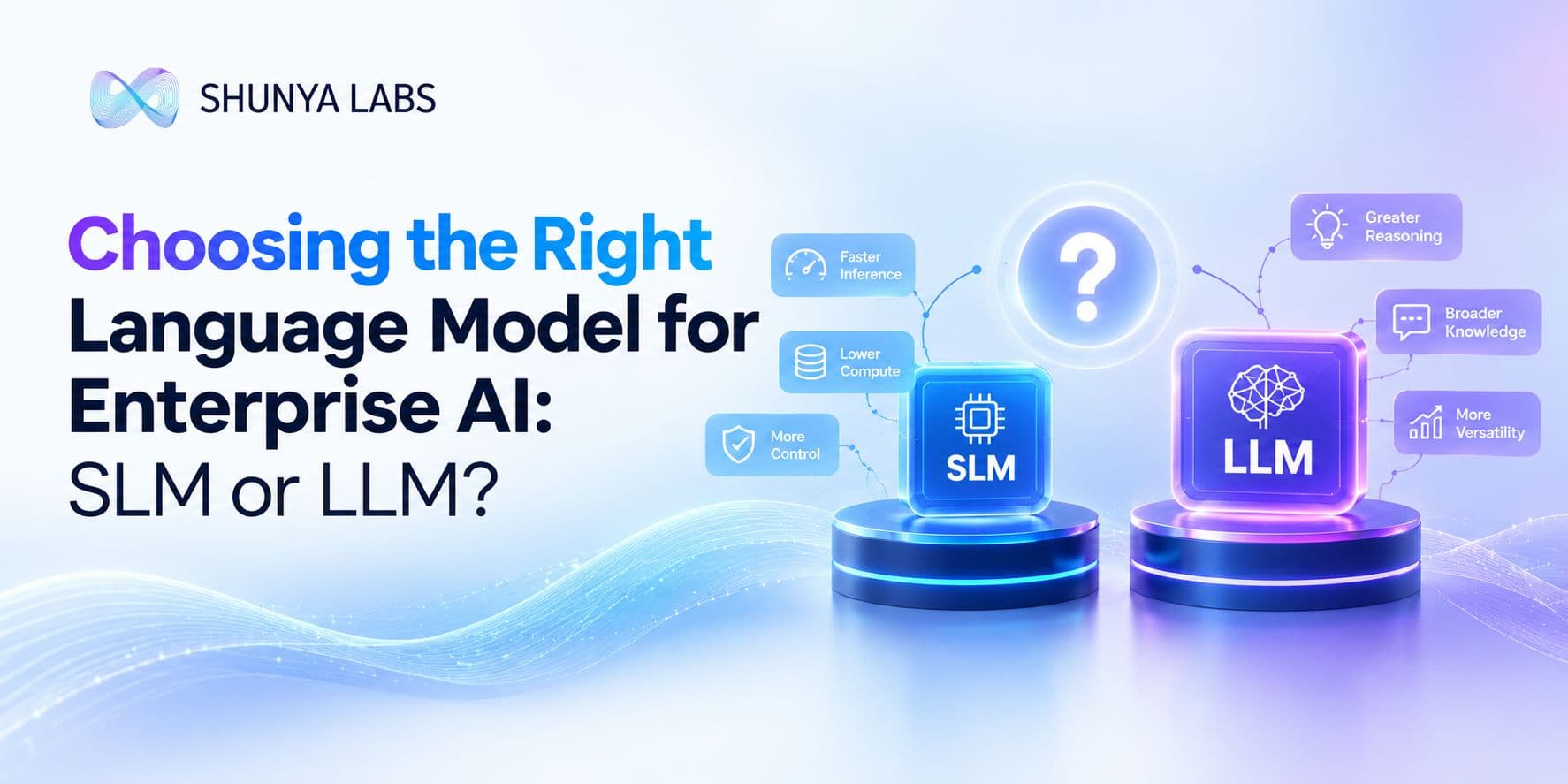
Choosing the Right Language Model for Enterprise AI: SLM or LLM?
TL;DR , Key Takeaways:
- SLMs are compact models designed for efficient inference and are particularly useful for focused, repeatable enterprise tasks.
- LLMs generally provide broader knowledge and stronger flexibility for complex, open-ended reasoning.
- There is no universal parameter threshold that defines an SLM. The category is relative to the models and workloads being considered.
- SLMs can reduce latency, infrastructure requirements, and operating cost, and they are often easier to deploy on private infrastructure or at the edge.
- An LLM can be preferable when the task requires broad knowledge, complex reasoning, long-context interpretation, or flexible generation.
- Fine-tuning and retrieval can make smaller models considerably more useful for specialized enterprise workloads.
- A hybrid architecture can route simple, high-volume requests to an SLM while escalating complex cases to an LLM.
- For voice AI, an SLM can handle tasks such as intent recognition, entity extraction, routing, policy checks, and other low-latency decisions, while a larger model handles more complex reasoning.
- Shunya builds purpose-trained Custom SLMs around enterprise data, terminology, workflows, and decision processes, with a focus on predictable production behavior and model ownership.
- The right enterprise metric is not simply parameters or price per token. Evaluate accuracy, latency, throughput, infrastructure cost, deployment requirements, and cost per completed task.
The SLM vs LLM discussion is often framed as a simple choice between a smaller model and a larger one.
For enterprise AI, that framing is too narrow.
The better question is:
What is the smallest model that can reliably perform this task at the required accuracy, latency, cost, privacy level, and scale?
A Small Language Model (SLM) can be a strong fit for focused, repetitive, high-volume tasks where low latency, lower infrastructure requirements, and deployment control matter. A Large Language Model (LLM) is generally more useful for open-ended reasoning, broad knowledge, complex instructions, and tasks where flexibility matters more than inference efficiency. AWS and Red Hat both describe these as key tradeoffs, while AWS also notes that the definition of an SLM is evolving rather than tied to one fixed parameter count.
For most enterprises, the answer does not have to be one model everywhere.
A better architecture can be:
SLM for focused work + LLM for complex work + routing between them.
This article explains how to choose between small language models and large language models for enterprise AI, when to use each, where custom SLMs make sense, and how to evaluate the economics and deployment requirements before making a model decision.
SLM vs LLM: What is the difference?
A Large Language Model is designed to handle a broad range of language tasks. It can summarize, generate, reason, answer questions, interpret context, write code, use tools, and handle tasks that were not narrowly defined during model development.
A Small Language Model is generally more compact and is often optimized for efficiency or a narrower scope.
That does not mean an SLM is simply an inferior LLM.
A well-designed smaller model can perform extremely well on a specific task, especially when it is fine-tuned or otherwise adapted to that domain. AWS specifically notes that SLMs can achieve comparable or even superior performance on specialized applications, while requiring fewer resources and offering faster inference.
The distinction is therefore better understood as:
| Small Language Model | Large Language Model | |
|---|---|---|
| Primary strength | Focused tasks | Broad capability |
| Knowledge | More specialized | Broad and general |
| Inference | Typically more efficient | Typically more resource-intensive |
| Latency | Often lower | Often higher |
| Customization | Often easier for targeted tasks | More expensive or complex at scale |
| Infrastructure | Smaller footprint | Larger infrastructure requirements |
| Edge deployment | Often practical | Usually more demanding |
| Privacy / private deployment | Often easier | Depends on model and infrastructure |
| Complex reasoning | Task-dependent | Generally stronger for broad reasoning |
| High-volume narrow workflows | Strong fit | Can be unnecessarily expensive |
| Open-ended tasks | More limited | Strong fit |
These are general architectural tendencies, not guarantees for every model.
What actually makes a model “small”?
One common mistake is treating parameter count as a universal definition.
There isn’t a single number at which a model becomes an SLM.
AWS describes SLMs as compact models that are often below roughly 20 billion parameters, while explicitly noting that the definition is evolving as model sizes and architectures change. Other current enterprise guidance similarly treats SLM as a relative category rather than a strict boundary.
This matters because modern model architectures are not always comparable simply by parameter count.
A model with:
2B parameters
and another with:
8B parameters
may behave very differently depending on:
Architecture
Training data
Fine-tuning
Quantization
Context length
Inference hardware
Task
For enterprises, therefore, the useful question isn’t:
“How many parameters does this model have?”
It is:
“How much model capacity does this workload actually need?”
When should an enterprise use an SLM?
SLMs tend to make the most sense when the task is well-defined and repeatable.
Typical examples include:
Intent classification
Entity extraction
Document classification
Routing
Structured information extraction
Policy checks
Spam or fraud signals
Customer segmentation
Workflow decisions
Text normalization
Speech and voice-agent intelligence
For these tasks, the model does not necessarily need to know everything about the world.
It needs to do one thing very reliably.
For example, a customer-support system might need to classify a request into:
Refund
Order status
Account issue
Technical support
Human escalation
A general-purpose LLM can perform this task.
But running a large model for millions of relatively simple classifications may not be the most efficient architecture.
A purpose-trained SLM can be optimized for the exact classification problem.
This is one reason enterprise AI teams are increasingly looking at model specialization rather than model size alone.
When should an enterprise use an LLM?
LLMs remain extremely useful when the problem is difficult to define in advance.
Consider:
Complex research
Open-ended analysis
Long documents
Advanced reasoning
Complex coding
Multistep planning
Broad knowledge questions
Novel user requests
These tasks benefit from a wider capability envelope.
An enterprise employee asking:
“Review these five policy documents, identify the conflicting clauses, explain the implications, and draft a revised policy.”
is asking for something much more complex than:
“Classify this support ticket.”
The first may justify an LLM.
The second may not.
The key principle is task complexity.
The strongest enterprise architecture is often hybrid
The most useful conclusion from the SLM vs LLM discussion is that enterprises do not necessarily need to choose only one.
A hybrid architecture can route requests based on complexity.
For example:
Customer request
↓
Lightweight classifier
↓
Simple request?
→ SLM
Complex request?
→ LLM
This can also work with confidence thresholds.
For example:
High-confidence, repetitive task
→ SLM
Low-confidence task
→ LLM
Exception or sensitive case
→ Human
This architecture is already being discussed in current enterprise guidance as a way of balancing cost, latency, accuracy, and model capability.
It also creates a practical form of AI model routing.
The largest model becomes a resource reserved for the requests that actually need it.
SLM vs LLM for enterprise AI cost
Cost is one of the strongest reasons to consider an SLM.
But model price is not the same thing as AI cost.
For API-based models, enterprises often compare:
Price per million tokens
That is useful, but it leaves out important variables.
Your actual cost also depends on:
How many tokens the model needs
How often it is called
How many turns an agent takes
Context length
Concurrency
GPU utilization
Hosting
Quantization
Retrieval
Tool calls
Retries
AWS’s current guidance on production inference specifically points to model architecture, quantization, workload shape, throughput, latency, and infrastructure as factors that affect the economics of serving language models.
This is why a better enterprise metric is:
Cost per completed task
rather than:
Cost per token
Imagine two systems:
System A
$X per million tokens
95% task completion
System B
$2X per million tokens
99.5% task completion
The second system could be cheaper in practice if incorrect outputs create costly manual reviews, customer escalations, or failed transactions.
Enterprise AI needs to be measured at the workflow level.
SLM vs LLM for latency
Latency matters differently depending on the application.
A few hundred milliseconds may not matter for a document summarization task.
It matters considerably more when an AI agent is having a live conversation.
For example:
Customer speaks
→ Speech recognition
→ Intent
→ Knowledge retrieval
→ Reasoning
→ Tool call
→ Response
Every component adds latency.
This is particularly important for Voice Agents, where the user experiences the complete conversational loop, not just model inference.
A smaller model can help reduce the reasoning portion of that loop, especially for narrow decisions.
Shunya’s current voice-agent architecture combines STT, knowledge-grounded reasoning and TTS, and its documentation describes low-latency SLM inference as part of the decision stage.
For simple voice-agent tasks, an SLM can therefore handle:
Intent
Entity extraction
Routing
Policy checks
Structured decisions
while a larger model can remain available for more complex requests.
SLMs can make private AI more practical
One of the biggest enterprise considerations is where the model runs.
An organization may not want every request to travel to a public cloud API.
Reasons can include:
Data sovereignty
Privacy
Regulatory requirements
Network constraints
Latency
Intellectual property
Air-gapped environments
AWS specifically identifies financial services, healthcare, telecom, and manufacturing as examples of industries where on-premise or edge deployment can matter, and discusses SLMs as a practical option for these environments.
A smaller model generally has fewer infrastructure requirements.
That can make deployment on:
Private servers
Edge systems
Industrial infrastructure
Branch locations
more practical.
Shunya supports Cloud, Private VPC, On-Premise and Edge deployment, allowing enterprises to choose where their AI infrastructure runs.
SLMs and edge AI
Edge deployment is one of the clearest cases for smaller models.
An AI system running on a device may have:
Limited memory
Limited CPU
No GPU
Unreliable connectivity
Strict latency requirements
An enormous model is usually difficult to run under those constraints.
Compact models can make local inference practical.
For example, Shunya’s On-Device Models are designed for CPU-based, offline and embedded deployments, with model packages optimized for phones, kiosks, vehicles and other constrained devices.
The broader principle applies beyond speech.
If an enterprise needs AI to operate where the data is generated, model size becomes an architectural consideration rather than just a benchmark number.
SLMs are particularly useful when the domain is narrow
A general-purpose model has to perform well across many possible tasks.
A custom enterprise model has a smaller target.
For example, consider healthcare.
A general AI system may need to understand:
Clinical terminology
Drug names
Procedure names
Abbreviations
Hospital workflows
Internal policies
A specialized model can be trained and evaluated around those specific requirements.
The same idea applies to:
Banking
Insurance
Logistics
Telecom
Customer support
Legal operations
This is where Custom SLMs become particularly relevant.
Shunya’s Custom SLM offering is positioned around training models on an organization’s terminology, workflows, decision processes and enterprise knowledge, with the resulting model owned and deployable within the customer’s environment.
The goal is not simply to make a model smaller.
It is to make the model more specialized.
Custom SLM vs general-purpose LLM
A custom SLM can be useful when an enterprise has a stable, clearly defined domain.
For example:
“Determine whether this insurance claim requires manual review.”
The model may need to understand:
Policy language
Claim attributes
Eligibility rules
Exception conditions
Required output format
It doesn’t necessarily need broad world knowledge.
A custom model can therefore be trained around the exact problem.
This can provide:
More predictable outputs
Lower inference requirements
Faster response
Better domain vocabulary
Greater deployment control
Shunya’s current Custom SLM architecture emphasizes enterprise vocabulary, workflow-aware reasoning, sovereign deployment and predictable behavior.
However, a custom SLM is not automatically the right choice.
If the task changes every week, requires broad external knowledge, or demands sophisticated open-ended reasoning, an LLM may remain more practical.
SLM vs LLM: fine-tuning, RAG, or both?
Model selection is only one part of the architecture.
Enterprises also need to decide how the model gets the information it needs.
There are three common approaches.
Prompting
Give the model instructions at runtime.
Best for:
Changing behavior
Output formatting
Simple constraints
RAG
Retrieve relevant information from an external knowledge source at runtime.
Best for:
Frequently changing knowledge
Internal documents
Policies
Product information
Fine-tuning
Train the model to behave differently for a specific task or domain.
Best for:
Consistent behavior
Task specialization
Domain terminology
Structured outputs
These approaches can be combined.
For example:
Custom SLM
RAG
Business rules
can be a strong architecture for a narrow enterprise workflow.
AWS similarly notes that RAG and fine-tuning can improve the performance of SLMs on specific domains while reducing the limitations of their smaller parametric knowledge base.
SLM vs LLM for voice agents
Voice AI is one of the clearest examples of where a hybrid model strategy makes sense.
A modern enterprise voice agent may look like:
Customer
↓
↓
Intent / Entity Detection
↓
SLM
↓
↓
LLM when required
↓
Business Action
↓
↓
Customer
For example:
“What’s my current account balance?”
That may be a simple retrieval task.
But:
“I lost my job last month, my EMI is due Friday, and I want to understand what options I have without damaging my credit history.”
requires considerably more reasoning.
A useful architecture can route those requests differently.
This is the broader idea behind purpose-trained intelligence: use the right amount of model capability for the actual task.
Shunya’s platform brings together STT, TTS, Speech Intelligence, Voice Agents, and Custom SLMs as part of one enterprise AI stack.
How to choose between an SLM and an LLM
Before choosing a model, score the workload across these questions.
| Question | Favors SLM | Favors LLM |
|---|---|---|
| Is the task narrow and repeatable? | Yes | |
| Does it need broad knowledge? | Yes | |
| Is latency critical? | Yes | |
| Is volume very high? | Yes | |
| Is the output highly structured? | Yes | |
| Does it require complex reasoning? | Yes | |
| Does it need broad context? | Yes | |
| Must it run on private hardware? | Often | Depends |
| Must it run on edge devices? | Often | Rarely practical |
| Does the task change frequently? | Often | |
| Is model behavior highly domain-specific? | Yes | |
| Are unexpected requests common? | Yes | |
| Is the workload cost-sensitive? | Often | Depends |
The best decision usually comes from the workload, not the model’s benchmark position.
A practical enterprise decision framework
A simple model-selection process is:
Step 1: Define the task
What exactly does the model need to do?
Step 2: Define the accuracy bar
What happens when it gets something wrong?
A wrong marketing summary is very different from a wrong financial transaction decision.
Step 3: Measure latency
How quickly must the system respond?
Step 4: Estimate volume
10 requests per hour and 10 million requests per day are completely different economics.
Step 5: Assess data sensitivity
Does the information contain:
PII
financial data
medical data
proprietary information
regulated information?
Step 6: Decide where inference should run
Cloud
Private VPC
On-premise
Edge
Step 7: Test customization
Can the model understand your:
terminology
entities
workflows
rules
output formats?
Step 8: Benchmark the complete workflow
Don’t test the model in isolation.
Test:
Input → model → retrieval → tools → output → business result
That produces a much more useful decision than comparing parameter counts.
A good enterprise architecture may use both
The strongest enterprise AI architecture is often not:
SLM or LLM
It is:
SLM + LLM + routing
For example:
80% simple requests
→ SLM
15% moderately complex
→ larger model
5% high-risk or uncertain
→ LLM + human review
The exact percentages will vary by workload.
The architecture should be based on measured traffic rather than assumptions.
This approach can provide:
Lower average latency
Lower inference cost
Better scalability
More predictable workloads
while preserving access to a larger model when complexity requires it.
That is one reason current enterprise discussions are increasingly moving toward right-sizing models for individual workloads rather than choosing one model for the entire organization.
How Shunya approaches custom SLMs
Shunya’s approach is to start with the enterprise problem rather than starting with an arbitrary model size.
Its Custom SLM platform describes a process built around:
Enterprise data
Terminology
Customer language
Intents
Workflows
SOPs
The resulting model is purpose-trained around the organization’s specific requirements. Shunya also positions custom models around lower latency, lower infrastructure cost, predictable behavior, and customer model ownership.
That is particularly relevant when the enterprise’s competitive advantage is not generic knowledge.
It is its proprietary operating knowledge.
For example:
How a particular bank handles a disputed transaction
How an insurer evaluates a claim
How a healthcare organization handles a workflow
How a telecom operator routes a service request
That information is what makes the application useful.
How to benchmark an SLM against an LLM
Don’t compare models using only a public benchmark.
Create a test set from the actual enterprise workload.
Include:
Normal requests
Edge cases
Ambiguous inputs
Domain terminology
Long inputs
Unexpected inputs
Then measure:
Accuracy
How often does the system produce the correct result?
Critical error rate
How often does it make a mistake that materially affects the business?
Latency
Measure:
time to first token
total response time
and, where relevant, end-to-end workflow latency.
Throughput
How many concurrent requests can the system handle at the required performance level?
Infrastructure
How much:
CPU
GPU
memory
and storage are required?
Cost
Measure:
cost per request
cost per completed task
cost at production volume
Privacy and deployment
Can the system run in the environment required by the business?
Reliability
Does performance remain stable as traffic and context grow?
Shunya’s Benchmarks page provides published speech benchmarks, while its broader Platform brings model evaluation, production monitoring, and voice-AI infrastructure into the same environment.
The same principle should be used for language-model selection:
benchmark the workload, not the marketing claim.
Final words
Choosing between an SLM and an LLM isn’t really a contest between small and large.
It is a decision about how much intelligence a particular workload needs.
Use an LLM when the application depends on broad knowledge, flexible reasoning, complex instructions, or unpredictable requests.
Use an SLM when the task is narrow, high-volume, latency-sensitive, structured, domain-specific, or needs efficient private or edge inference.
And use both when the workload contains a mixture of simple and complex requests.
For many enterprises, this is the most practical architecture:
Small model for speed and scale
Large model for complexity
Routing for efficiency
Enterprise knowledge for grounding
Business rules for control
Shunya’s approach to Custom SLMs focuses on building models around enterprise terminology, workflows, decision processes and proprietary data, with deployment options that extend from cloud infrastructure to private and on-premise environments.
That same architecture extends naturally into Voice Agents, Speech Intelligence, Speech-to-Text, and On-Device AI.
The most useful question for an enterprise is therefore not:
“Should we use an SLM or an LLM?”
It is:
“Which model should handle which part of our AI workload?”
When model size is matched to task complexity, enterprises can build systems that are faster, more predictable, easier to control, and more economical to operate without giving up the reasoning capability of larger models where it is genuinely needed.
Frequently asked questions
What is an SLM?
A Small Language Model (SLM) is a relatively compact language model designed for efficient inference and often optimized for specific tasks or deployment environments. The category does not have one universally accepted parameter threshold.
What is an LLM?
A Large Language Model (LLM) is a broader-capability language model designed to handle a wide range of language tasks, including open-ended generation, reasoning, summarization, coding, question answering, and complex instructions.
Is an SLM better than an LLM?
Neither is universally better. An SLM can be a better fit for a focused, high-volume or latency-sensitive task, while an LLM can be a better fit for complex, open-ended workloads.
What are the advantages of SLMs for enterprise AI?
SLMs can provide lower inference requirements, lower latency, lower infrastructure cost, easier customization, and more flexible private or edge deployment for appropriate workloads.
When should an enterprise use an LLM?
Use an LLM when the task requires broad knowledge, complex reasoning, open-ended generation, large or varied contexts, or handling of unexpected requests.
Can SLMs replace LLMs?
For some workloads, yes. For others, no. A common enterprise architecture is to use an SLM for focused tasks and route more complex requests to an LLM.
What is the difference between an SLM and a fine-tuned LLM?
An SLM describes the model’s scale and intended efficiency, while fine-tuning describes how a model is adapted to a particular task or domain. A small model can be fine-tuned, and a large model can also be fine-tuned.
Is RAG better than fine-tuning?
They solve different problems. RAG is useful when the model needs access to information that changes or belongs in an external knowledge source. Fine-tuning is useful when you want to change the model’s behavior, task specialization, or output patterns.
Can an SLM use RAG?
Yes. RAG can provide an SLM with access to external enterprise knowledge while keeping the underlying model relatively compact. AWS specifically discusses combining SLMs with RAG and fine-tuning for specialized applications.
Are SLMs cheaper than LLMs?
They can be, especially for high-volume workloads, because smaller models generally require fewer computational resources. But the total cost also depends on hardware, hosting, concurrency, quantization, model accuracy, token usage, retrieval, and the number of turns required to complete a task.
Are SLMs faster than LLMs?
Smaller models typically require less computation and can therefore deliver lower inference latency, but actual performance depends on model architecture, hardware, optimization, and workload.
Can SLMs run on-premise?
Yes. Smaller language models are often more practical to deploy on private infrastructure because of their lower resource requirements. AWS specifically discusses SLMs for on-premise and edge deployments, including regulated industries.
Can SLMs run on edge devices?
Yes. Lightweight models can be deployed on devices with constrained compute and connectivity. Shunya’s On-Device Models are designed for CPU-based, offline and embedded speech AI workloads.
What are Custom SLMs?
Custom SLMs are smaller language models adapted or trained around an organization’s specific terminology, workflows, data, and decision requirements. Shunya’s Custom SLM platform is designed around this approach.
How do SLMs work in voice agents?
An SLM can handle focused tasks such as intent recognition, entity extraction, routing, policy checks, and structured decisions, while larger models can handle requests requiring broader reasoning. Shunya’s Voice Agent architecture combines speech recognition, grounded reasoning and speech synthesis.
How should enterprises choose between an SLM and an LLM?
Evaluate the task complexity, accuracy requirement, latency, request volume, data sensitivity, customization needs, deployment environment, infrastructure cost, and business impact of errors. Then benchmark the models using real enterprise workloads rather than relying only on public model benchmarks.

Bio: Navvya works at the intersection of product strategy and applied AI research at Shunya Labs. With a background in human behaviour and communication, she writes about the people, markets, and technology behind voice AI, with a particular focus on how speech interfaces are reshaping access across emerging markets.