

Why Smaller AI Models Are Faster: How SLMs Reduce Enterprise AI Latency
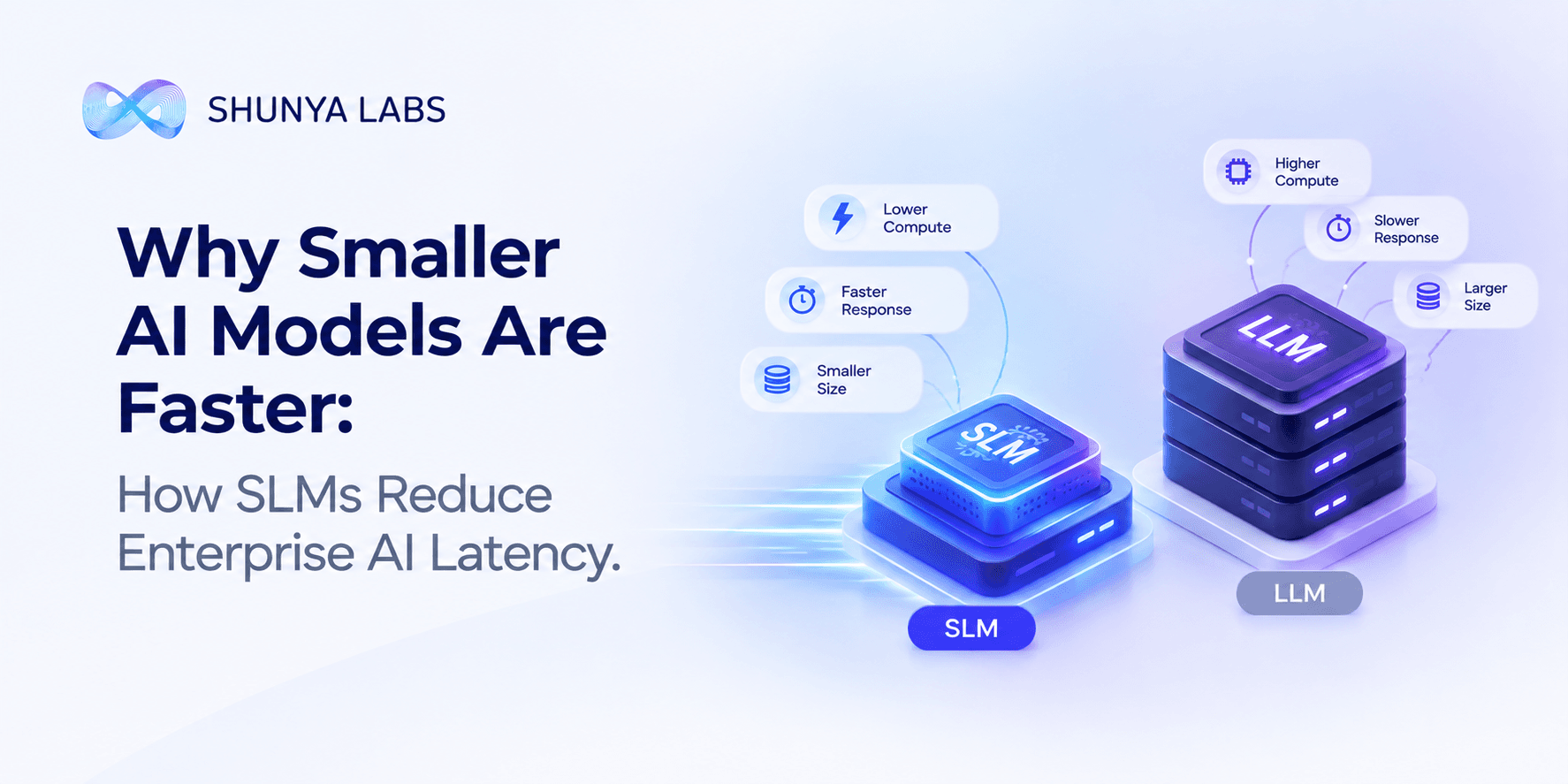
TL;DR , Key Takeaways:
- Smaller AI models can be faster because they require less computation and memory to process each request.
- Model size is only one factor. Prompt length, context, retrieval, output length, concurrency and infrastructurealso affect latency.
- An SLM is most useful when the task is narrow, repetitive, domain-specific, high-volume or latency-sensitive.
- A smaller model does not automatically mean lower accuracy. A purpose-trained model can be highly effective when its task is clearly defined.
- Knowledge graphs can make SLMs more capable by providing structured enterprise context instead of forcing the model to memorise the entire business.
- Smaller models can improve inference density, allowing more concurrent workloads on the same infrastructure.
- Smaller models can also make private, on-premises and edge deployment more practical.
- Enterprises do not need to choose between “use a large LLM for everything” and “use a small model for everything.” A model-routing architecture can use different levels of intelligence for different tasks.
- The goal is lower latency without sacrificing the accuracy and reliability the business actually needs.
When an AI application feels slow, the first assumption is often that the model needs more optimisation.
Sometimes that is true. But in many enterprise workloads, the bigger question is simpler:
Is the model doing more work than the task actually requires?
A large general-purpose model is designed to handle a very broad range of problems. That flexibility is valuable for complex reasoning, open-ended tasks and situations where the requirements are difficult to predict.
But enterprise AI often involves narrower, repeatable workflows.
A system may need to identify an intent, classify a request, extract information, route a conversation, understand domain terminology or determine which workflow should run next. These tasks do not always require a large general-purpose model.
This is where Small Language Models (SLMs) become interesting.
The goal is not to make AI smaller for the sake of making it smaller. The goal is to use the right amount of model capacity for the task, which can reduce inference work, improve latency, increase concurrency and lower infrastructure requirements.
Shunya’s current Custom SLM architecture is built around purpose-trained models for specific enterprise workflows, terminology and decision-making rather than using one general-purpose model for every task.
What makes a smaller AI model faster?
The simplest explanation is:
A smaller model generally has less computation to perform.
Language models contain parameters that are used during inference to transform an input into an output. As the model becomes larger, inference can require more compute and memory.
That does not mean parameter count alone determines speed. Hardware, optimisation, quantisation, context length, serving architecture and workload all matter.
But model size is an important part of the equation.
Imagine two systems handling the same narrow classification task.
- Model A is a very large general-purpose model capable of handling thousands of different reasoning patterns.
- Model B is a purpose-trained model designed specifically for that classification task.
Model A has much more capability than the workflow needs. Model B can focus its capacity on the actual problem.
That difference can translate into lower inference latency and more efficient use of infrastructure.
Why large models can be unnecessary for enterprise workflows
Large language models are extremely useful when the task requires broad reasoning.
For example, a complex research assistant may need to compare information from multiple sources, understand ambiguous instructions and generate a detailed response.
But many enterprise processes are more structured.
Consider these tasks:
- Classifying customer intent
- Routing a request to the correct workflow
- Extracting entities from a document
- Identifying a product or policy
- Detecting whether a workflow condition has been met
- Recognising domain-specific terminology
- Generating a structured output
- Determining the next step in a known process
A business may process millions of these requests.
Using a large model for every one can mean paying for capabilities that are rarely used.
A purpose-trained Custom SLM can instead be built around the language, workflows and terminology that actually matter to that enterprise. Shunya’s current architecture describes models trained around enterprise vocabulary, workflow-aware reasoning and decision-making processes.
The question is therefore not:
“Can a large model solve this task?”
It usually can.
The more useful question is:
“What is the smallest model that can solve this task reliably?”
Smaller does not mean less intelligent
One of the biggest misconceptions around SLMs is that a smaller model automatically means a less capable system.
That is too simplistic.
A general-purpose model needs to support a very wide range of tasks.
A specialised model can focus its capacity on one domain or workflow.
For example, a banking workflow may need to understand:
KYC terminology, account actions, transaction intents, compliance language and internal workflows.
A healthcare workflow may need:
medical terminology, clinical workflow states, patient interactions and specific structured outputs.
A customer-support system may need:
product names, issue categories, refund rules, escalation states and response routing.
A model trained around that environment is solving a much narrower problem than a general-purpose LLM.
That is one reason specialisation matters as much as size.
Where knowledge graphs fit
A smaller model does not need to store the entire enterprise inside its parameters.
This is where knowledge grounding becomes important.
A knowledge graph can represent relationships between enterprise entities such as:
Customer → owns → Account
Account → uses → Product
Product → governed by → Policy
Policy → applies to → Region
The model can then work with the relevant enterprise context instead of trying to memorise every relationship.
Shunya’s enterprise AI platform describes a knowledge graph layer for enterprise concepts including products, regulations, SOPs and workflows, combined with purpose-trained models and business rules.
This changes the role of the model.
Instead of:
Large model → remember everything → reason about everything
the architecture can become:
Knowledge graph → provide structure
Retrieval → provide relevant information
Custom SLM → understand and perform the task
Business rules → control deterministic decisions
That is a much more efficient way to build certain enterprise systems.
Why smaller models can reduce inference latency
There are several reasons smaller models can improve the speed of an AI workload.
1. Less computation
A smaller model generally requires fewer operations during inference.
That can reduce the time required to produce an output.
2. Lower memory pressure
Smaller models require less memory for their model weights and can be easier to keep available for inference.
That becomes particularly important when many requests arrive at the same time.
3. Higher inference density
If a workload uses less compute per request, the same infrastructure may be able to handle more concurrent requests.
Shunya’s current published Custom SLM benchmarks report 240+ concurrent users on a single L4 for its evaluated workload. The same benchmark page reports approximately 16× the inference density of its stated industry-typical reference.
This is why looking only at milliseconds per request is not enough.
An enterprise also needs to ask:
How many requests can this system handle at the same time?
Faster model loading and deployment
A smaller model can also be easier to package, move and deploy, particularly when applications need private or edge infrastructure.
That becomes important when the business cannot rely entirely on a large central cloud deployment.
Model size is not the only factor in latency
A smaller model does not automatically guarantee a faster AI application.
Latency is affected by the complete architecture.
For example:
User request → retrieval → model → API call → database → response
Even if the model responds quickly, the application can still feel slow if retrieval or external systems add significant delay.
This is why SLMs work best as part of an efficient architecture rather than as a standalone optimisation.
The system should minimise unnecessary work at every stage.
Smaller models can also reduce context requirements
Another source of latency is how much information the model needs to process.
A general-purpose LLM might be given:
system instructions + conversation history + retrieved documents + product information + business rules + tool results
That context can become very large.
A purpose-trained model can often operate within a more structured workflow.
Instead of asking it to reason through an enormous prompt, the architecture can provide:
intent → relevant entity → relevant knowledge → task
Knowledge graphs and targeted retrieval can help narrow that context before inference.
This creates an important relationship between the technologies:
smaller model + better knowledge architecture = less unnecessary computation
That is more useful than simply saying:
smaller model = faster AI
SLMs are especially useful for high-volume workflows
The economics become more interesting when a task happens thousands or millions of times.
Imagine a workflow that processes: 100 requests per day.
A small latency improvement may not matter much.
Now imagine: 1 million requests per day.
A small difference in compute per request can have a significant impact on total infrastructure requirements.
This is where purpose-trained SLMs can make sense.
They are particularly relevant for workloads that are:
- High volume
- Repetitive
- Narrowly defined
- Domain-specific
- Latency-sensitive
- Structured
- Sensitive to inference cost
Shunya’s published Custom SLM benchmarks also report approximately 20× lower inference cost for an equivalent workload in its stated benchmark comparison. That figure is specific to the published benchmark and should be evaluated against the workload and methodology used.
The underlying principle is broader:
When a task is repeated at scale, reducing unnecessary model capacity can materially change the economics of the system.
Smaller models can make edge AI more practical
Cloud infrastructure is not always the best place to run every AI task.
Some applications need: very low latency, offline operation, data privacy, local processing, low bandwidth requirements, CPU-only deployment.
A smaller model can make these constraints much easier to manage.
Shunya’s Zero Tiny ONNX models are currently packaged at 5–15 MB, designed for CPU-only inference and offline deployment without requiring a GPU.
That enables use cases such as:
- Mobile applications
- Retail kiosks
- Automotive systems
- Healthcare devices
- Industrial equipment
- Embedded voice interfaces
This is an important example of how model size can change not only latency but the deployment architecture itself.
A model small enough to run on a local CPU has very different infrastructure requirements from a large model that needs dedicated GPU infrastructure.
Smaller models can support private enterprise deployment
Some organisations cannot send every request to an external AI service.
They may need:
private infrastructure
VPC deployment
on-premises deployment
air-gapped environments
local processing
A smaller model can make these deployment options more practical because the infrastructure needed to serve the model can be substantially lighter.
Shunya’s enterprise platform is designed around multiple deployment environments, while its documentation describes CPU-compatible configurations that can run on commodity infrastructure.
This is especially relevant for BFSI, healthcare, government and other sensitive enterprise workflows, where data movement and infrastructure control can be important architectural constraints.
Smaller models do not have to work alone
The strongest enterprise architecture is rarely:
“Use an SLM for everything.”
It is:
“Use the right level of intelligence for each step.”
For example:
| Task | Suitable approach |
|---|---|
| Intent classification | Custom SLM |
| Entity extraction | Custom SLM |
| Workflow routing | Custom SLM + rules |
| Policy lookup | Knowledge graph + RAG |
| Structured decision | SLM + business rules |
| Complex reasoning | Larger LLM |
| Speech recognition | Specialised speech model |
| On-device command recognition | Tiny edge model |
This approach avoids forcing one model to perform every role.
It also creates a natural model-routing architecture.
A simple request can stay on a small model.
A complex request can escalate to a larger model.
A deterministic condition can bypass model reasoning entirely.
This is one of the most practical ways to reduce unnecessary inference.
When should an enterprise use a smaller model?
An SLM is worth considering when most of the following are true:
- The task is clearly defined.
- The task happens frequently.
- The domain has specialised terminology or workflows.
- Latency matters to the user experience.
- The organisation needs predictable behaviour.
- Inference cost matters at scale.
- The workload can be evaluated with clear success criteria.
- The enterprise wants greater control over deployment.
A smaller model may not be the right choice when the workload is highly open-ended and constantly changes, or when the task genuinely requires broad reasoning and general knowledge.
That is why the decision should begin with the workload, not the model.
SLM vs LLM: The useful way to think about it
The question is not:
“Which is better, an SLM or an LLM?”
There is no universal answer.
Instead, think about the division of responsibilities.
| Requirement | SLM | Large LLM |
|---|---|---|
| Narrow domain task | Strong fit | Often unnecessary |
| High-volume classification | Strong fit | Often unnecessary |
| Low-latency workflow | Strong fit | Depends on model and setup |
| Structured extraction | Strong fit | Strong fit |
| Domain terminology | Strong fit with training | Strong with context |
| Simple workflow decisions | Strong fit | Often unnecessary |
| Broad reasoning | Limited | Strong fit |
| Open-ended generation | Limited | Strong fit |
| Highly variable tasks | Limited | Strong fit |
| Edge deployment | Often practical | Usually more difficult |
| High inference density | Often stronger | More infrastructure-intensive |
The practical architecture is often:
SLM for specialised intelligence
LLM for complex reasoning
Knowledge graph for enterprise relationships
RAG for supporting information
Business rules for deterministic decisions
That is much more useful than trying to make one model do everything.
How to measure whether a smaller model is actually better
Don’t choose an SLM simply because it has fewer parameters.
Measure the things that matter to your business.
Accuracy
Can the model complete the target task correctly?
Latency
How long does the user actually wait?
Throughput
How many requests can the system handle?
Concurrency
How does performance change under realistic load?
Infrastructure
How much CPU, GPU and memory does the workload require?
Cost
What does it cost to complete the actual business task?
Reliability
How consistently does the model behave on edge cases?
Escalation rate
How often does a request need a larger model or human intervention?
A smaller model that is 2× faster but fails too many important cases is not necessarily a better architecture.
The objective is:
the lowest practical inference cost and latency while meeting the required accuracy and reliability.
Why purpose-trained models are different from simply choosing a smaller model
There is a difference between:
using a smaller general-purpose model
and
building a model specifically for a business workflow.
Purpose training can teach the system:
- enterprise vocabulary
- customer intents
- workflow states
- decision patterns
- structured outputs
- industry terminology
Shunya describes its Custom SLMs as models trained around an organisation’s language, workflows and decision-making processes, rather than simply shrinking a general-purpose model.
That distinction matters.
The objective is not simply to reduce parameters.
It is to remove unnecessary generality while preserving the intelligence required for the task.
The role of SLMs in enterprise voice AI
Voice AI is one of the clearest examples of where latency matters.
A caller does not want to wait while a large model processes unnecessary context.
The system needs to:
- hear
- understand
- retrieve
- decide
- act
- and respond
All as quickly as possible.
Shunya’s Voice Agent platform combines speech recognition, knowledge grounding, reasoning, business rules and speech generation in a single voice workflow. The current platform describes responses grounded in the enterprise knowledge graph and business systems rather than relying on generic knowledge alone.
For these systems, a purpose-trained SLM can handle narrow conversational tasks while the broader architecture provides the information and actions required to complete the conversation.
That can be far more efficient than putting every stage onto one large model.
Smaller models are about efficiency, not compromise
The strongest argument for SLMs is not:
“Large models are bad.”
Large models have an important role in AI.
The better argument is:
“Not every enterprise task requires a large model.”
A customer intent classifier does not need to write a research paper.
A workflow router does not need general-purpose reasoning across every possible subject.
An entity extraction model does not need to know everything about the world.
A policy-matching model needs to understand the organisation’s policies.
An edge voice command model needs to respond quickly and locally.
When the task is clearly defined, specialisation can be an advantage.
Final thoughts
Enterprise AI does not have to choose between capability and efficiency.
It needs to choose the right architecture.
A large LLM can be extremely powerful, but using it for every enterprise task can mean paying for capabilities that the workflow never uses.
A smaller, purpose-trained model can focus on the task that actually matters.
Combined with a knowledge graph, it can access structured enterprise context without needing to memorise the entire business. Combined with RAG, it can retrieve supporting information. Combined with business rules, it can operate within clear boundaries. And when a request genuinely requires broader reasoning, the architecture can escalate it to a larger model.
That creates a much more practical model hierarchy:
Simple task → specialised SLM
Structured enterprise task → SLM + knowledge
Complex reasoning → larger LLM
Deterministic decision → business rules
Edge task → lightweight local model
The goal is not simply to use fewer parameters.
The goal is to do less unnecessary computation while delivering the accuracy, latency and reliability the business actually needs.
That is where smaller AI models become powerful for enterprise AI.
Frequently Asked Questions
Why are smaller AI models faster?
Smaller models generally require less computation and memory during inference. When the model is also purpose-trained for a narrow task, the system can avoid unnecessary reasoning and context processing, which can further improve latency.
Are Small Language Models less accurate than LLMs?
Not necessarily. Accuracy depends on the task, training data, architecture and evaluation method. A specialised SLM can perform very well on a narrow enterprise workflow because it is trained around the specific domain and task rather than a broad set of use cases.
When should I use an SLM instead of an LLM?
An SLM is particularly useful for narrow, repetitive, high-volume, domain-specific or latency-sensitive tasks. A larger LLM remains useful for open-ended reasoning and complex tasks where broader capabilities are required.
Can SLMs reduce AI inference costs?
They can reduce compute and infrastructure requirements when they can handle a workload effectively with less model capacity. Shunya’s current published benchmarks report approximately 20× lower inference cost for an equivalent evaluated workload, alongside 10× smaller models and 3× faster inference.
Can smaller models run on CPUs?
Some can. Model architecture and optimisation determine whether CPU inference is practical. Shunya’s on-device models, for example, include CPU-optimised models designed to run without a GPU.
Can SLMs work with knowledge graphs?
Yes. A knowledge graph can provide structured enterprise relationships while the SLM handles the specialised language or workflow task. This allows the model to work with relevant enterprise context without requiring the model itself to encode the entire knowledge base.
Do enterprises need one AI model for everything?
No. A multi-model architecture can route simple tasks to specialised SLMs, complex reasoning to larger models, deterministic conditions to business rules and edge workloads to lightweight local models.
Are SLMs useful for voice AI?
Yes. Voice applications often have strict latency requirements, making efficient models particularly useful for intent detection, routing, conversation state and other specialised tasks. Shunya’s enterprise voice agent architecture combines speech recognition, knowledge grounding, decision-making and speech generation in an end-to-end workflow. (Shunya Labs)
Learn More
Explore Shunya’s Custom SLMs, enterprise AI platform, on-device AI models, enterprise voice agents, enterprise speech-to-text, and AI benchmarks.

Bio: Navvya works at the intersection of product strategy and applied AI research at Shunya Labs. With a background in human behaviour and communication, she writes about the people, markets, and technology behind voice AI, with a particular focus on how speech interfaces are reshaping access across emerging markets.