
Top Open-Source Speech Recognition Models(2025)
Speech recognition technology has become an integral part of our daily lives—from voice assistants on our smartphones to automated transcription services, real-time captioning, and accessibility tools. As demand for speech recognition grows across industries, so does the need for transparent, customizable, and cost-effective solutions.
This is where open-source Automatic Speech Recognition (ASR) models come in. Unlike proprietary, black-box solutions, open-source ASR models provide developers, researchers, and businesses with the freedom to inspect, modify, and deploy speech recognition technology on their own terms. Whether you’re building a voice-enabled app, creating accessibility features, or conducting cutting-edge research, open-source ASR offers the flexibility and control that proprietary solutions simply cannot match.
But with dozens of open-source ASR models available, how do you choose the right one? Each model has its own strengths, trade-offs, and ideal use cases. In this comprehensive guide, we’ll explore the top five open-source speech recognition models, compare them across key criteria, and help you determine which solution best fits your needs.
What is Open-Source ASR?
Understanding Open Source
Open source refers to software, models, or systems whose source code and underlying components are made publicly available for anyone to view, use, modify, and distribute. The core philosophy behind open source is transparency, collaboration, and community-driven development.
Open-source projects are typically released under specific licenses that define how the software can be used. These licenses generally allow:
- Free access: Anyone can download and use the software without paying licensing fees
- Modification: Users can adapt and customize the software for their specific needs
- Distribution: Modified or unmodified versions can be shared with others
- Commercial use: In many cases, open-source software can be used in commercial products (depending on the license)
The open-source movement has powered some of the world’s most critical technologies—from the Linux operating system to the Python programming language. It fosters innovation by allowing developers worldwide to contribute improvements, identify bugs, and build upon each other’s work.
What Open-Sourcing Means for ASR Models
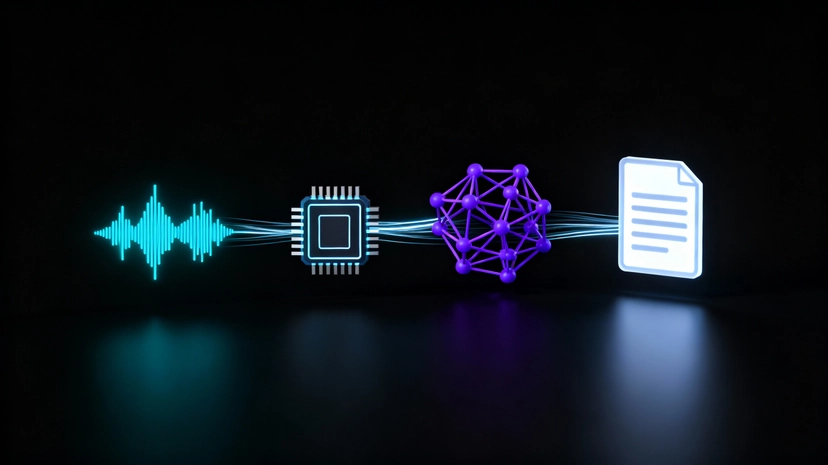
When it comes to Automatic Speech Recognition (ASR) models—systems that convert spoken language into written text—being “open-source” takes on additional dimensions beyond just code availability.
Open-source ASR models typically include:
1. Model Architecture The neural network design and structure are publicly documented and available. This includes the specific layers, attention mechanisms, and architectural choices that make up the model. Developers can understand exactly how the model processes audio and generates transcriptions.
2. Pre-trained Model Weights The trained parameters (weights) of the model are available for download. This is crucial because training large ASR models from scratch requires massive computational resources and thousands of hours of audio data. With pre-trained weights, you can use state-of-the-art models immediately without needing to train them yourself.
3. Training and Inference Code The code used to train the model and run inference (make predictions) is publicly available. This allows you to:
- Reproduce the original training results
- Fine-tune the model on your own data
- Understand the preprocessing and post-processing steps
- Optimize the model for your specific use case
4. Open Licensing The model is released under a license that permits use, modification, and often commercial deployment. Common open-source licenses for ASR models include:
- MIT License: Highly permissive, allows almost any use
- Apache 2.0: Permissive with patent protection
- MPL 2.0: Requires sharing modifications but allows proprietary use
- RAIL (Responsible AI Licenses): Permits use with ethical guidelines and restrictions
5. Documentation and Community Comprehensive documentation, usage examples, and an active community that supports adoption and helps troubleshoot issues.
Why Open-Source ASR Matters
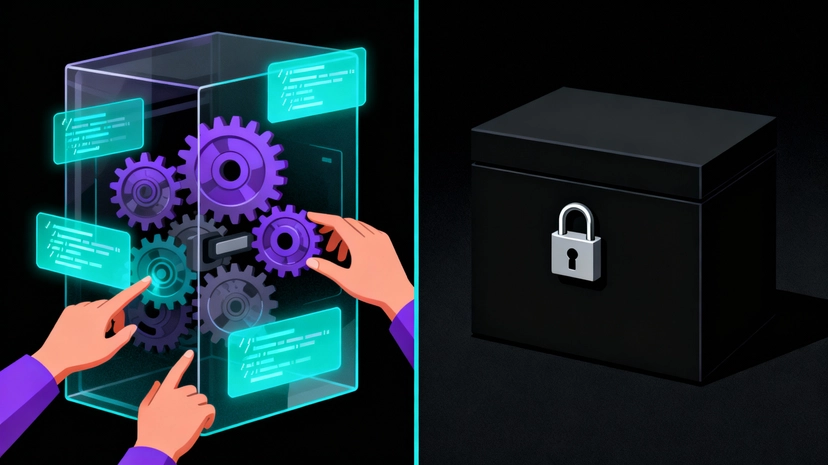
Transparency and Trust Unlike proprietary “black box” ASR services, open-source models allow you to understand exactly how speech recognition works. You can inspect the training process, validate performance claims, and ensure the technology meets your ethical and technical standards.
Cost-Effectiveness Proprietary ASR services typically charge per minute or per API call, which can become extremely expensive at scale. Open-source models can be deployed on your own infrastructure with no per-use costs—you only pay for the compute resources you use.
Customization and Fine-Tuning Every industry has its own vocabulary, accents, and acoustic conditions. Open-source models can be fine-tuned on domain-specific data—whether that’s medical terminology, legal jargon, regional dialects, or technical vocabulary—to achieve better accuracy than generic solutions.
Privacy and Data Control With open-source ASR deployed on your own servers or edge devices, sensitive audio data never leaves your infrastructure. This is crucial for healthcare, legal, financial, and other privacy-sensitive applications where data sovereignty is paramount.
No Vendor Lock-In You’re not dependent on a single vendor’s pricing, API changes, service availability, or business decisions. You own your speech recognition pipeline and can switch hosting, modify the model, or change deployment strategies as needed.
Innovation and Research Researchers and developers can build upon existing open-source models, experiment with new architectures, and contribute improvements back to the community. This collaborative approach accelerates innovation across the field.
How We Compare: Key Evaluation Criteria
To help you choose the right open-source ASR model, we’ll evaluate each model across five critical dimensions:
1. Accuracy (Word Error Rate – WER) Accuracy is measured by Word Error Rate (WER)—the percentage of words incorrectly transcribed. Lower WER means better accuracy. We’ll look at performance on standard benchmarks and real-world conditions.
2. Languages Supported The number and quality of languages each model supports. This includes whether it’s truly multilingual (one model for all languages) or requires separate models per language, as well as any special capabilities like dialect or code-switching support.
3. Model Size The number of parameters and memory footprint of the model. This directly impacts computational requirements, deployment costs, and whether the model can run on edge devices or requires powerful servers.
4. Edge Deployment How well the model performs when deployed on edge devices like smartphones, IoT devices, or embedded systems. This includes CPU efficiency, latency, and memory requirements.
5. License The license type determines how you can legally use, modify, and distribute the model. We’ll clarify whether each license permits commercial use and any restrictions that apply.
With these criteria in mind, let’s dive into our top five open-source speech recognition models.
1. Whisper by OpenAI
When it comes to accuracy and versatility, Whisper sets the benchmark. With word error rates as low as 2-5% on clean English audio, it delivers best-in-class performance that remains robust even with noisy or accented speech.
What truly sets Whisper apart is its genuine multilingual capability. Unlike models that require separate training for each language, Whisper’s single model handles 99 languages with consistent quality. This includes strong performance on low-resource languages that other systems struggle with.
Whisper offers five model variants ranging from Tiny (39M parameters) to Large (1.5B parameters), giving you the flexibility to choose based on your deployment needs. The smaller models work well on edge devices, while the larger ones deliver exceptional accuracy when GPU resources are available.
Released under the permissive MIT License, Whisper comes with zero restrictions on commercial use or deployment, making it an attractive choice for businesses of all sizes.
2. Wav2Vec 2.0 by Meta
Meta’s Wav2Vec 2.0 brings something special to the table: exceptional performance with limited labeled training data. Thanks to its self-supervised learning approach, it achieves 3-6% WER on standard benchmarks and competes head-to-head with fully supervised methods.
The XLSR variants extend support to over 50 languages, with particularly strong cross-lingual transfer learning capabilities. While English models are the most mature, the system’s ability to leverage learnings across languages makes it valuable for multilingual applications.
With Base (95M) and Large (317M) parameter options, Wav2Vec 2.0 strikes a good balance between size and performance. It’s better suited for server or cloud deployment, though the base model can run on edge devices with proper optimization.
The Apache 2.0 License ensures commercial use is straightforward and unrestricted.
3. Shunya Labs ASR
Meet the current leader on the Open ASR Leaderboard with an impressive 3.10% WER . But what makes Shunya Labs’ open source model – Pingala V1 – so special isn’t only its accuracy, but also that it’s revolutionizing speech recognition for underserved languages.
With support for over 200 languages, Pingala V1 offers the largest language coverage in open-source ASR. But quantity doesn’t compromise quality. The model excels particularly with Indic languages (Hindi, Tamil, Telugu, Kannada, Bengali) and introduces groundbreaking code-switch models that handle seamless language mixing—perfect for real-world scenarios where speakers naturally blend languages like Hindi and English.
Built on Whisper’s architecture, Pingala V1 comes in two flavors: Universal (~1.5B parameters) for broad language coverage and Verbatim (also ~1.5B) optimized for precise English transcription. The optimized ONNX models support efficient edge deployment, with tiny variants running smoothly on CPU for mobile and embedded systems.
Operating under the RAIL-M License (Responsible AI License with Model restrictions), Pingala V1 permits commercial use while emphasizing ethical deployment—a forward-thinking approach in today’s AI landscape.
4. Vosk
Sometimes you don’t need state-of-the-art accuracy—you need something that works reliably on constrained devices. That’s where Vosk shines. With 10-15% WER, it prioritizes speed and efficiency over absolute accuracy, making it perfect for real-world applications where resources are limited.
Vosk supports 20+ languages including English, Spanish, German, French, Russian, Hindi, Chinese, and Portuguese. Each language has separate models, with sizes ranging from an incredibly compact 50MB to 1.8GB—far smaller than most competitors.
Designed specifically for edge and offline use, Vosk runs efficiently on CPU without requiring GPU acceleration. It supports mobile platforms (Android/iOS), Raspberry Pi, and various embedded systems with minimal memory footprint and low latency.
The Apache 2.0 License means complete freedom for commercial use and modifications.
5. Coqui STT / DeepSpeech 2
Born from Mozilla’s DeepSpeech project, Coqui STT delivers 6-10% WER on standard English benchmarks with the added benefit of streaming capability for low-latency applications.
Supporting 10+ languages through community-contributed models, Coqui STT’s quality varies by language, with English models being the most mature. Model sizes range from 50MB to over 1GB, offering flexibility based on your requirements.
The system runs efficiently on CPU and supports mobile deployment through TensorFlow Lite optimization. Its streaming capability makes it particularly suitable for real-time applications.
Released under the Mozilla Public License 2.0, Coqui STT permits commercial use but requires disclosure of source code modifications—something to consider when planning your deployment strategy.
Common Use Cases for Open-Source ASR
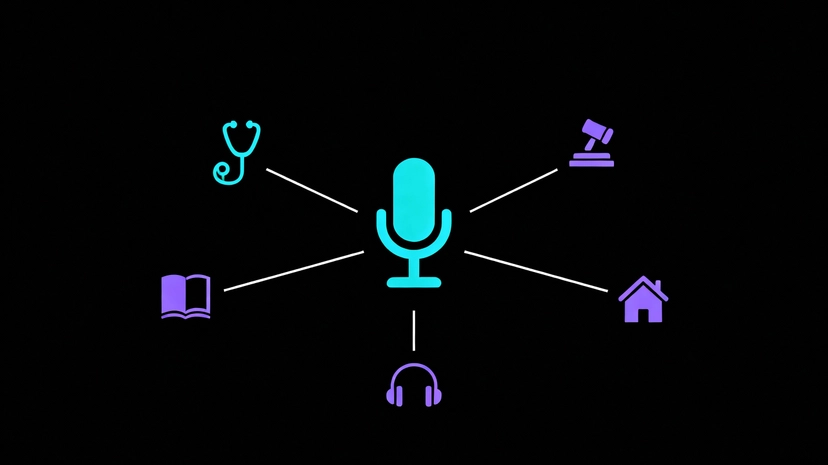
Open-source ASR powers a wide range of applications:
- Accessibility: Real-time captioning for the deaf and hard of hearing
- Transcription Services: Meeting notes, interview transcriptions, podcast subtitles
- Voice Assistants: Custom voice interfaces for applications and devices
- Call Center Analytics: Automated call transcription and sentiment analysis
- Healthcare Documentation: Medical dictation and clinical note-taking
- Education: Language learning apps and automated lecture transcription
- Media & Entertainment: Subtitle generation and content indexing
- Smart Home & IoT: Voice control for connected devices
- Legal & Compliance: Deposition transcription and compliance monitoring
The Trade-offs to Consider
While open-source ASR offers tremendous benefits, it’s important to understand the trade-offs:
- Technical Expertise: Self-hosting requires infrastructure, ML/DevOps knowledge, and ongoing maintenance
- Initial Setup: More upfront work compared to plug-and-play API services
- Support: Community-based support rather than dedicated customer service (though many models have active, helpful communities)
- Resource Requirements: Some models require significant compute power, especially for real-time processing
However, for many organizations and developers, these trade-offs are well worth the benefits of control, customization, and cost savings that open-source ASR provides.
While open-source ASR models provide a powerful foundation, optimizing them for production scale can be complex. If you are navigating these trade-offs for your specific use case, see how we approach production-ready ASR.

Bio: Abeer Sehrawat is a Product Manager at Shunya Labs who owns the end-to-end user experience—making voice AI clear, intuitive, and genuinely useful. She partners with design, research, and engineering to turn messy real-world scenarios into simple flows, helpful defaults, and documentation that unblocks teams. Her focus: products that are easy to adopt (clean APIs, sensible UI), fast to trust (accurate, low-latency), and respectful of context (privacy-first, deployable in cloud or on-prem). Before Shunya Labs, she led high-visibility trust-and-safety operations and communications at Change.org during fast-moving global events, then moved into sales and business development at startups, translating customer needs into product opportunities. She holds a B.A. in Political Economy from UC Berkeley and Sciences Po.