

Why Long Context Makes AI More Expensive: How to Reduce Token Usage
TL;DR , Key Takeaways:
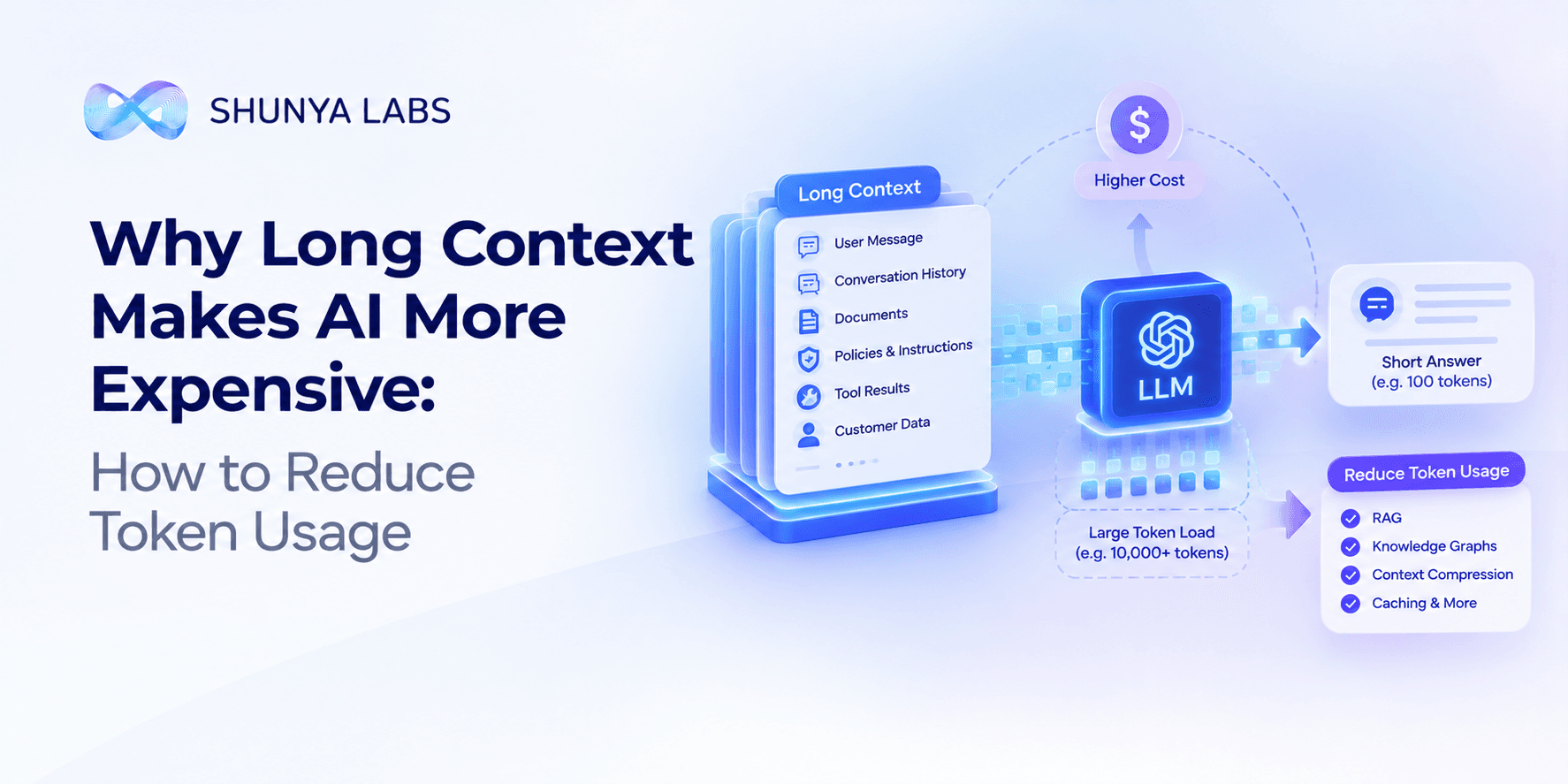
- More context means more information for the AI to process, which can increase token usage and inference work.
- A long context window is useful when the task genuinely requires a large amount of information, but it should not become an excuse to send everything.
- Conversation history, retrieved documents, tool outputs and repeated instructions are common sources of unnecessary context.
- RAG can reduce context by retrieving only the information relevant to the question.
- Knowledge graphs can narrow the information further by identifying relevant entities and relationships before retrieval.
- Smaller, purpose-trained models can be more efficient when the task is narrow and predictable.
- AI agents can create especially large contexts because each step may add more information to the next request.
- Context compression, summarisation, structured memory and caching can help prevent context from growing unnecessarily.
- The goal is not the smallest possible context. It is the smallest useful context that still gives the AI enough information to do the job accurately.
- Context efficiency is therefore part of enterprise AI cost optimisation, not just a technical optimisation.
One of the easiest ways for an enterprise AI application to become expensive is to give the AI too much information.
A user may ask a simple question, but the system might send the model the entire conversation history, multiple documents, product information, internal instructions, tool results and other context before generating an answer.
The answer itself might be short.
The work required to produce it may not be.
This is why context length has become an important consideration when enterprises think about AI cost, latency and scalability.
A larger context window can be useful when an AI system genuinely needs to understand a long document, a complex conversation or a large set of connected information. But having the ability to process more information does not mean an application should send more information by default.
The better question is:
How much context does the AI actually need to complete this task correctly?
For enterprise AI, that question can have a direct impact on token consumption, inference cost, response time and infrastructure requirements.
What is an AI context window?
The simplest way to think about a context window is:
It is the amount of information an AI model can consider as part of a request.
That information can include much more than the user’s latest question.
For an enterprise AI assistant, the context might contain:
- The user’s current message
- Previous conversation
- System instructions
- Company policies
- Retrieved documents
- Customer information
- Tool results
- Workflow information
- Previous AI responses
Imagine a customer asks:
“Can I change my repayment date?”
The visible question is short.
But the system might provide the AI with:
the full conversation + customer profile + account information + product documentation + payment policy + regional policy + previous tool results
The actual context is therefore much larger than the user’s message.
This is where AI applications can start consuming far more tokens than businesses expect.
Why does a longer context cost more?
An AI model has to process the information it receives before it can produce a response.
If the system sends:
500 tokens of relevant context
that is one workload.
If it sends:
10,000 tokens of mixed information
that is a much larger workload.
The difference becomes significant when the application handles thousands or millions of requests.
This is particularly important for enterprise applications because context often includes repeated information.
For example, every customer-support request might include the same:
- company instructions
- product information
- policy text
- workflow rules
Sending that information repeatedly can add to the total amount of AI processing.
This is why context efficiency should be considered alongside model choice and token pricing.
A short question can create a large AI workload
Consider:
“What is the refund policy?”
The user has asked five words.
The AI system could still process:
3,000 tokens of system instructions
5,000 tokens of retrieved documents
2,000 tokens of conversation history
1,000 tokens of customer context
The final answer might be only 100 tokens.
The user sees:
100-token answer
The system processed far more information.
This is one of the most important ideas in enterprise AI:
The length of the final answer does not tell you how much work the AI performed.
That is why reducing unnecessary context can have a larger impact than simply asking the model to give shorter answers.
Why long conversations can become expensive
Conversation history is one of the easiest ways for context to grow.
A customer might start with:
“I want to change my plan.”
Then ask:
“What plans are available?”
Then:
“What happens to my existing benefits?”
Then:
“Can I change back later?”
Then:
“I meant the business account, not the personal one.”
If the application sends the entire conversation with every request, the amount of information being processed grows over time.
This becomes even more significant for:
- customer-support assistants
- employee copilots
- voice agents
- long-running agents
- workflow assistants
The solution is not always to delete the history.
Instead, the architecture can decide what information is still useful.
For example:
recent conversation → keep directly
important customer facts → store as structured information
older discussion → summarise
supporting documents → retrieve when needed
This turns conversation history from a growing transcript into managed context.
AI agents can make context growth even worse
A normal chatbot might answer after one model call.
An AI agent may perform several steps:
understand the request
→ search
→ read results
→ call a tool
→ inspect the tool response
→ search again
→ reason about the results
→ complete the task
Each step can add information.
The agent may carry forward:
tool results
previous decisions
documents
intermediate reasoning
conversation history
By the end of a long workflow, the amount of context can be much larger than the original request.
This is why efficient context management is increasingly important for agentic enterprise applications.
The goal should be to preserve the information that remains relevant without repeatedly carrying every previous detail into the next step.
RAG can reduce unnecessary context
RAG is one of the most practical ways to control how much information enters the model.
Instead of sending the entire company knowledge base, the system searches for information relevant to the current request.
For example:
“What is the leave policy for employees in India?”
A targeted retrieval flow can identify:
India
→ employee policy
→ leave
→ current policy version
and retrieve only the relevant material.
Our enterprise AI platform is designed around this knowledge-grounded approach, connecting enterprise information to AI workflows without requiring the entire knowledge base to be placed into every request.
The goal is:
retrieve relevant information → provide focused context → generate the answer
rather than:
send everything → ask the model to find what matters
Knowledge graphs can make context even more focused
RAG helps retrieve relevant information.
A knowledge graph can help determine what is relevant in the first place.
Consider a more complex question:
“Which customers in India using Product A are affected by the updated policy?”
The system needs to understand relationships between:
customers
products
regions
policies
A knowledge graph can represent these relationships explicitly.
For example:
Customer → uses → Product A
Product A → sold in → India
Product A → governed by → Policy B
This can help the system narrow the information before retrieving the supporting documents.
That means the model receives:
the right customer
the right product
the right region
the right policy
instead of a large collection of loosely related information.
This is one reason the combination of knowledge graphs + RAG can be valuable for enterprise AI.
You can explore the architecture in our article on building a hybrid Knowledge Graph + RAG system.
More context does not always mean better AI
There is a common assumption that giving an AI system more information will automatically improve its answer.
That is not always true.
Extra information can introduce:
- irrelevant content
- duplicate information
- old information
- conflicting information
- unnecessary instructions
- more processing
The model then has to work through information that was never needed.
For enterprise applications, the better approach is to provide useful context rather than maximum context.
A customer asking for the status of one order does not need the entire product catalogue.
An employee asking about one HR policy does not need every HR document.
A support agent asking about one product issue does not need every version of the product manual.
The architecture should determine what matters.
Long context can also increase latency
Cost is only one reason to manage context.
Longer inputs can also affect response time because the system needs to process that information before producing the answer.
This creates an important connection between the two topics:
more context → more processing → potentially more latency
That is why context optimisation should be part of an enterprise AI latency strategy.
Our article on AI latency and enterprise response time covers the broader architecture, including retrieval, model inference, APIs and other factors that affect the response users actually experience.
Reducing unnecessary context can contribute to improvements in both cost and speed.
Context management becomes more important at scale
For a small internal assistant with limited usage, an inefficient context strategy may not create an obvious problem.
At enterprise scale, it can.
Imagine:
10,000 requests per day
and each request carries an additional:
2,000 unnecessary tokens
That is:
20 million unnecessary tokens per day.
The exact financial impact depends on the model and deployment method, but the workload itself is significant.
Now consider an application with:
1 million requests per month
or several AI agents operating continuously across different departments.
Context efficiency becomes an infrastructure concern, not simply a prompt-design preference.
This is why enterprises should monitor:
- Average context size
- Average retrieved content
- Tokens per completed task
- Conversation history size
- Number of model calls per task
- Repeated context
- Cache reuse
- Latency caused by large inputs
You do not always need a large model to handle a large context
Another important optimisation is separating knowledge size from model size.
An enterprise might have millions of documents.
That does not mean it needs a massive model simply because the organisation has a lot of information.
A better architecture can use:
knowledge layer → store enterprise information
retrieval → find the relevant information
knowledge graph → understand relationships
purpose-trained SLM → handle the specialised task
larger LLM → handle complex reasoning when needed
Our Custom SLM architecture is designed around specialised enterprise tasks rather than requiring one general-purpose model to carry all the organisation’s knowledge.
The model does not need to memorise every policy or product relationship.
The architecture can retrieve the information when it is needed.
Smaller models can reduce the amount of context you need
A purpose-trained model often has a narrower job.
For example, if a model is designed specifically for:
intent classification
it does not need the same amount of contextual information as a model being asked to reason broadly across an enterprise.
Similarly, an extraction model may only need:
the relevant document section
rather than an entire knowledge base.
That can create a useful combination:
smaller task → smaller model → smaller context
This is one of the strongest ways to improve enterprise AI efficiency.
Our Custom SLM benchmarks report 10× smaller models and 3× faster inference for the evaluated workloads, alongside lower inference cost. The important principle is not the benchmark number itself. It is that specialisation can reduce unnecessary model capacity and processing.
Caching can reduce repeated context processing
Some enterprise applications repeatedly use the same information.
For example, a customer-support system may repeatedly use:
the same product information
the same policy
the same workflow instructions
the same tool definitions
When the same context is reused, caching can reduce the need to process identical information repeatedly.
This is particularly useful for applications with:
- long conversations
- repeated workflows
- shared instructions
- agentic systems
Caching should be viewed as a way of reusing work, not as a replacement for good context management.
The better architecture is:
first reduce unnecessary context
then:
cache the context that genuinely needs to be reused
This matters because caching a huge, poorly designed prompt does not solve the underlying problem.
How to reduce context and token usage in enterprise AI
A practical approach is to optimise context from several directions.
1. Retrieve only what the task needs
Use RAG instead of sending large document collections into every request.
2. Use structured enterprise information
Customer records, product information and other structured data can be provided directly rather than repeatedly embedding the same information into long natural-language prompts.
3. Use knowledge graphs for relationships
Use a knowledge graph when the answer depends on relationships between customers, products, policies, regions or workflows.
4. Manage conversation memory
Keep important facts and recent context while summarising or retrieving older information when required.
5. Remove duplicate instructions
Do not repeatedly send the same information if the architecture can reuse it.
6. Keep tool responses focused
Enterprise APIs can return large amounts of data. Return only the fields relevant to the current task.
7. Use smaller models for specialised steps
Route narrow tasks to Custom SLMs instead of sending every task to a large LLM.
8. Limit unnecessary output
Ask for concise or structured outputs when long-form generation is not required.
9. Cache reusable context
Where the same information is repeatedly processed, use appropriate caching mechanisms.
10. Measure context before optimising it
Track how much information is actually being sent to the model and identify which parts are unnecessary.
What should enterprises measure?
Context optimisation should be measurable.
Useful metrics include:
- Average input tokens per request
- Average context size
- Retrieved tokens per request
- Tokens per completed task
- Average conversation length
- Number of model calls per task
- Average response time
- Cost per successful task
- Cache reuse
- Error and escalation rate
The most useful metric is usually not:
“How small can we make the prompt?”
It is:
“How much relevant context does the system need to complete the task accurately?”
That keeps efficiency connected to business outcomes.
Context windows are a capability, not a strategy
A larger context window can be useful.
It can allow an AI system to work with: long documents, large conversations, complex workflows, multiple sources
But a larger capacity does not mean the architecture should fill that capacity every time.
Think of a context window like storage space.
Having a larger room does not mean you need to fill it with everything you own.
Good enterprise AI architecture is about putting the right information in the room at the right time.
The future of enterprise AI is more selective context
As AI applications become more agentic, context management will become increasingly important.
An AI system that simply answers questions can often work with relatively small context.
An agent that works for several minutes, interacts with enterprise systems, retrieves documents and performs multiple actions can accumulate a large amount of information.
That means future enterprise architectures will increasingly need:
- context selection
- context summarisation
- structured memory
- knowledge graphs
- retrieval
- caching
- model routing
The objective is not to make AI remember everything.
It is to make AI remember the right things and retrieve the rest when needed.
Final thoughts
The biggest AI cost problem is not always an expensive model.
Sometimes, it is simply giving the model too much work to do.
A short user question can generate a very large context.
A long conversation can carry unnecessary history.
A RAG system can retrieve too many documents.
An agent can accumulate tool outputs.
A workflow can repeatedly send the same information.
All of that adds up.
The answer is not to eliminate context.
The answer is to manage context intelligently.
Retrieve only what matters.
Use structured enterprise data where possible.
Use knowledge graphs when relationships matter.
Summarise information that no longer needs to stay in full detail.
Cache genuinely reusable context.
Use smaller models for narrow tasks.
Reserve larger LLMs for situations that actually require them.
The result is a more efficient enterprise AI system that can reduce:
token consumption
inference cost
latency
and unnecessary infrastructure demand.
The goal is simple:
Give the AI enough context to be useful, but not so much context that the architecture spends resources processing information it never needed.
Frequently Asked Questions
What is a context window in AI?
A context window is the amount of information an AI model can consider as part of a request. This can include the user’s question, conversation history, instructions, documents, retrieved information and tool results.
Does a larger context window make AI more expensive?
A larger context window itself is a capability. The cost comes from how much information the application actually sends and processes. Larger inputs can increase token usage, processing requirements and latency, particularly when large amounts of context are repeatedly sent.
Why are long prompts expensive?
Long prompts contain more information for the model to process. At enterprise scale, repeatedly sending large amounts of context can significantly increase total token usage and inference workload.
How can I reduce AI context size?
Use targeted retrieval, conversation summarisation, structured memory, metadata filtering, knowledge graphs, focused tool responses and smaller task-specific models.
Does RAG reduce context size?
It can. RAG can retrieve the most relevant information for a specific question rather than sending an entire collection of documents to the model.
Can knowledge graphs reduce AI token usage?
They can help by identifying which entities and relationships are relevant before retrieving supporting documents, allowing the model to work with a more focused context.
Should I always use a smaller context?
No. Some tasks genuinely require large amounts of information. The goal is not minimum context. It is relevant context.
Can caching reduce context-processing costs?
Caching can allow reusable context or previously processed information to be reused in supported inference architectures, reducing repeated processing. It is most useful when the same context appears across multiple requests.
How do AI agents increase context usage?
Agents may accumulate conversation history, search results, tool responses, workflow state and intermediate information across multiple steps. Without context management, these can make later requests much larger than the original user query.
Does reducing context reduce AI accuracy?
It can if important information is removed. That is why context optimisation should focus on removing irrelevant information rather than simply reducing the amount of information.
Learn More
Explore our enterprise AI platform, Custom Small Language Models, hybrid Knowledge Graph + RAG architecture, knowledge-grounded AI, and enterprise voice agents.

Bio: Navvya works at the intersection of product strategy and applied AI research at Shunya Labs. With a background in human behaviour and communication, she writes about the people, markets, and technology behind voice AI, with a particular focus on how speech interfaces are reshaping access across emerging markets.