Top Benefits Of A Complete Voice AI Platform For Enterprises In 2026
The traditional corporate phone system is broken. We’ve all been there, trapped in a “press 1 for sales” menu that feels more like a maze than a service. While basic chatbots have moved the needle for text based support, voice has remained the final frontier of customer frustration. But that’s changing fast.
A complete voice AI platform for enterprises is no longer just a futuristic concept. It’s a strategic operational layer that combines foundation models, intelligence layers, and orchestration to handle conversations from start to finish. According to Gartner, by 2029, 80% of common customer service issues will be resolved autonomously through AI.
But what does a “complete” platform actually look like, and why should your organization care? Let’s break down the strategic advantages of moving to a unified voice stack.
What is a complete voice AI platform for enterprises?
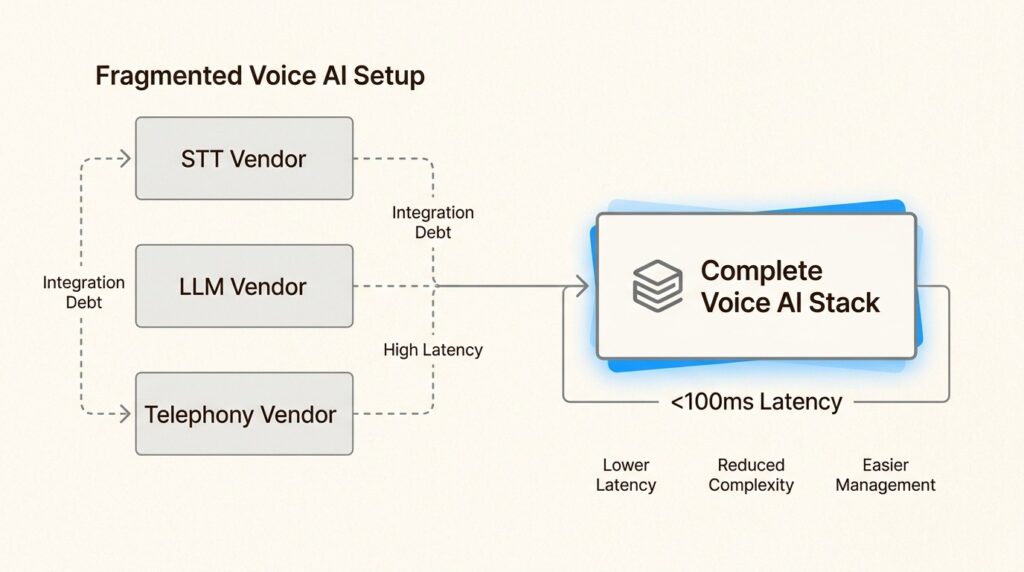
At its heart, a complete voice AI platform for enterprises is a unified system that manages the entire lifecycle of a voice interaction. Instead of buying a speech to text tool from one vendor, a large language model from another, and a telephony connector from a third, a complete stack integrates these components into a single, high performance environment.
We generally categorize these platforms into four critical layers:
- Foundation Models: These are the engines of the platform. They include high accuracy Speech-to-Text (STT) for transcription and Text-to-Speech (TTS) for natural sounding responses.
- Intelligence Layer: This is where the reasoning happens. It uses Small Language Models (SLMs) to detect intent, extract key entities like account numbers, and analyze caller sentiment in real time.
- Orchestration Framework: This serves as the brain of the operation. It manages business rules, conversation memory, and integration with your backend systems to ensure the AI follows company policy.
- Channel Integrations: These are the connectors that link the AI to your existing infrastructure, whether that’s telephony, web widgets, or mobile apps.
The shift we’re seeing today is moving away from “passive assistants” that just take messages and toward “autonomous agents” that can actually complete work. For more on what to look for when evaluating these systems, see our guide on what to look for in an enterprise speech AI platform in 2026.
Reducing Operational Costs With Autonomous Agentic Execution
The most immediate benefit of a complete voice AI platform for enterprises is the dramatic reduction in operational overhead. In a traditional contact center, the cost of a human led interaction typically ranges between $5.00 and $15.00 per contact, depending on the complexity of the request.
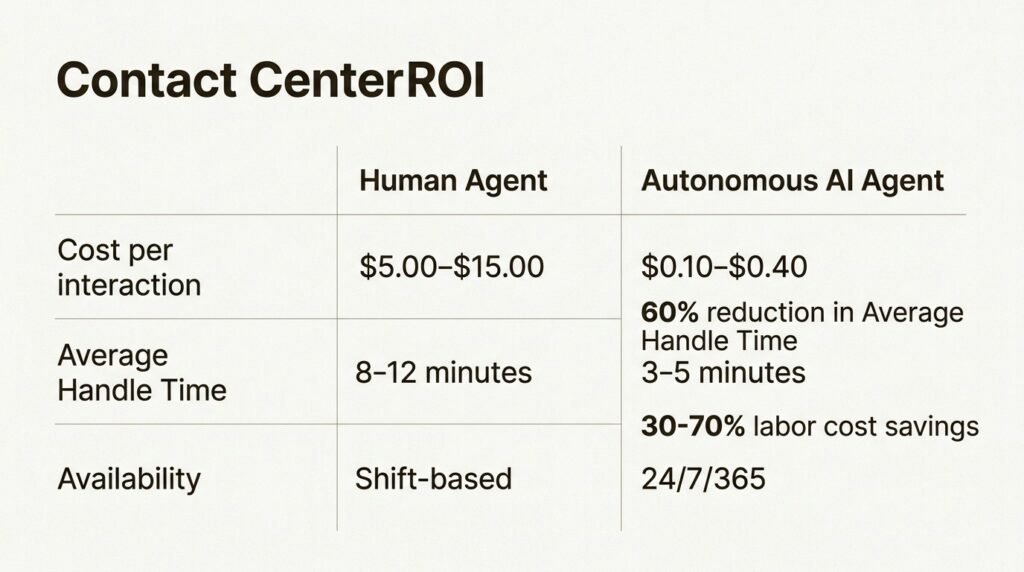
When you shift those interactions to an AI agent, the cost profile changes fundamentally. An AI interaction often costs between $0.10 and $0.40 per minute. This represents a 30% to 70% reduction in total labor costs for most enterprises.
But the savings go beyond just the per minute rate. Here’s how the process works:
- Task Completion: Our Voice Agent Platform doesn’t just talk, it acts. It can help update CRM records, book appointments on a calendar, or qualify a lead without any human intervention.
- Elastic Scalability: Traditional centers struggle with volume spikes during product launches or holiday seasons. A complete platform scales instantly, handling 5,000 concurrent calls as easily as five, without the need for temporary hiring.
- Lower Average Handle Time: AI agents can retrieve customer history and backend data simultaneously. This often leads to a 60% reduction in handle time because the AI doesn’t need to toggle between multiple screens.
By automating the routine Tier 1 and Tier 2 inquiries, your human team is freed to focus on high empathy, complex tasks that truly require a personal touch. You can see more examples of this in our post on speech to text AI in action: Top 10 use cases across industries.
Achieving Clinical-Grade Accuracy Through Vertical-Specific Models
One major pitfall for many enterprises is relying on “general purpose” AI models. While a general model might be fine for summarizing a casual chat, it often fails in high stakes environments where every syllable matters. This is where a complete voice AI platform for enterprises differentiates itself through specialization.
Take healthcare for example. In clinical documentation, a general model might struggle with complex drug names or medical jargon. Our Zero STT Med model is specifically tuned for these environments, delivering clinical grade accuracy.
Understanding the nuance of a conversation is about more than just words. It’s about context. For a deeper dive into how we track these nuances, read our article on sentiment analysis in voice AI: What it measures and where it works.
Scaling Global Reach With 200+ Languages and Real-Time Translation
For the modern enterprise, “global” is the default. But building a support team that can handle 50 different languages is a logistical nightmare. A complete voice AI platform for enterprises solves this by offering out of the box support for hundreds of languages and dialects.
Our ecosystem currently supports 216 languages and over 30 writing scripts. This allows you to serve 96.8% of the global population through a single API.
Key features for global enterprises include:
- Zero STT Indic: We provide specialized support for Indic languages, including regional dialects that general Western models often overlook.
- Vāķ Real-Time Translation: Our Vāķ service offers real time speech to speech translation across 2,970 language pairs. Imagine a customer speaking in Hindi being understood and answered in English instantly.
- Codeswitching: Our codeswitch models are trained to handle “Hinglish” or other multilingual speech patterns where users can mix languages in a single sentence. The AI retains context throughout the switch.
- Language Identification: The system automatically detects the caller’s language and switches its responses and logic to match, creating a seamless experience for international customers.
This capability eliminates the need for expensive offshore teams or specialized linguistic hires, allowing you to enter new markets in weeks rather than months.
Enterprise-Grade Security and The Freedom of Edge Deployment
Security is often the biggest hurdle for enterprise AI adoption. When you are dealing with sensitive customer data, “good enough” is not an option. A complete voice AI platform for enterprise must be built with a security first mindset.
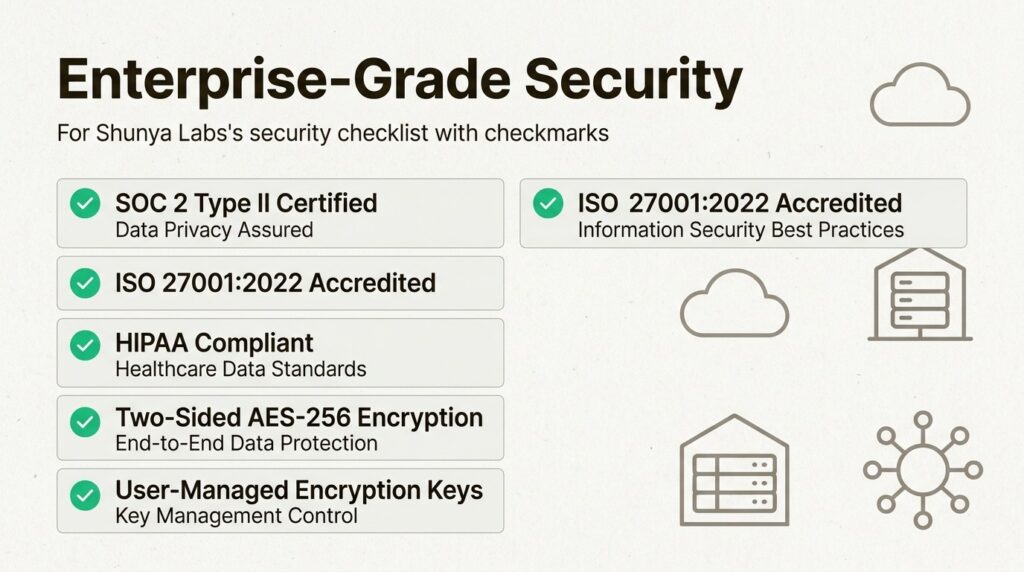
At Shunya Labs, we prioritize what we call “Voice AI on your terms.” This means providing the highest level of compliance alongside flexible deployment options that keep you in control of your data.
Our security framework includes:
- Foundational Compliance: We maintain SOC 2 Type II, ISO 27001:2022, and HIPAA certifications. This ensures that we meet the strict requirements of healthcare and financial services.
- Two-Sided Encryption: All data is encrypted in transit using TLS 1.3 and at rest using AES-256. Crucially, we allow for user managed encryption keys, so your data stays your data.
- Edge and On-Premises Deployment: Unlike cloud only competitors, we offer flexible deployment options. You can run our models on your own servers or directly on edge devices (via ONNX) for <100ms latency and total data sovereignty.
- Privacy First Retention: We don’t permanently store audio files. Temporary processing files are securely deleted within 24 hours of transcription, ensuring your customers’ privacy is protected.
This flexibility allows you to build applications that work even in offline environments or high security zones where a cloud connection is not permitted. For more details on protecting your stack, see our post on essential voice security measures for enterprise AI in 2026.
Scale Your Enterprise Operations With Shunya Labs’ Complete Voice AI Stack
The future of enterprise communication is autonomous, intelligent, and real time. By moving away from fragmented, legacy systems and adopting a complete voice AI platform for enterprises, you can transform your customer experience while significantly reducing operational costs.
We have built our stack to solve the problems that make voice AI expensive and slow. With low latency, clinical grade accuracy, and the ability to deploy on the edge, we give you the tools to build voice applications without compromise.
Bottom line? It’s time to stop settling for passive voice assistants and start building a digital workforce that can actually move the needle for your business.
Ready to see the Shunya Labs ecosystem in action? Contact our sales team today to discuss your custom enterprise requirements or start for free in our playground.
Frequently Asked Questions
What are the primary components of a complete voice AI platform for enterprises?
A complete voice AI platform for enterprises includes four main layers: foundation models for speech to text and text to speech, an intelligence layer for sentiment and intent analysis, an orchestration framework to manage business logic, and channel integrations to connect with telephony or web systems.
How does a complete voice AI platform for enterprises help reduce contact center costs?
A complete voice AI platform for enterprises reduces costs by automating routine Tier 1 and Tier 2 inquiries, lowering the cost per interaction from $5-$15 (human) to $0.10-$0.40 (AI). It also provides elastic scalability, allowing businesses to handle volume spikes without additional hiring.
Can a complete voice AI platform for enterprises handle specialized medical terminology?
Yes, a complete voice AI platform for enterprises like Shunya Labs offers vertical-specific models such as Zero STT Med, which provides clinical grade accuracy and medical keyterm correction for healthcare documentation and doctor-patient conversations.
Does a complete voice AI platform for enterprises support multilingual customers?
A complete voice AI platform for enterprises can support hundreds of languages. For example, our platform covers 207+ languages and includes specialized models like Zero STT Indic for regional dialects and Vāķ for real time speech to speech translation across 2,970 pairs.
What security certifications should I look for in a complete voice AI platform for enterprises?
You should ensure the complete voice AI platform for enterprises is SOC 2 Type II, ISO 27001:2022, and HIPAA compliant. It should also offer two-sided encryption and flexible deployment options like on-premises or edge hosting to ensure data sovereignty.

Bio: Navvya works at the intersection of product strategy and applied AI research at Shunya Labs. With a background in human behaviour and communication, she writes about the people, markets, and technology behind voice AI, with a particular focus on how speech interfaces are reshaping access across emerging markets.