
Why Enterprise LLMs Hallucinate: The Problem Is Often the Architecture
TL;DR , Key Takeaways:
- LLMs can hallucinate by design because generating plausible language is not the same as verifying facts.
- Enterprise hallucinations often come from missing, stale, irrelevant, or poorly retrieved context rather than model capability alone.
- RAG helps, but bad retrieval can still produce confident wrong answers.
- A knowledge graph can add structure when the answer depends on relationships between products, customers, policies, regulations, or workflows.
- Access control is part of grounding. Retrieving the wrong information can be as dangerous as generating the wrong information.
- Large prompts do not automatically create better answers. Too much irrelevant context can make retrieval and reasoning worse.
- AI systems should have a way to abstain, ask for clarification, escalate, or show supporting evidence when confidence is low.
- The most reliable enterprise AI architecture connects models, enterprise knowledge, business rules, tools, permissions, evaluation, and monitoring.
- Choosing a larger model can improve some tasks, but it cannot fix an architecture that supplies the wrong information.
Large language models can write convincing answers even when the underlying information is incomplete, outdated, or wrong.
That is what makes LLM hallucinations particularly difficult in enterprise AI.
A model might invent a policy that does not exist, use an outdated product rule, confidently answer from the wrong document, or combine information from two sources that should never have been combined.
The natural response is often to ask:
Which LLM should we use instead?
But that is not always the right question.
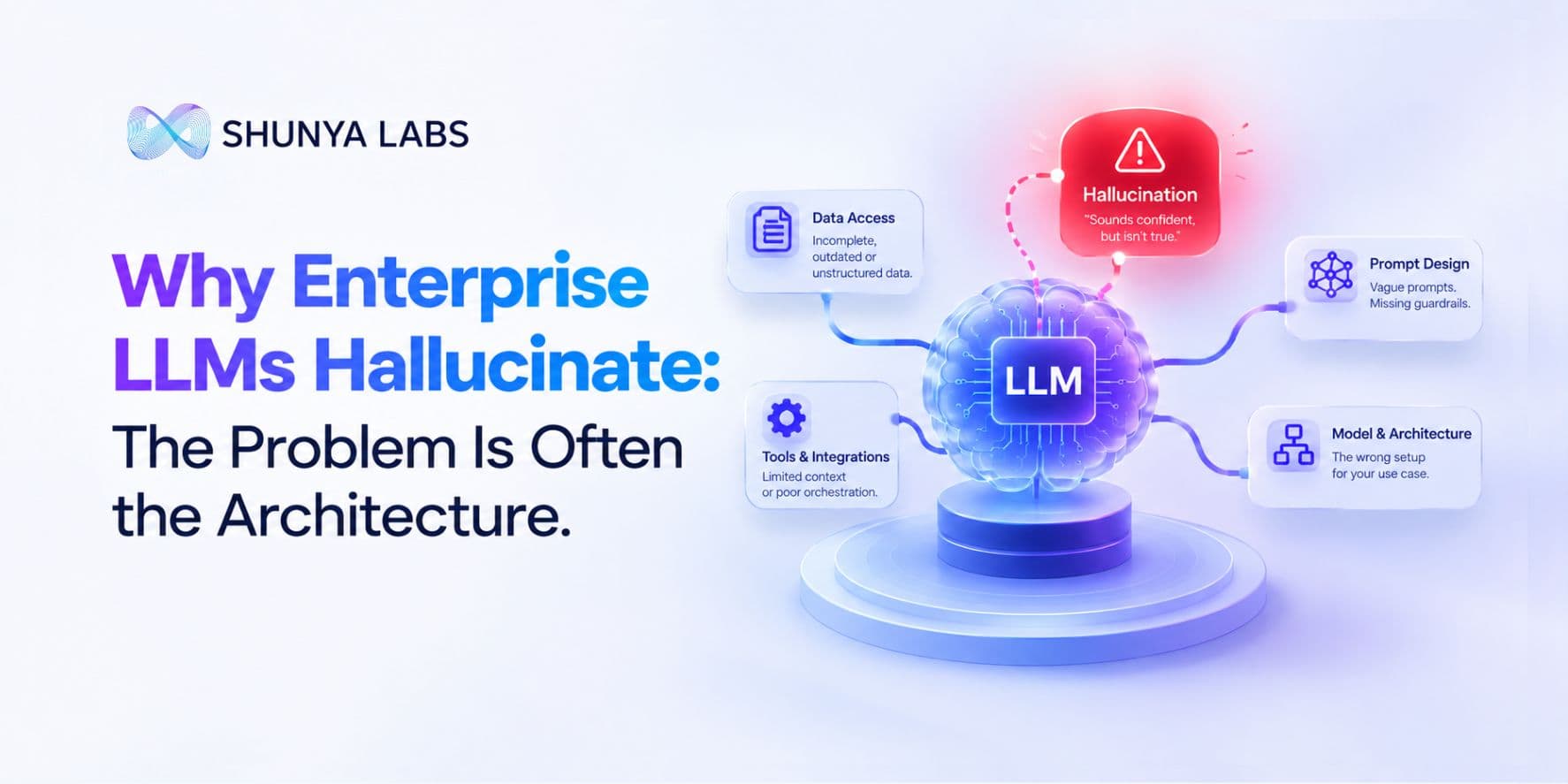
In enterprise environments, hallucinations are often influenced by the architecture around the model: how information is retrieved, how business context is represented, how permissions are enforced, how tools are called, how stale information is handled, and whether the system knows when it does not have enough evidence to answer.
Google Cloud describes this as the need to ground generative AI in “enterprise truth”, rather than relying on the model’s learned knowledge alone. AWS similarly notes that foundation models generally lack awareness of proprietary data, business rules, and recent operational changes unless those are provided through grounding and retrieval.
So the real problem is often not simply:
“The LLM hallucinates.”
It is:
“The system gave the LLM too much freedom and too little reliable context.”
What is an LLM hallucination?
An AI hallucination is an output that sounds plausible but is factually incorrect, unsupported, fabricated, or irrelevant to the question. IBM defines hallucinations as outputs that can present fabricated or incorrect information as though it were factual.
For enterprise AI, this could mean:
- inventing a company policy
- citing a document that does not exist
- giving an outdated price
- confusing two products
- applying the wrong compliance rule
- inventing a customer detail
- claiming that an action was completed when it was not
The problem becomes more serious when the AI is connected to actual business systems.
A chatbot that invents an explanation is a trust problem.
An AI agent that invents an account status and then takes an action based on it is an architecture problem.
AWS explicitly highlights this risk for enterprise agents because LLMs are unbounded by default and do not inherently know proprietary data, business rules, or operational state.
Why do LLMs hallucinate?
At the model level, an LLM is designed to generate likely sequences of tokens based on patterns it learned during training.
That does not mean it has a built-in database of verified enterprise facts.
Google Cloud explains the distinction clearly: foundation models are trained on broad data and are not automatically aware of the internal workings of a specific organisation or information that changed after training.
This creates several different hallucination sources.
The model does not know the answer
If the required information was never part of training, the model has to generate an answer from what it has learned about similar concepts.
That can produce a fluent but unsupported response.
The information has changed
Enterprise information changes constantly.
Pricing changes.
Policies change.
Products are discontinued.
Regulations are updated.
Customer records change.
An LLM trained months or years ago cannot know those changes unless the architecture gives it access to current information.
AWS specifically recommends grounding agents in current, domain-specific information rather than relying solely on model knowledge.
The model has the information but receives the wrong context
This is where architecture becomes especially important.
Suppose an employee asks:
“What is our current international travel reimbursement limit?”
The system may have the correct policy.
But if retrieval returns:
- an old travel policy
- a regional policy
- an outdated FAQ
- an unrelated expense document
the LLM may still produce a confident answer.
The model is generating from the context it received.
That means improving model quality without improving retrieval may not solve the actual problem.
RAG reduces hallucinations, but RAG is not a hallucination cure
Retrieval-Augmented Generation, or RAG, is one of the most common ways enterprises ground LLMs in company information.
The basic architecture is:
User question → retrieve relevant information → provide context to LLM → generate answer
AWS describes RAG as a pattern that retrieves content from curated knowledge sources and places that information into the model’s context before generation.
It is a major improvement over relying entirely on model memory.
But RAG introduces another set of failure modes.
Bad retrieval creates bad answers
Microsoft’s 2026 guidance on confidence-aware RAG highlights several common problems:
- retrieved documents are only loosely related
- the answer is only partially present
- sources contradict each other
- the question falls outside the knowledge base
In those cases, a RAG system can still produce a confident answer even though the evidence is insufficient.
This is why the architecture needs to evaluate retrieval quality, not just response quality.
A better LLM cannot reliably fix a retrieval system that keeps selecting the wrong documents.
The hidden architecture problem: enterprise context
An enterprise often has thousands or millions of documents.
But documents alone do not necessarily capture how the business works.
Consider a simple question:
“Which customers are affected by this product policy?”
The answer might require connecting:
Policy → Product → Customer segment → Region → Contract → Eligibility
A vector database may retrieve relevant documents.
But the system still needs to understand the relationships between entities.
This is where a knowledge-grounded enterprise AI architecture becomes useful.
A knowledge graph can represent relationships such as:
Product A → governed by → Policy B
Policy B → applies to → Region C
Customer D → uses → Product A
The model can then reason over a more structured representation of enterprise context.
Google Cloud’s current work around enterprise knowledge context similarly emphasizes that when agents lack business semantics and data relationships, hallucinations, stale insights, and inefficient retrieval can become problems.
Why enterprise AI needs more than RAG
A reliable enterprise architecture may need several sources of truth.
Think of the system as:
LLM
↓
Knowledge + Retrieval
↓
Business Rules
↓
Enterprise Systems
↓
Permissions + Governance
The LLM should not be expected to store everything.
Instead, the architecture should determine where each type of truth lives.
For example:
| Information | Better source |
|---|---|
| Company policy | Approved policy repository |
| Current customer status | CRM or operational database |
| Product relationships | Knowledge graph or structured catalogue |
| Latest transaction status | Transaction system or API |
| Business workflow | Workflow engine / business rules |
| Historical conversations | Conversation database |
| Natural-language reasoning | LLM |
This separation is important.
An LLM should not be the system of record for information that changes frequently.
Hallucinations can come from stale data
One of the easiest problems to overlook is knowledge freshness.
Imagine a company updates its refund policy every quarter.
The AI system may have:
- the new policy
- the previous policy
- an old presentation
- a customer-facing FAQ
- a training document from last year
All of these documents may contain semantically similar language.
A retrieval system can therefore find the wrong version.
AWS’s agentic AI guidance specifically calls for validating knowledge freshness and handling content that exceeds defined staleness thresholds.
Enterprise RAG therefore needs metadata such as:
document owner, effective date, version, region, department, customer segment, and status.
Without that information, “relevant” does not necessarily mean current.
Hallucinations can also come from poor access control
Enterprise AI does not operate in a world where every employee should see every document.
A finance employee, HR employee, customer support agent, and executive may need different information.
That means retrieval needs to respect identity and permissions.
Suppose a user asks:
“What happened with this account?”
The system should not retrieve a confidential document simply because the document is semantically relevant.
AWS has recently published an architecture for secure multi-tenant RAG specifically addressing this problem, using permissions to control which users can access which documents.
So access control is not just a cybersecurity feature.
It is part of AI grounding.
The model cannot be grounded in information that the user was never authorised to access.
Too much context can also hurt
It is tempting to assume that giving the LLM more information will always make the answer better.
It does not.
If a prompt contains dozens of loosely related documents, outdated policies, duplicated content, and contradictory information, the model has to determine which information matters.
That increases complexity and can increase both latency and cost.
AWS’s current RAG guidance specifically calls out the token and cost impact of large retrieved contexts and recommends techniques such as chunking, summarization, and metadata filtering to maintain retrieval precision.
The objective should therefore be:
not maximum context, but the right context.
Knowledge graphs can reduce architectural ambiguity
RAG is particularly good at retrieving what a document says.
A knowledge graph is useful for representing what is connected to what.
That distinction matters when the enterprise question is relationship-heavy.
For example:
“Which customers using Product A in India are affected by Regulation B?”
The system needs to establish:
Customer → uses → Product A
Product A → sold in → India
Product A → affected by → Regulation B
Only then does it need the relevant policy or regulatory text.
A knowledge graph architecture can provide this structured context before or alongside retrieval.
This does not mean every enterprise needs a knowledge graph.
For a simple document assistant, RAG may be enough.
For complex enterprise relationships, regulatory workflows, business rules, and multi-hop questions, structured knowledge can become much more important.
Business rules should not live only inside the prompt
Another common architecture mistake is putting critical business logic entirely inside natural-language prompts.
For example:
“Always approve a refund if the customer has been subscribed for more than 12 months unless the order is above ₹50,000…”
That may work for a demo.
But important deterministic logic is usually better represented in business rules or application code, with the model interpreting the result rather than inventing the rule.
An enterprise AI platform can then use the LLM for what it does well:
understanding language, summarising information, reasoning over context, and communicating decisions.
The deterministic system handles what should remain deterministic.
What happens when the AI does not know?
This is one of the most important questions in enterprise AI.
A trustworthy system should not be designed to answer every question.
It should be able to:
- answer
- ask for clarification
- retrieve more information
- show its sources
- say that evidence is insufficient
- escalate to a human
or stop before taking an action.
Microsoft’s recent work on enterprise agent grounding argues that reliable enterprise agents need grounding and citations rather than simply producing fluent answers.
This is a major architectural shift.
The system is not optimised purely for:
“Can the AI generate an answer?”
It is optimised for:
“Can the AI determine whether it has enough evidence to answer safely?”
Agentic retrieval can improve complex enterprise questions
For simple questions, a single retrieval step may be sufficient.
For complex questions, the system may need to search, inspect a document, find a second source, compare information, and then reason over the combined evidence.
Microsoft Research’s 2026 AgenticRAG work describes an architecture where an LLM can iteratively use search, find, open, and summarisation tools instead of relying entirely on a fixed set of documents selected by a single retrieval step. Their evaluation reported improved factuality and answer correctness on several benchmarks, although these are research results rather than a guarantee for every enterprise workload.
This points toward an important principle:
retrieval itself may need reasoning.
The architecture can decide:
“I do not have enough information yet. I need to look somewhere else.”
That is very different from asking a model to answer from whatever context it was given initially.
What does a reliable enterprise LLM architecture look like?
A practical enterprise architecture can look like:
User
↓
Application / Voice / Agent
↓
Query understanding
↓
Knowledge + Retrieval
- RAG
- Knowledge graph
- Metadata
- Enterprise search
↓
Business context
- Rules
- Permissions
- Current system state
- User identity
↓
Model layer
- LLM
- Custom SLM
- specialised models
↓
Tools and enterprise systems
- CRM
- ERP
- APIs
- Databases
- Workflow systems
↓
Validation + Guardrails
↓
Answer or action
↓
Monitoring + Evaluation
The model is only one part of that architecture.
Shunya’s enterprise AI platform follows a similar architecture-first approach, combining speech AI, knowledge graphs, purpose-trained Small Language Models, enterprise knowledge and orchestration into a common intelligence layer.
For voice applications, Shunya’s enterprise voice agent architecture combines speech recognition, knowledge-grounded reasoning and text-to-speech, with a five-stage flow of Listen, Ground, Decide, Translate and Speak.
That matters because a voice agent has the same fundamental grounding problem as a text agent, but with additional constraints around latency, speech recognition, multilingual conversations, and real-time actions.
Where custom SLMs fit
Sometimes the problem is not that an enterprise needs a bigger model.
The problem may be that the model is too general.
A domain-specific model can be trained around a company’s terminology, intents, workflows, and data.
For example, a custom SLM can be designed for a narrower enterprise task instead of asking a general model to handle every possible situation.
Smaller specialised models can be useful for:
classification
routing
intent detection
structured extraction
domain terminology
workflow decisions
A specialised model does not eliminate hallucinations automatically. But when combined with good grounding and clear task boundaries, it can reduce unnecessary model freedom.
How to reduce LLM hallucinations in enterprise AI
The strongest approach is not one magic technique.
It is a combination of architectural controls.
Ground the model in trusted enterprise information
Use RAG and enterprise knowledge instead of relying only on model memory.
Improve retrieval quality
Measure whether the system is actually retrieving the right evidence, not simply whether it retrieved something.
Add structured knowledge where relationships matter
Use knowledge graphs when answers depend on relationships, hierarchies, rules, or multi-hop reasoning.
Keep important business rules deterministic
Do not expect an LLM to reliably recreate critical business logic from a prompt.
Enforce permissions before retrieval
The system should retrieve only information that the user and application are authorised to access.
Validate freshness
Track versions, effective dates, owners, and source status.
Give the model a way to abstain
A system that can say “I don’t have enough evidence” can be more useful than one that always answers.
Evaluate with real enterprise data
Use representative business questions, edge cases, contradictory documents, outdated data, and failure scenarios.
For speech applications, evaluation should also cover word error rate, latency, multilingual behaviour, terminology, speaker diarization, and conversation outcomes. Shunya publishes speech AI benchmarks alongside its production speech infrastructure.
The real enterprise AI problem is not just hallucination
Hallucinations are often treated as a model-quality problem.
They are also a systems problem.
An LLM can only reason over the information it receives. If the architecture supplies incomplete evidence, stale documents, the wrong customer record, conflicting policies, or unauthorised context, even a highly capable model can produce a bad result.
That is why the next generation of enterprise AI is increasingly focused on grounding, context, retrieval, knowledge graphs, permissions, tool use, evaluation and observability rather than simply chasing larger models.
Google Cloud’s current grounding documentation makes the same architectural point: grounding connects model outputs to verifiable sources and can reduce the chance of invented content while improving auditability. (Google Cloud Documentation)
Final thoughts
The question should not be:
“How do we find an LLM that never hallucinates?”
No production architecture can simply assume that risk disappears.
The more useful question is:
“How do we design the system so the model has the right information, the right context, the right permissions, and the right boundaries?”
That means treating the LLM as one component of an enterprise intelligence system, not as the system itself.
The strongest architecture combines:
trusted data + retrieval + structured knowledge + business rules + models + tools + permissions + evaluation
When those pieces are designed together, the model has less reason to guess, more reliable evidence to work from, and clearer boundaries around what it should and should not do.
That is the difference between an AI demo that sounds intelligent and an enterprise AI system that can actually be trusted in production.
Frequently Asked Questions
Why do enterprise LLMs hallucinate?
Enterprise LLMs can hallucinate when they lack the required information, receive irrelevant or stale context, retrieve conflicting sources, or are asked to generate answers without enough evidence. The model itself is only one part of the problem.
Does RAG eliminate hallucinations?
No. RAG can reduce hallucinations by grounding the model in external information, but poor retrieval, stale documents, incomplete evidence, or conflicting sources can still lead to incorrect answers. (AWS Documentation)
Can a better LLM reduce hallucinations?
A stronger model can improve factuality and reasoning on some tasks, but it cannot fully compensate for incorrect retrieval, stale enterprise data, missing context, or poor system design.
How do I reduce hallucinations in an enterprise chatbot?
Use trusted enterprise data, high-quality retrieval, metadata and freshness controls, permissions, business rules, citations, evaluation, and an explicit fallback when sufficient evidence is unavailable.
Does a knowledge graph reduce LLM hallucinations?
A knowledge graph can provide structured enterprise context and relationships, which can reduce ambiguity in problems where the answer depends on multiple connected entities. It does not guarantee factual responses by itself.
Should enterprise AI use an LLM or SLM?
The answer depends on the workload. Large models are useful for complex reasoning and broad capabilities, while custom SLMs can be useful for narrower, domain-specific tasks where latency, cost, deployment, or specialised behaviour matter.
How can AI agents avoid hallucinating actions?
Agents should retrieve current system state, follow explicit business rules, use authorised tools, validate tool results, and avoid claiming that an action succeeded unless the underlying system confirms it.
Learn More
Explore Shunya’s enterprise AI platform, custom SLMs, enterprise voice agents, enterprise speech-to-text, enterprise AI solutions, AI use cases, and speech AI benchmarks.

Bio: Navvya works at the intersection of product strategy and applied AI research at Shunya Labs. With a background in human behaviour and communication, she writes about the people, markets, and technology behind voice AI, with a particular focus on how speech interfaces are reshaping access across emerging markets.