
Why Shunya Beats Self-Hosting Whisper for Production Speech-to-Text
TL;DR , Key Takeaways:
- Whisper is often used when you want an open-source ASR model, full control over infrastructure, offline processing, or a foundation for your own speech stack.
- Shunya is designed for production speech-to-text, where you need the infrastructure around transcription rather than just the model.
- Indian-language depth is a key difference: Shunya Zero STT supports 55+ Indian languages, with dedicated models for Indic and code-switched speech.
- Real-time applications require more than an ASR model: Shunya provides a dedicated streaming workflow with sub-500ms first-token positioning, while self-hosting Whisper requires additional streaming architecture.
- Production features matter: speaker diarization, intent, sentiment, emotion, domain terminology and specialized models can all require additional components when starting from Whisper.
- Cost is more than the model price: Whisper has no software fee when self-hosted, but GPU infrastructure, scaling, monitoring and engineering become part of the total cost.
- The decision comes down to control vs convenience: use Whisper when you want to own the speech stack; use Shunya when you want to focus on building the product that uses speech.
Whisper is one of the most widely used open-source speech recognition models today.
It can give developers something most managed speech APIs cannot: control.
You can download it, run it yourself, keep audio inside your infrastructure, and build around the model however you want.
But there is a difference between running Whisper and running speech-to-text in production.
Once speech becomes part of a real product, you need more than transcription. Moreover, you need streaming, speaker diarization, language detection, code-switching, domain vocabulary, speech intelligence, scaling, monitoring and deployment.
That is where Shunya Zero STT takes a different approach.
Whisper gives you the model. Shunya gives you the production speech layer around it.
This guide compares the two across accuracy, features, real-time performance, pricing, deployment and engineering effort, so you can decide which approach makes sense for your application.
Shunya vs Whisper: at a glance
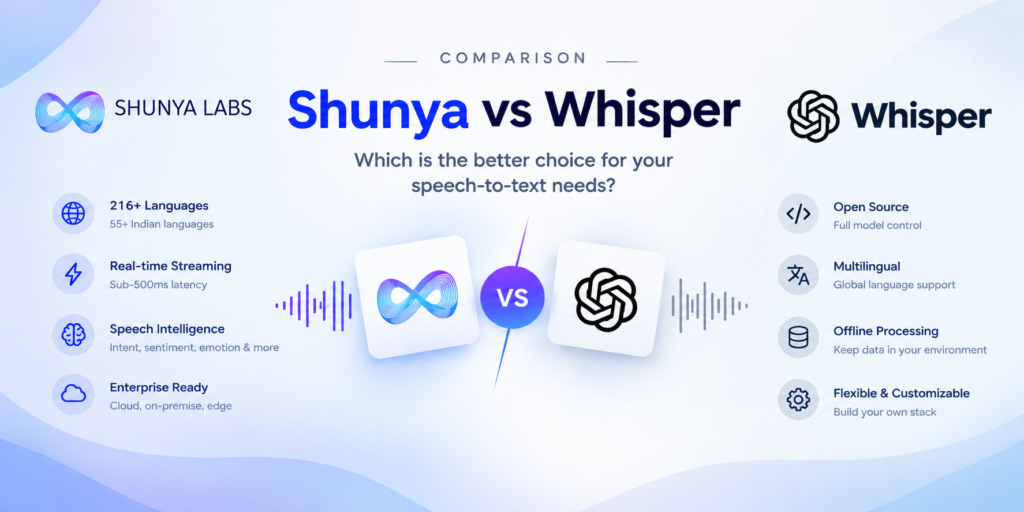
Shunya Zero STT and OpenAI Whisper both convert speech to text, but they solve different problems. Whisper is an open-source model you can run yourself. Shunya Zero STT is a speech-to-text platform built around production workloads.
| Aspect | Shunya Zero STT | Self-hosted Whisper |
|---|---|---|
| Deployment model | API, cloud, on prem deployment and enterprise options | Self-hosted open-source model |
| Pricing | From $0.0039/min | Free software, infrastructure extra |
| Key strength | Production speech infrastructure | Control and flexibility |
| Best use cases | Production apps, voice agents, enterprise speech | Research, offline processing, custom infrastructure |
| Setup complexity | API integration/ custom integrations available | GPU, model, runtime and infrastructure |
| Language coverage | 216+ | Multilingual |
| Indian languages | 55+ | General multilingual capability |
| Real-time | Sub-500ms first-token positioning | Requires additional streaming architecture |
| Speaker diarization | Built in | Additional tooling |
| Code-switching | Dedicated model | General multilingual model |
| Speech intelligence | Intent, sentiment, emotion and more | Additional models/services |
| Medical ASR | Dedicated Zero STT Med | Additional workflow |
| Scaling | Managed | Self-managed |
The core question is convenience versus control.
Whisper gives you more control over the model and infrastructure. Shunya takes responsibility for more of the production speech stack.
Whisper is a model. Production ASR is a system.
Whisper was trained on 680,000 hours of multilingual and multitask audio data and released as an open-source ASR model. Its ability to run locally is one of its biggest advantages.
That makes Whisper a great fit for research, offline transcription and teams that want to own the inference stack.
The problem appears when your requirements move beyond:
audio → text
A production voice application often needs:
audio → transcription → speakers → language → terminology → intent → sentiment → action
You can build all of that around Whisper.
But now you’re no longer just running Whisper.
You’re building the speech system around it.
Shunya starts from that production requirement. Zero STT currently provides 216+ language coverage, sub-500ms first-token streaming, speaker diarization, intent detection, sentiment, emotion and smart formatting. Know more here.
Which is more accurate?
This is where ASR comparisons often become too simplistic.
Word Error Rate (WER) matters. But it is not the only thing that matters in production.
A recognizer can have an excellent average WER and still struggle with:
- Proper names
- Product names
- Medical terms
- Financial terminology
- Noisy calls
- Regional accents
- Code-switched speech
Shunya currently publishes a 3.10% composite WER in English across eight OpenASR benchmarks and reports 1.10% WER on SPGISpeech, 1.43% on TED-LIUM and 4.19% on AMI.
| Benchmark | Shunya Zero STT |
|---|---|
| LibriSpeech Clean | 0.71% |
| SPGISpeech | 1.10% |
| TED-LIUM | 1.43% |
| LibriSpeech Other | 2.17% |
| AMI | 4.19% |
| VoxPopuli | 4.34% |
| GigaSpeech | 4.99% |
| Earnings22 | 5.83% |
| Composite | 3.10% |
These are published Shunya benchmark, however, the right evaluation is always your own audio and domain.
The feature gap is bigger than it looks
This is where the difference between an open-source model and a production speech platform becomes obvious.
| Feature | Shunya | Whisper |
|---|---|---|
| Batch transcription | Built in | Built in |
| Real-time streaming | Built in | Requires additional engineering |
| Speaker diarization | Built in | Additional models |
| Language detection | Built in | Model capability |
| Code-switching | Dedicated model | General multilingual |
| Sentiment analysis | Built in | Additional model |
| Emotion detection | Built in | Additional model |
| Intent detection | Built in | Additional model |
| PII workflows | Supported | Additional implementation |
| Smart formatting | Built in | Additional implementation |
| Custom terminology | Supported | Additional implementation |
| Medical speech | Zero STT Med | Additional workflow |
| Private deployment | Available | Available through self-hosting |
| Scaling | Managed infrastructure | Self-managed |
None of this means Whisper can’t be used to build these features.
It can.
The difference is who has to build and maintain them.
Real-time is where self-hosting Whisper gets complicated
Whisper works very well for transcription.
Real-time conversation is a different problem.
A voice agent needs the transcript while the user is still talking. That means handling:
audio buffering → chunking → partial results → endpoint → timing → concurrency
With self-hosted Whisper, your engineering team needs to build the surrounding streaming architecture.
Shunya provides dedicated streaming infrastructure and currently positions Zero STT at sub-500ms first-token latency.
That matters for:
voice agents, live captions, contact centers and interactive assistants.
For batch transcription, the difference may barely matter.
For conversational AI, it can change the entire experience.
Indian languages are where specialization matters
Whisper is multilingual.
Shunya is designed specifically around multilingual enterprise speech, with an additional focus on Indian languages and regional speech.
Zero STT Indic currently supports 55+ Indian languages and 40+ dialects, while Zero STT Codeswitch is designed for multilingual conversations where users switch languages mid-sentence.
Consider a customer saying:
“My card block ho gaya, can you help me activate it?”
This isn’t a cleanly separated Hindi or English utterance.
It’s a normal conversation.
Shunya’s code-switching model is designed to recognize that type of speech without requiring a separate language-detection hand-off between models.
That matters in:
- Indian contact centers
- Banking
- Telecom
- Customer support
- Voice agents
- Regional applications
Language support is not just about checking a language off a list.
It’s about how people actually speak.
The hidden cost of “free” Whisper
Whisper’s software is free.
Your infrastructure isn’t.
A production self-hosted deployment can require:
GPU infrastructure
You need enough compute for your model size, latency and concurrency requirements.
Deployment
You need to configure the runtime, dependencies, audio processing and serving layer.
Scaling
Traffic spikes mean queues, load balancing, additional GPUs and failover.
Monitoring
Someone has to monitor processing latency, infrastructure health and failures.
Maintenance
Model upgrades, dependency updates, security and compatibility become your responsibility.
Engineering
You still need to build the features around the model.
That’s why comparing:
$0 Whisper
with:
$0.0039/min Shunya
doesn’t tell the full story.
The real comparison is:
self-managed infrastructure vs managed speech infrastructure
Shunya currently lists Zero STT pricing from $0.0039/min, with separate model pricing and enterprise plans.
For extremely high and predictable volumes, self-hosting can make financial sense.
For many teams, the value of a managed platform is that infrastructure costs become a predictable operating expense rather than another engineering project. Contact us to know more.
Implementation: API integration vs building the stack
With a managed speech platform, the basic workflow is straightforward:
send audio → receive transcript
With self-hosted Whisper, you’re responsible for:
compute → model → preprocessing → inference → serving → queues → scaling → monitoring
Then you add the features your application actually needs.
This is not an argument against self-hosting.
It is an argument for being honest about what you’re building.
If your team has a strong ML infrastructure function and wants complete control, owning the stack can be the right decision.
If your team wants to launch a speech-enabled product quickly, the engineering trade-off can look very different.
Where Whisper can be the better choice
Whisper still wins in some situations.
Choose Whisper when you need:
Open source
You want direct access to the model and its ecosystem.
Offline processing
Audio must remain entirely inside your environment.
Research
You want to experiment with the model itself.
Infrastructure control
You already have GPU infrastructure and ML engineering resources.
Very high predictable volume
You can keep your own infrastructure highly utilized.
Whisper’s biggest advantage is simple:
you control it.
When Shunya makes more sense
Choose Shunya when you need:
Fast implementation
You want to integrate speech without building the underlying infrastructure.
Real-time transcription
Your product depends on low-latency speech interactions.
Indian-language depth
Your users speak Indian languages, dialects or mixed-language speech.
Code-switching
Your users naturally switch languages during a conversation.
Speech intelligence
You need intent, sentiment, emotion, speaker labels and other information alongside the transcript.
Domain-specific recognition
You’re working with healthcare, BFSI, telecom, contact centers or technical terminology.
Private enterprise deployment
You need cloud, on-premise or edge options. See the Shunya platform for the broader deployment and speech infrastructure stack.
Shunya vs Whisper by use case
| Use case | Better fit | Why |
|---|---|---|
| Local transcription | Whisper | Open and easy to run locally |
| Research | Whisper | Model-level access |
| Offline batch processing | Whisper | Full control |
| Custom ASR experimentation | Whisper | Open-source flexibility |
| Production transcription API | Shunya | Managed infrastructure |
| Real-time voice agent | Shunya | Streaming-first workflow |
| Indian-language application | Shunya | 55+ Indian languages |
| Hinglish application | Shunya | Dedicated code-switching model |
| Contact-centre intelligence | Shunya | Transcription + speech intelligence |
| Healthcare speech | Shunya | Dedicated Zero STT Med |
| Speaker-labelled calls | Shunya | Diarization included |
| Private/offline deployment | Both | Different implementation models |
| Very high predictable self-hosted volume | Whisper | Can favour infrastructure ownership |
Can you use Whisper and Shunya together?
Yes.
A hybrid architecture can make sense.
You might use Whisper for:
offline processing + research + internal workloads
and Shunya for:
real-time applications + enterprise workloads + Indian-language speech + production voice systems
This lets teams use open-source infrastructure where it makes sense without forcing every production workload through a self-managed ASR stack.
Final words
The choice between Shunya and Whisper comes down to a fairly simple question:
Do you want to build with speech, or build the infrastructure that runs speech?
Whisper is an excellent open-source ASR foundation. It gives developers something extremely valuable: control.
If you need offline processing, model-level experimentation or complete ownership of your infrastructure, Whisper can be the right choice.
Shunya takes a different approach.
Zero STT combines multilingual transcription with 216+ languages, 55+ Indian languages, sub-500ms streaming, speaker diarization, intent, sentiment, emotion, smart formatting and specialized speech models.
The difference is not simply model versus model.
It is:
model ownership vs production infrastructure
build the speech stack vs use the speech stack
engineering the pipeline vs building the product
For teams where speech is becoming a core production capability, that distinction matters.
Whisper gives you the model. Shunya gives you the production speech layer around it.
Frequently asked questions
Is Shunya better than Whisper?
It depends on the use case. Whisper is a strong choice for open-source, offline and self-managed workloads. Shunya is designed for production speech applications that need managed streaming, Indian-language specialization, speech intelligence, domain-specific models and enterprise deployment options.
Is OpenAI Whisper free?
The open-source Whisper model is free to use. Self-hosting still creates costs for compute, infrastructure, scaling and engineering.
How much does Shunya STT cost?
Shunya currently lists Zero STT from $0.0039/min for batch transcription. Specialized models and enterprise deployments have different pricing.
Does Shunya support Indian languages?
Yes. Zero STT Indic supports 55+ Indian languages and 40+ dialects.
Can Whisper handle Indian languages?
Yes. Whisper is multilingual and supports multiple Indian languages. Shunya goes further with a dedicated Indic model family and a dedicated code-switching model.
Can Whisper handle Hinglish?
Whisper can process multilingual speech, but Shunya has a dedicated Zero STT Codeswitch model designed for conversations where languages change within the same utterance.
Can Whisper do real-time transcription?
Yes, but production streaming requires additional engineering around chunking, buffering, timing and state management.
Does Whisper have speaker diarization?
The original Whisper model does not provide a complete native speaker-diarization workflow. Additional tooling is generally required.
Can I run Whisper offline?
Yes. Offline processing is one of Whisper’s major advantages.
Can I deploy Shunya privately?
Yes. Shunya documents private deployment options for enterprise speech workloads, including VPC and on-premise deployment paths.
Which is cheaper, Whisper or Shunya?
It depends on your workload. Whisper has no model license fee when self-hosted, but infrastructure and engineering add to the total cost. Shunya uses usage-based pricing, making the direct transcription cost more explicit.
Which is better for voice agents?
Shunya is generally better suited to production voice-agent workloads because of its streaming architecture and speech-intelligence capabilities. Whisper can be used as part of a voice agent, but the surrounding production infrastructure must be built separately.
Can I use Whisper and Shunya together?
Yes. A hybrid setup can use Whisper for offline or research workloads and Shunya for real-time or enterprise production workloads.

Bio: Navvya works at the intersection of product strategy and applied AI research at Shunya Labs. With a background in human behaviour and communication, she writes about the people, markets, and technology behind voice AI, with a particular focus on how speech interfaces are reshaping access across emerging markets.